




In toolrooms, machine shops and production environments, the situation often looks like this: after machining or reconditioning, a component seems to fit correctly on the bench, but problems appear after assembly — local rubbing, noise, rapid wear, uneven contact or a fit that keeps shifting. In many cases, the issue is not a lack of skill. The real problem is that you cannot see two critical things: where the actual contact occurs and how the material correction is really progressing.
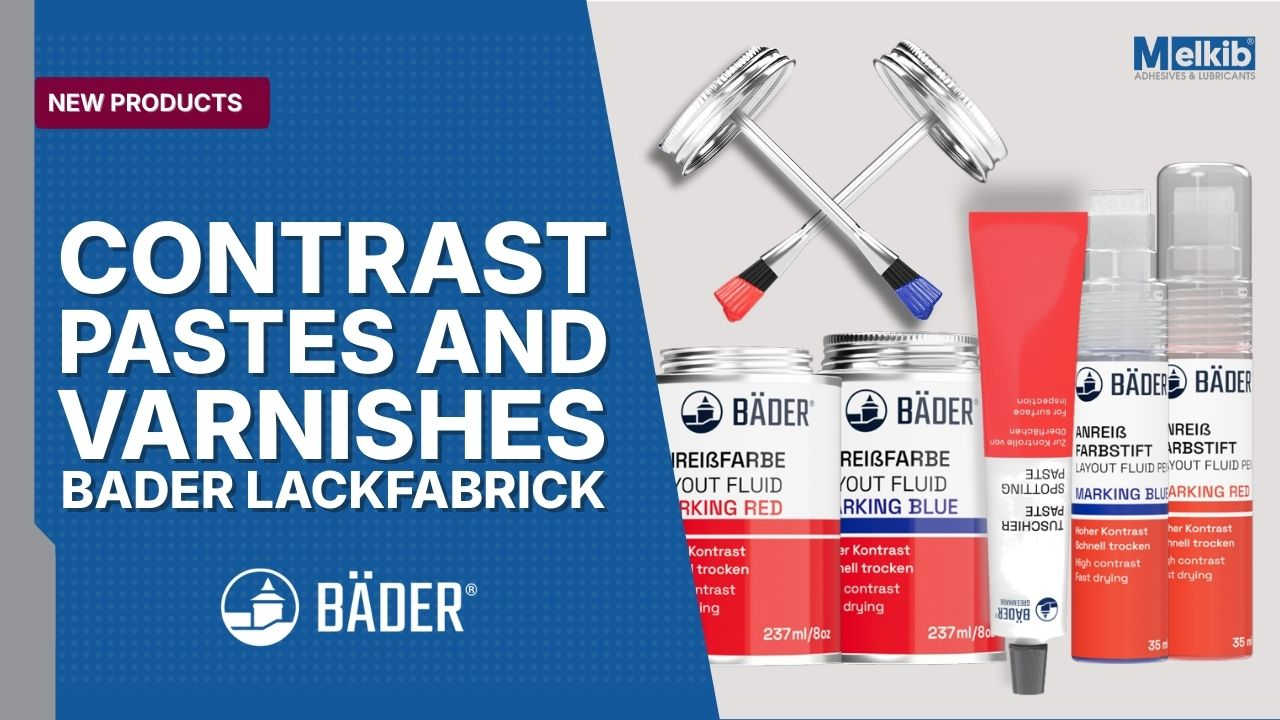
That is why, as a new addition to Melkib.com, we introduced process tools that provide clear visual feedback: LAYOUT FLUID (marking dye / contrast coating) and SPOTTING PASTE (spotting compound / contact-checking paste). These are simple products, but they bring order to fitting work: instead of correcting blindly, you work according to the trace.
Key takeaways
- LAYOUT FLUID improves contrast during scribing and makes it easier to monitor machining progress.
- SPOTTING PASTE shows the actual contact pattern between two surfaces and helps identify areas that require correction.
- For both methods, a thin product layer and a clean, degreased surface are essential.
- A 237 ml brush-top can is useful for larger surfaces, while a 35 ml pen is better for quick and precise marking.
- The most process-oriented approach is to combine both tools: the paste identifies where the problem is, while the contrast coating helps control the correction.
Shop-floor case: “It fits on the bench” ≠ “It works correctly after assembly”
In fitting work after machining or reconditioning, the problem often does not result from workmanship itself, but from a lack of clear feedback. Without a real contact pattern and without a contrast layer showing machining progress, the operator may remove material over too large an area or in the wrong place. LAYOUT FLUID and SPOTTING PASTE turn this into a simple sequence: trace → correction → verification.
Products featured in this article — new in our range
LAYOUT FLUID and SPOTTING PASTE in different colour variants and pack sizes:
...
What problems do they solve, and what do they replace in practice?
- Poor contrast during scribing and machining checks. Standard markers do not always provide repeatable results, may smear or fail to show actual machining progress. LAYOUT FLUID creates a contrast layer so you can clearly see where material has already been removed.
- No contact map between two surfaces. SPOTTING PASTE makes the bearing pattern visible: where the real contact occurs, where the “high spots” are and where there is little or no contact.
- Too many assembly trials. Instead of repeating “assemble → check → disassemble → correct”, you get a trace that points directly to the area that needs correction.
LAYOUT FLUID — marking dye / contrast coating for scribing and machining checks
LAYOUT FLUID creates a thin, even contrast layer that makes precise marking and machining control easier. Scribed lines, edges and areas already worked by the tool become much easier to see.
When should you choose the 237 ml brush-top can, and when the 35 ml pen?
237 ml brush-top can
- when you need to cover a larger surface with an even layer,
- when you work at a dedicated station and need repeatable application,
- the brush is integrated into the cap, which makes the workstation easier to keep tidy.
35 ml pen
- when you need quick markings on smaller components,
- when you work in hard-to-reach areas without opening a can,
- when you want to draw a precise line along an edge or contour.
Colours: transparent red and blue — choose the colour that provides the best contrast with the material and the lighting at the workstation.
SPOTTING PASTE — spotting compound for checking contact and fit
SPOTTING PASTE is used to check contact and fit. It shows the bearing pattern, makes point contact easier to identify and guides the correction exactly where it is needed instead of requiring the whole surface to be reworked.
Packaging: 50 ml tube (red / blue). The tube makes it easier to apply a very thin layer — and that is essential for obtaining a clear result.
Greenmark® — what does it mean in practice?
SPOTTING PASTE is marked by the manufacturer as Greenmark®. BÄDER describes Greenmark® as a range of marking and coating systems designed with a gentler profile for people and the environment. The manufacturer states that almost all Greenmark® products are water-based and that all products in the range are VOC-free and HAP-free. In practice, this can be an important consideration in plants where working comfort and environmental aspects matter — while still following workplace safety rules and the documentation for the specific product.
How to use them so they actually shorten fitting time — a simple SOP
Method 1: SPOTTING PASTE — contact map in a few minutes
- Clean and degrease both surfaces — oil and dirt can distort the trace.
- Apply a very thin layer of paste to one surface.
- Assemble the components and perform a short working movement or apply the normal seating force used in operation.
- Separate the components and evaluate the trace — where transfer or removal is visible, there is contact.
- Correct only the “high spots” and repeat the test.
Method 2: LAYOUT FLUID — control machining without guessing
- Apply a thin layer of LAYOUT FLUID using either the can or the pen.
- Scribe or mark the correction areas.
- After machining, check where the layer has been removed — this shows progress and how evenly material is being removed.
Method 3 — the most effective approach: combine both tools
First, the paste shows where the problem is by revealing the contact pattern. Then LAYOUT FLUID helps you carry out the correction precisely by controlling the machining process. This is the simplest route to stable, even bearing contact.
Common mistakes that spoil the result
- applying too thick a layer of paste — the contact pattern becomes blurred,
- skipping degreasing — the trace can become misleading,
- testing with unrealistically high force — the result does not reflect actual operating conditions,
- correcting the whole surface instead of only the high spots — this extends the fitting process.
Why did we decide to add LAYOUT FLUID and SPOTTING PASTE to Melkib?
Because in real production work, a great deal of time is lost on repeated corrections without clear feedback. These two products turn “working by feel” into a process: trace → correction → verification. This makes fitting easier to standardise and helps achieve repeatable results faster, especially during repairs, reconditioning and machining corrections.
See BÄDER solutions at Melkib
Explore the full range of BÄDER products available in our store.
Bonus video: TAGGR — when you need durable shop-floor marking
If you also make service or production markings under difficult conditions such as oil, moisture or rust, see the TAGGR 50 ml industrial marker in 9 colours and watch the YouTube test:
FAQ
Does SPOTTING PASTE replace dial indicator measurements, micrometer measurements or geometric inspection?
No — it is a process tool for quickly assessing contact and support. In critical applications, measurements are still required, but the paste can shorten the path to the area that needs correction.
Why is a thin layer of paste so important?
Because a thick layer blurs the pattern. A thin layer provides a clearer map of contact points.
Pen or brush-top can — which one is more useful in production?
The pen is better for quick marking and small components. The brush-top can is better when you need to cover larger surfaces with an even, repeatable layer.
Red or blue?
Choose according to the contrast with the material and workstation lighting — the key factor is that the trace must be easy for the operator and quality control to read.
Summary
LAYOUT FLUID and SPOTTING PASTE solve two different but related problems. The first improves visibility during scribing and machining checks, while the second shows the actual contact between fitted surfaces. Used separately, they make process control more structured; used together, they allow corrections to be guided by a clear trace rather than by feel alone.