



Concrete glue
Products:
11
Concrete adhesives are specialized chemicals used to join concrete elements or to glue various materials to concrete surfaces. Thanks to their properties, they provide durable and strong connections, resistant to various environmental conditions.
Properties of concrete adhesives:
- High mechanical strength: Concrete adhesives provide exceptional load-bearing capacity and compressive and tensile strength.
- Weather resistance: They are resistant to moisture, frost, high temperatures and UV radiation, making them ideal for outdoor applications.
- Fast setting: Many concrete adhesives offer a fast setting time, which allows for rapid construction progress.
- Chemical resistance: They are resistant to various chemicals, including oils, acids and salts.
- Flexibility: Some adhesives provide some flexibility, which allows for compensation for movements and vibrations construction.
Applications of concrete adhesives:
- Structural repairs: Concrete adhesives are used to repair cracks, gaps and other damage in concrete elements.
- Anchoring elements: Used to anchor reinforcing bars, bolts, anchors and other structural elements in concrete.
- Fixing tiles and cladding: Concrete adhesives are ideal for fixing ceramic tiles, stone tiles and other claddings to concrete surfaces.
- Joining precast elements: Used to join precast elements in residential and industrial construction.
- Industry: Used in various industries to secure machinery, equipment, pipelines and other elements construction.
Types of concrete adhesives:
- Epoxy adhesives: They are characterized by very high mechanical and chemical resistance, ideal for heavy loads and industrial applications.
- Polyurethane adhesives: They offer good flexibility and resistance to weather conditions, suitable for outdoor applications.
- Cement adhesives: Traditional cement-based adhesives, mainly used for fixing tiles and cladding.
Concrete adhesive application process:
- Surface preparation: Cleaning and preparing the concrete surface by removing dust, grease and other contaminants.
- Mixing the adhesive: In the case of two-component adhesives, thoroughly mixing the components according to the instructions manufacturer.
- Applying the adhesive: Applying the appropriate amount of adhesive to the surface using appropriate tools, such as a spatula or glue gun.
- Joining the elements: Placing the elements on the surface covered with adhesive and pressing them to ensure full adhesion.
- Curing time: Waiting for the recommended time for the adhesive to fully cure, which may vary depending on the type of adhesive and environmental conditions.
Concrete adhesives are irreplaceable in modern construction and industry, offering durable and strong solutions for various applications. Thanks to their advanced properties, you can obtain reliable and long-lasting connections in various conditions.
List of products

Bestseller
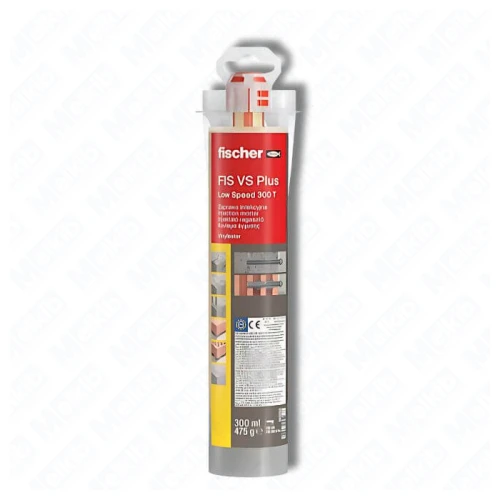
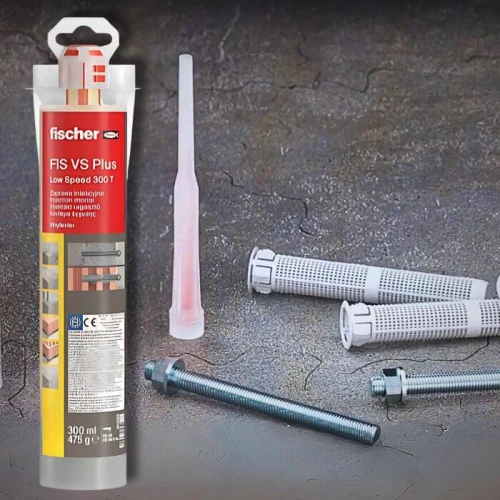
Fischer FIS VS PLUS Low Speed 300 T – Chemical Anchor for Demanding Conditions (300 ml, T-Cartridge)
Gross price
€20.03
incl. %s VAT
Net price
€16.29
without 23% VAT
Gross price
€11.96
incl. %s VAT
Net price
€9.73
without 23% VAT

Gross price
€36.16
incl. %s VAT
Net price
€29.40
without 23% VAT

Gross price
€13.38
incl. %s VAT
Net price
€10.88
without 23% VAT

Gross price
€13.38
incl. %s VAT
Net price
€10.88
without 23% VAT

Gross price
€13.35
incl. %s VAT
Net price
€10.85
without 23% VAT

Gross price
€13.35
incl. %s VAT
Net price
€10.86
without 23% VAT
Gross price
€22.20
incl. %s VAT
Net price
€18.05
without 23% VAT

Gross price
€11.34
incl. %s VAT
Net price
€9.22
without 23% VAT

Gross price
€22.20
incl. %s VAT
Net price
€18.05
without 23% VAT

Gross price
€51.72
incl. %s VAT
Net price
€42.05
without 23% VAT