




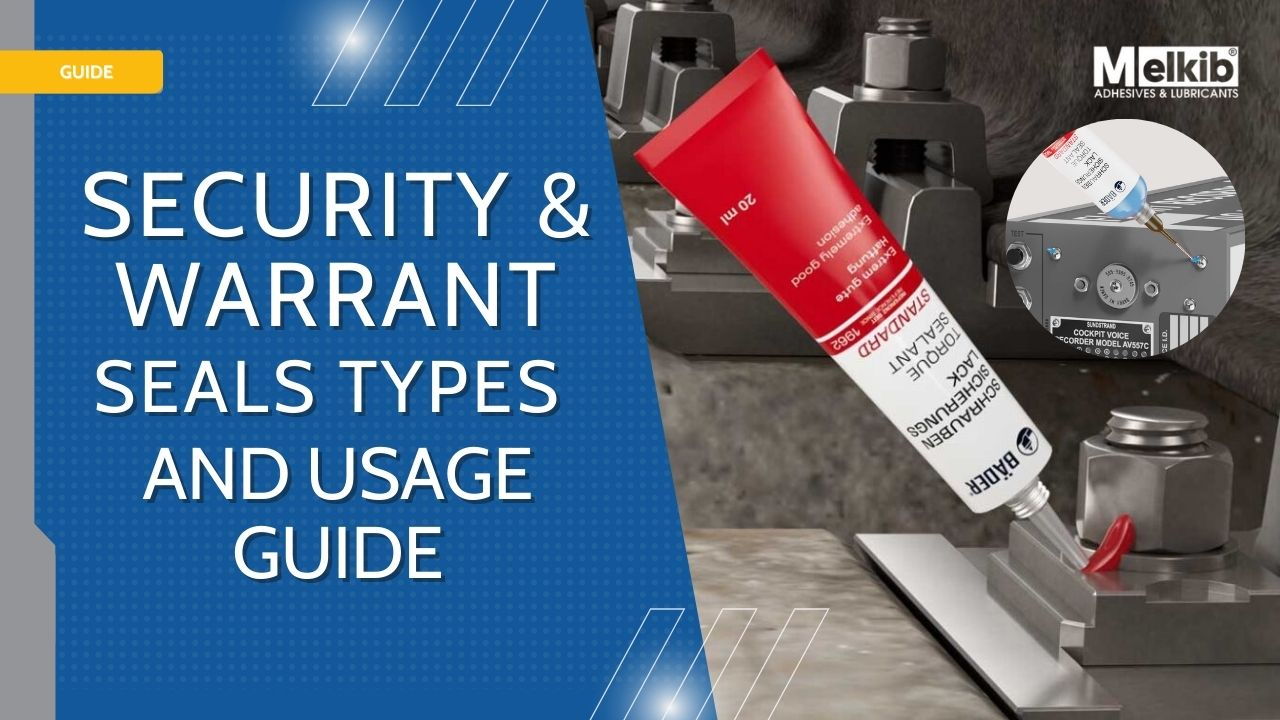
Security seals are one of the simplest ways to verify whether an adjustment screw, valve, guard or housing has been tampered with. In industrial maintenance, chemical lacquer seals and thread-locking products are particularly useful because they can provide both a visible manipulation indicator and additional protection of the connection.
Selecting the right seal means more than choosing a colour. A different product may be needed for electronics, another for equipment exposed to oils or cleaning agents, and another where reduced solvent emissions or specific hygiene requirements are important.
What is a security seal and when do you need one?
In technical applications, a security seal is an element or coating that makes it possible to detect whether a protected component has been moved, opened or adjusted.
Depending on the solution, it can:
- help prevent accidental or unauthorised adjustment of a screw, knob or lever,
- leave a clearly visible indication of manipulation,
- provide identification using colour, markings or codes,
- support additional functions such as position marking, vibration monitoring or thread locking.
Typical applications include:
- adjustment screws in machinery and equipment,
- controller housings, covers and access panels,
- valves, fittings, meters and measuring equipment,
- equipment subject to quality, maintenance or safety inspections.
Types of security seals – mechanical and chemical
Security solutions can generally be divided into mechanical seals and chemical seals. They serve a similar inspection purpose but differ in construction, application and the type of component they protect.
Mechanical seals
This group includes plastic pull-tight seals, metal and cable seals and tamper-evident labels.
- Plastic pull-tight seals are typically used for doors, bags, cabinets and containers.
- Metal and cable seals are used where higher mechanical resistance is required.
- VOID and tamper-evident labels help reveal whether a housing or enclosure has been opened.
Mechanical seals are particularly useful for protecting access to a larger area. For individual screws, nuts or adjustment points, a chemical lacquer seal is usually more practical.
Chemical seals – lacquer seals and thread lockers
Lacquer seals are applied directly across the protected joint, for example between a screw head and the surrounding surface. Once dry or cured, the coating forms a visible bridge.
If the screw moves, the marking cracks, shifts or detaches, making the change visible during inspection.
Depending on the product, a chemical seal can therefore be used to:
- indicate that a screw or setting has been changed,
- show whether a screw has moved due to vibration,
- mark the original or approved position of an adjustment,
- support inspection and quality-control procedures.
Some anaerobic thread-locking adhesives additionally provide mechanical resistance to self-loosening.
BADER and WIKO lacquer seals – Standard, Fast Dry, Zero, Secure and Topsecure
A practical way to classify lacquer security seals is by their chemical base, drying characteristics, application conditions and required resistance.
The Melkib range includes solutions from brands such as BADER and WIKO, covering both general-purpose marking lacquers and more specialised variants.
Standard seals – general-purpose security lacquers
Standard lacquer seals are classic products intended for general industrial marking and tamper indication.
- They adhere to metals and many coated surfaces.
- Strong colours make the marking easy to inspect visually.
- Movement of the protected element causes the lacquer bridge to crack or shift.
They can be used on adjustment screws in machines, switchgear, control cabinets and measuring equipment.
Fast Dry seals – quick drying and application on vertical surfaces
The BADER Fast Dry range is intended for applications where short drying time and controlled application are particularly important.
- the material has strong anti-sag properties,
- the lacquer is electrically non-conductive according to the product specification,
- selected resistance to oils, fuels, coolants and other media should always be checked in the current TDS.
Fast Dry can be useful where many security points need to be marked in a short production cycle or where the lacquer is applied on vertical or overhead surfaces.
See BADER Fast Dry security seals
...
Zero seals – water-based security lacquers
BADER Zero products are water-based lacquer seals designed without organic solvents. Compared with conventional solvent-based systems, they can be useful where reducing solvent emissions and odour is important.
- water-based formulation,
- no organic solvents according to the product specification,
- different colours and packaging options are available,
- selected variants are marketed for applications requiring food-contact-related compliance.
...
Secure and Topsecure – increased tamper resistance
Secure and Topsecure variants are intended for applications where a more resistant tamper indication is required.
They may be considered where:
- unauthorised changes to settings could create a significant process or safety risk,
- a clear audit trail is important,
- the marking must withstand demanding mechanical or chemical exposure.
The exact resistance and suitability of the selected variant should be confirmed against the manufacturer’s current technical documentation.
WIKO lacquers for thread and position marking
WIKO marking lacquers provide a practical way to create a visible reference mark on a screw or nut.
- they show the original position of the connection,
- they make movement or loosening easier to detect during inspection,
- selected products can be used at elevated operating temperatures.
The primary purpose of this type of lacquer is position monitoring and tamper indication. It should not automatically be treated as a substitute for a dedicated anti-corrosion coating.
...
Anaerobic thread lockers as security indicators
In applications where the connection must also be mechanically secured against self-loosening, an anaerobic thread-locking adhesive can be used.
Products such as LOCTITE 222, LOCTITE 243 or LOCTITE 2701 are designed primarily to lock threaded connections. Their function is therefore different from that of a visible lacquer bridge.
In practice, the two technologies can be combined:
- thread locker – mechanical resistance to loosening,
- lacquer seal – visible position or tamper indication.
When should you choose a lacquer seal and when a mechanical seal?
- Mechanical seal: when you need to protect access to doors, covers, containers, packaging or other larger access points.
- Lacquer seal: when you need to monitor a small adjustment point such as a screw, valve, connector or potentiometer.
- Thread locker: when preventing self-loosening is an essential mechanical requirement.
In many industrial systems, these solutions complement each other rather than compete with each other.
How to select the right security seal – practical guide
Step 1: Identify exactly what you want to protect
- adjustment screw or nut,
- locking ring,
- valve or fitting,
- meter or transducer,
- housing or cover,
- electronic component or adjustment point.
Step 2: Check the operating conditions
Consider:
- temperature,
- oils, fuels, coolants, detergents and other media,
- humidity and washing processes,
- vibration,
- electrical requirements.
Resistance should always be verified against the current technical data sheet of the specific lacquer.
Step 3: Check hygiene and environmental requirements
Where reduced solvent emissions are important, a water-based system may be preferable.
For food, pharmaceutical or other regulated applications, verify the actual product documentation and the requirements of the plant before approving the seal for use.
Step 4: Select the packaging and application method
Depending on the series, lacquer seals may be available in:
- small tubes for service and low-volume production,
- cartridges for controlled dispensing,
- larger packs for production and automated application.
Step 5: Prepare the surface correctly
- remove loose contamination and old residues,
- clean and degrease the application area with a suitable cleaner,
- allow the surface to dry completely,
- apply the lacquer according to the manufacturer’s instructions.
Common mistakes when using security seals
- Applying the seal to a contaminated surface – poor adhesion can make the marking unreliable.
- Applying an unnecessarily thick layer – this can extend drying time and alter the way the lacquer breaks.
- Ignoring temperature and chemical exposure – an unsuitable lacquer may soften or lose adhesion.
- Using a product near electrical components without confirming electrical properties.
- No process documentation – the plant should know which product, colour and application standard were used.
Security seals in practice – example applications
- Machines and production lines: adjustment screws, end stops, valve settings and pressure devices.
- Electronics and automation: potentiometers, switches, plugs, connectors and communication modules, provided the selected product is suitable for the application.
- Food and pharmaceutical plants: selected water-based systems where their documentation and the plant requirements permit their use.
The Melkib video shows practical differences between Standard, Zero and Fast Dry lacquer seals and demonstrates how this type of tamper marking is applied.
TAGGR industrial markers – a useful complement to security seals
TAGGR industrial markers are not security seals in the strict sense. They do not lock or automatically reveal manipulation in the same way as a lacquer bridge.
They are used for durable industrial marking, for example:
- position marks,
- arrows and reference lines,
- machine and component numbers,
- service points,
- media routes and identification markings.
What surfaces can TAGGR Rough Surface Markers be used on?
According to the manufacturer’s product information, selected TAGGR Rough Surface Markers are intended for difficult industrial substrates such as:
- smooth and rough metal,
- greasy, oily or dirty surfaces,
- wet surfaces,
- concrete, stone, rust, wood, plastics, glass and neoprene.
The exact temperature and media resistance depends on the specific product and colour, so current technical documentation should be checked before specifying the marker for a demanding application.
Marker or security seal?
- Lacquer security seal: use when you need visible evidence that a screw, valve or setting has moved.
- TAGGR marker: use when the priority is a durable operational mark on a difficult industrial surface.
FAQ – security and warranty seals
Does a lacquer seal prevent a screw from being unscrewed?
A lacquer seal is primarily a visual tamper and position indicator. If mechanical resistance to self-loosening is required, use a suitable thread-locking technology.
How should the colour of a security seal be selected?
Choose a colour that is clearly visible on the substrate and fits the plant inspection standard. Different colours can also be used to identify functions, production lines, service status or inspection stages.
Are Zero seals suitable for food-industry applications?
Selected BADER Zero products are water-based and are marketed for applications requiring food-contact-related compliance. Suitability for a specific application must still be verified using the current product documentation and the plant’s hygiene and regulatory requirements.
Can a lacquer seal be removed without leaving a trace?
The purpose of this type of lacquer is to produce a visible change when the protected element moves or the marking is disturbed. The exact fracture behaviour depends on the product, substrate and application method.
How quickly does a Fast Dry seal dry?
Fast Dry products are designed for rapid drying, but the actual time depends on the product, layer thickness and environmental conditions. Use the current TDS for the specific product rather than one universal drying value.
Can a lacquer seal be combined with a thread locker?
Yes. This can be useful where the threaded connection requires mechanical locking while the lacquer provides a visible position or tamper indication.
Need help selecting a security seal?
Tell us what component you want to protect, the operating temperature, exposure to oils or cleaning agents and whether the application involves electronics or specific hygiene requirements. We can help narrow the choice to the appropriate lacquer or thread-locking technology.