




Adhesive bonding does not begin with choosing the strongest adhesive. A reliable bonded joint depends on adhesion to the substrate, cohesion within the adhesive layer, proper surface preparation, joint geometry and controlled curing conditions.
In this guide, we explain the fundamentals of adhesive bonding: what adhesion and cohesion are, what determines surface wettability, how roughness and contamination affect bonding and how to prepare a surface before applying an adhesive.
Key takeaways
- Adhesion describes interactions at the adhesive–substrate interface and requires proper wetting and real contact with the surface.
- Cohesion is the internal strength of the adhesive layer and depends, among other factors, on adhesive chemistry and correct curing.
- The most important surface properties affecting bonding include cleanliness, surface energy and roughness.
- Greater roughness does not automatically mean better bonding. Excessive or contaminated roughness can prevent proper wetting.
- A water-drop test can provide a quick indication of wettability, but it is only an approximate assessment.
- Cleaning, surface preparation and curing parameters should always be checked against the current TDS and SDS of the specific product.
What is an adhesive?
European standard EN 923 defines an adhesive as a non-metallic substance capable of joining materials through surface bonding – adhesion – while maintaining sufficient internal strength within the bond line, known as cohesion.
This definition explains why the concept of a simply “strong adhesive” is not enough. Even an adhesive with high internal strength will not create a durable joint if it does not wet the substrate properly, if the surface is contaminated or if the curing process is incorrect.
Video: adhesive bonding fundamentals
The following videos introduce the fundamental principles of adhesive bonding: adhesion, cohesion, surface preparation and the practical approach to selecting a bonding technology.
Adhesion and cohesion – what is the difference?
Adhesion
Adhesion describes the interactions created at the interface between an adhesive and the material onto which it is applied. Effective bonding requires sufficiently close contact between the adhesive and the substrate.
In practice, this means proper surface wetting and the absence of a contamination layer separating the adhesive from the actual material.
Cohesion
Cohesion is the internal strength of the adhesive layer after curing or setting. It depends on the product chemistry, degree of cure, bond-line thickness, temperature, humidity, time and other curing conditions specified by the manufacturer.
Put simply: adhesion describes the quality of the adhesive–substrate interface, while cohesion describes the strength of the adhesive layer itself.

What does adhesion depend on?
From a process perspective, three surface properties are especially important: cleanliness, surface energy and roughness. They should be considered together because improving one parameter will not compensate for neglecting the others.
| Factor | Why is it important? | What should be checked in the process? |
|---|---|---|
| Surface cleanliness | Oil, grease, dust, release agents and other contamination can form a layer separating the adhesive from the substrate. | Cleaning method, compatibility of the cleaner with the substrate, wipe cleanliness and complete evaporation of the cleaning agent. |
| Surface energy and wettability | The adhesive must spread across the surface and establish sufficiently close contact with the substrate. | Type of plastic or coating and whether activation, primer or another surface treatment is required. |
| Roughness | Roughness can increase the actual contact area and support mechanical anchoring. | Whether treatment is too aggressive and whether dust and contamination are completely removed afterwards. |
1. Surface roughness
Surface roughness depends on the material, previous processing and the tool used. Properly selected mechanical treatment can increase the real contact area and support mechanical anchoring of the adhesive layer.
Typical methods include:
- grinding,
- abrading or matting,
- sandblasting,
- shot blasting.
2. Surface contamination and degreasing
Before bonding, substances that reduce direct contact between the adhesive and the substrate should be removed. These may include machining oils, grease, dust, fingerprints, corrosion products and – in the case of moulded components – residues of release agents.
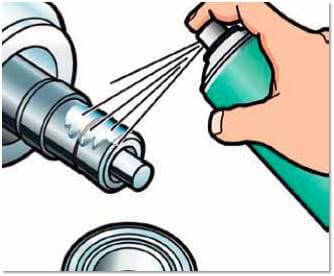
For this stage, use surface preparation and cleaning products and industrial cleaning wipes matched to the contamination, substrate and process requirements.
An example of a universal cleaner used before adhesive bonding is LOCTITE SF 7063.
3. Surface energy and wettability
Wettability describes the ability of a liquid to spread across a surface. If an adhesive wets a substrate well, it can establish sufficiently close contact with the material.
On low-surface-energy materials, a liquid tends to form droplets rather than spread across the substrate. This makes it more difficult to achieve good adhesion.
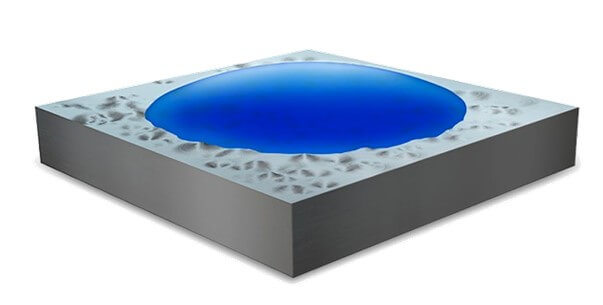
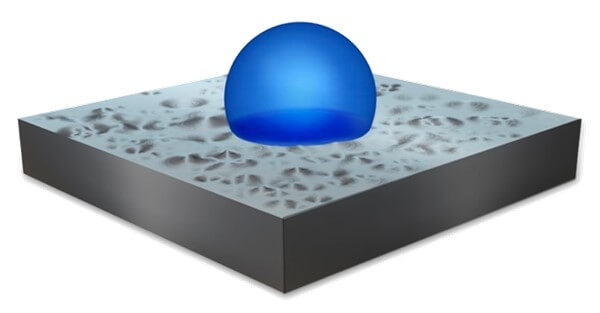
A water-drop test can be useful as a quick visual indication of wettability, but it does not provide an accurate numerical value for surface energy.
If the substrate has low surface energy or the adhesive does not wet it correctly, an appropriately selected primer or surface activation method may be required. Depending on the substrate, this may include plasma treatment, corona treatment, flame treatment or another chemical or physical preparation process.
What does cohesion depend on?
Cohesion depends on the structure and condition of the adhesive layer. Factors influencing it include adhesive chemistry, mixing ratio in multi-component systems, temperature, humidity, time and degree of cure.
For this reason, it is important to distinguish between open time, fixture or handling strength and full cure time. These values are not interchangeable.
A component that can already be moved or handled may not yet have reached its full mechanical properties or chemical resistance.
Process conditions should always be based on the current TDS for the specific adhesive.
Adhesion, cohesion and joint geometry – three elements of one process
Good surface preparation cannot compensate for poor joint geometry, and a high-strength adhesive cannot compensate for a contaminated substrate.
A modern adhesive-bonding process should therefore combine three areas:
- Surface – cleanliness, surface energy, roughness and, where required, activation.
- Adhesive chemistry – curing mechanism, viscosity, flexibility, resistance and material compatibility.
- Joint geometry – bonding area, bond-line thickness and the way loads are introduced into the adhesive layer.
These three elements should be assessed together, especially when adhesive bonding is used for structural or repeatable production applications.
How to prepare a surface before bonding – basic process
- Identify the exact substrate and coating. Descriptions such as “plastic” or “metal” are usually not precise enough to define a bonding process.
- Remove contamination. Select the cleaner according to the type of oil, grease, release agent or other contamination.
- If required, use mechanical preparation. Grinding, matting, sandblasting or shot blasting should follow a defined and repeatable standard.
- Remove dust and residues after mechanical treatment. Adhesive should not be applied to a surface contaminated with abrasive particles.
- Check whether activation or primer is required. This is particularly important for substrates with low surface energy and difficult-to-bond plastics.
- Maintain defined process timing and conditions. Once prepared, the surface should not become contaminated again before adhesive application.
Common mistakes when starting with adhesive bonding
- Selecting an adhesive only by the general name of the substrate without identifying the exact plastic, alloy, coating or elastomer.
- Treating degreasing as the only required surface-preparation step.
- Touching a prepared surface with bare hands before adhesive application.
- Assuming that a rougher surface always produces a stronger bonded joint.
- Treating a water-droplet observation as an accurate measurement of surface energy.
- Using a random solvent without checking its compatibility with the substrate.
- Loading the joint after handling strength is reached but before the adhesive reaches the required degree of cure.
- Failing to test the bonding process on real substrates and under representative operating conditions.
FAQ – adhesive bonding fundamentals
What is the difference between adhesion and cohesion?
Adhesion concerns the interactions between the adhesive and the substrate, while cohesion describes the internal strength of the adhesive layer. A durable joint requires both sufficient adhesion and sufficient cohesion.
Why is degreasing so important before bonding?
Oil, grease, dust and release agents can form a layer between the adhesive and the actual substrate. In such a situation, the adhesive may bond to the contamination rather than to the material.
Can acetone be used for degreasing before bonding?
It depends on the substrate. Acetone is used in certain technical processes, but it can damage some plastics, coatings and paints. Compatibility with the specific material must therefore be checked before use.
Is LOCTITE SF 7063 safe for every plastic?
No solvent-based cleaner should automatically be assumed to be safe for every plastic. Compatibility should be verified for the specific plastic and application.
How can surface wettability be checked quickly?
You can observe how a drop of clean water behaves on the surface. Strong spreading generally indicates better wetting, while pronounced beading indicates poorer wetting. This is only an approximate test.
Does greater roughness always improve bonding?
No. Moderate surface development may increase actual contact area and mechanical anchoring, but excessive roughness can impair wetting.
Is good adhesion enough to create a durable bonded joint?
No. Adequate adhesive cohesion, correct joint geometry and compatibility with temperature, loads and the operating environment are also required.
When should a bonding trial be carried out?
A trial should be performed whenever the joint has structural, quality or production importance, or whenever the actual substrate, coating or process conditions differ from reference conditions.
Summary
Adhesive bonding technology begins with the surface. The adhesive must wet the substrate properly and establish sufficient adhesive interactions before reaching the required cohesion through the correct curing process.
The most repeatable results are achieved when surface preparation, product selection, joint geometry and curing conditions are treated as one complete process.
This is particularly important in serial production and maintenance applications, where one successful trial does not replace a stable and repeatable procedure.
Next step: surface preparation before bonding
Once you understand the difference between adhesion and cohesion, the next step is to build a repeatable cleaning, degreasing and – where required – surface-activation process.
Sources and technical materials
- EN 923:2015, Adhesives – Terms and definitions – definitions of adhesive, adhesion and cohesion.
- Henkel LOCTITE training materials – adhesive bonding, adhesion, cohesion and surface preparation.
- Henkel, LOCTITE SF 7063 technical documentation – information concerning surface cleaning before bonding.