Loctite Henkel Premium Partner
 Free delivery from 600 EURO to EU Countries*
  +48 509 336 666


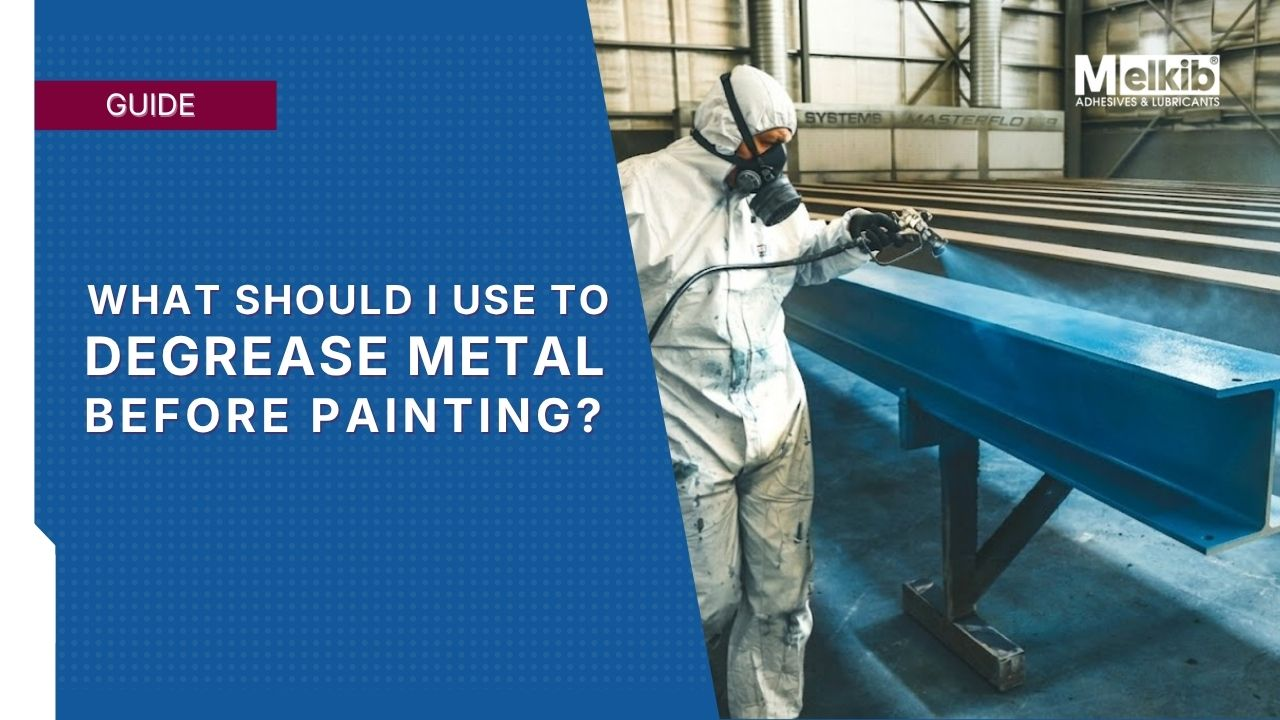
Before painting metal, the issue is not just “degreasing,” but removing precisely those contaminants that will actually destroy coating adhesion. Oil, grease, machining dust, salt, mill scale, galvanizing residues, and fingerprints do not behave the same way, so they are not removed with the same agent or the same procedure. That is exactly why a part that looks fine right after application may start peeling over time, develop blisters, or show underfilm corrosion.
If you want to choose the right product and avoid a “trial-and-error” implementation, break the problem down into three questions: what is on the surface, what metal the part is made of, and what the subsequent painting process looks like. Only then should you select the chemistry, cleaning method, and cleanliness control approach. In practice, this stage is what determines whether the paint will adhere to the metal itself or only to the contaminants left on it.
What should you use to degrease metal before painting?
The shortest answer is: an agent selected for the type of contamination and the substrate, not a random solvent “because it evaporates quickly.” In practice, three main groups of solutions are used before painting: fast final solvent degreasing, water-based cleaning with detergent or alkaline chemistry, and specialist process products for industrial cleaning.
If the problem is typical oil and grease contamination, workshop dirt, and operational residues, LOCTITE SF 7840 is applicable. This product makes sense when you need to effectively break down organic contamination and remove it from the surface without building an entire multi-stage cleaning process. It works particularly well in workshops, maintenance departments, and when preparing individual parts or smaller batches.
If surface preparation before painting is a full process stage rather than a quick wipe before application, Molti RS is more strongly justified. This product is better suited to manual, spray, or immersion cleaning when you need to remove oils, grease, and process residues from the entire surface, not just from a localized area. That is an important difference. In technological practice, many problems stem from using an ad hoc product where full pre-paint cleaning was actually required.
In serial production, with repeatable parts and greater responsibility for process stability, BONDERITE process products come into play. Here, selection depends not only on the type of contamination, but also on the application method and working conditions. BONDERITE C-MC 1204 performs well for universal cleaning, BONDERITE C-MC 352 for spray cleaning of mechanical parts, and BONDERITE C-MC 3000 for heavier contamination and high-pressure cleaning.
The most important point, however, is that the product is selected for the problem, not the other way around. A light oil film before powder coating requires one type of agent, a surface after heavy processing with thick grease requires another, and a part after winter transport with suspected salt contamination requires yet another. And it is precisely this third case that is most often misjudged.
Cleaning and degreasing products available in our offer
[product id="3528,3529,4544,2062"]
Why is “degreasing” alone often not enough?
Paint adheres properly only when it actually wets the metal surface and maintains stable contact with it. If a thin layer of oil, cleaning agent, salt, or dust remains between the coating and the substrate, a weak boundary layer is created. In practice, this means the paint may not fail immediately, but it will have poorer adhesion, greater susceptibility to blistering, and a higher risk of underfilm corrosion.
This is especially important for technologists and people responsible for process repeatability. Adhesion problems very often do not result from the quality of the paint itself, but from an incorrectly prepared substrate. In that case, the complaint comes back to the paint shop, even though the source of the error occurred earlier: at the washing, rinsing, drying, or workstation organization stage. For the maintenance department, this means additional rework and downtime. For procurement, it means a greater risk of complaints, supplier disputes, and costs that were difficult to avoid because the error did not lie in the final product, but in surface preparation.
That is exactly why degreasing should not be treated as an auxiliary operation. It is part of the technology. If it is selected incorrectly, the rest of the process is built on a weak foundation.
What contaminants really need to be distinguished before painting?
Oils, greases, and coolants
This is the most common group of contaminants. They come from processing, assembly, storage, or the actual operation of machines and parts. They are usually removed either with solvents or water-based cleaning, depending on the scale of the process and the type of contamination. Light oils are relatively easy to remove, but solid greases, assembly pastes, and heavy contamination usually require two stages: first coarse removal, then proper degreasing.
This is exactly the area where the question about the “strongest product” most often appears. In practice, that is the wrong question. A much more important one is: does the product need to deal with a thin oil film, or with thick, multi-layer contamination from production and operation? In the first scenario, final degreasing is often sufficient. In the second, real cleaning is required, not just wiping the surface.
Soluble salts
This is one of the most common causes of wrong decisions. If chlorides or sulfates are present on the surface after transport, storage, technological washing, or operation in an aggressive environment, a solvent does not solve the problem. Salt does not behave like oil or grease, so it will not be effectively removed by simply wiping with a solvent degreaser.
Salts must be washed off with water and detergent or with a suitable water-based preparation, and then thoroughly rinsed. This is crucial, because an invisible salt layer can act under the coating as an electrolyte. The effect appears later: osmotic blistering, underfilm corrosion, delamination, and rework that costs far more than the cleaning itself.
The conclusion is simple: if you suspect salt, do not start with a solvent. Start with water-based cleaning with detergent and rinsing. Only then should you assess whether additional final degreasing is necessary.
Dust, mill scale, and oxides
Dust from grinding, rolling mill scale, or metal oxides are not an issue for a degreaser alone. Here, mechanical treatment is often necessary, and sometimes also a separate etching or surface activation stage. If mill scale remains on steel, the paint may initially look fine, but the entire layer will be sitting on an unstable substrate.
Solvent or water-based cleaning: what should you choose?
When a solvent makes sense
Solvents work well for fast final degreasing, light organic contamination, and wherever fast evaporation matters. Isopropyl alcohol is a typical example of an agent used for final surface preparation. The problem starts when a solvent is used for everything: for heavy grease, for salt, for heavily contaminated surfaces, or together with dirty wipes.
When water-based cleaning is the better choice
Water-based cleaning has a major advantage when you need to remove not only grease, but also mixed contamination, process residues, and mineral contaminants. It is also the natural choice wherever salt is suspected. In production systems, water-based cleaning agents are often safer from a process perspective and more scalable than intensive solvent cleaning.
How should you select a product for the type of metal?
| Substrate | Most important risk | What to watch out for during selection | Practical direction |
|---|---|---|---|
| Carbon steel | oils, greases, salt, flash rust | a degreaser alone will not remove mill scale and rust | chemical cleaning plus, if necessary, mechanical treatment |
| Stainless steel | damage to passivation, contamination with free iron | avoid aggressive products and contact with carbon steel | milder degreasing and control of process cleanliness |
| Aluminum | surface etching, blackening, uncontrolled reaction with chemicals | strong alkalis for steel may damage aluminum | neutral, inhibited products or products selected specifically for light metals |
| Galvanized steel | smooth surface, storage passivation, white rust | ordinary degreasing “as for steel” is not enough | gentle surface preparation and compatibility control with the paint |
Which products from Melkib’s offer are worth considering and in which scenario?
| Scenario | Recommended direction | Product example | When it makes sense |
|---|---|---|---|
| Typical oil and grease contamination and workshop dirt | universal cleaning and degreasing | LOCTITE SF 7840 | when you want to remove typical contamination quickly without an extensive process |
| Full surface preparation before painting | manual, spray, or immersion cleaning | Molti RS | when complete and more repeatable cleaning of the entire surface matters |
| Universal industrial cleaning | process product | BONDERITE C-MC 1204 | when you need a more stable process under production conditions |
| Spray cleaning of mechanical parts | spray cleaning | BONDERITE C-MC 352 | when the process is based on spraying and repeatability is important |
| Heavier contamination and high-pressure cleaning | more intensive process cleaning | BONDERITE C-MC 3000 | when contamination is heavier and you need stronger action |
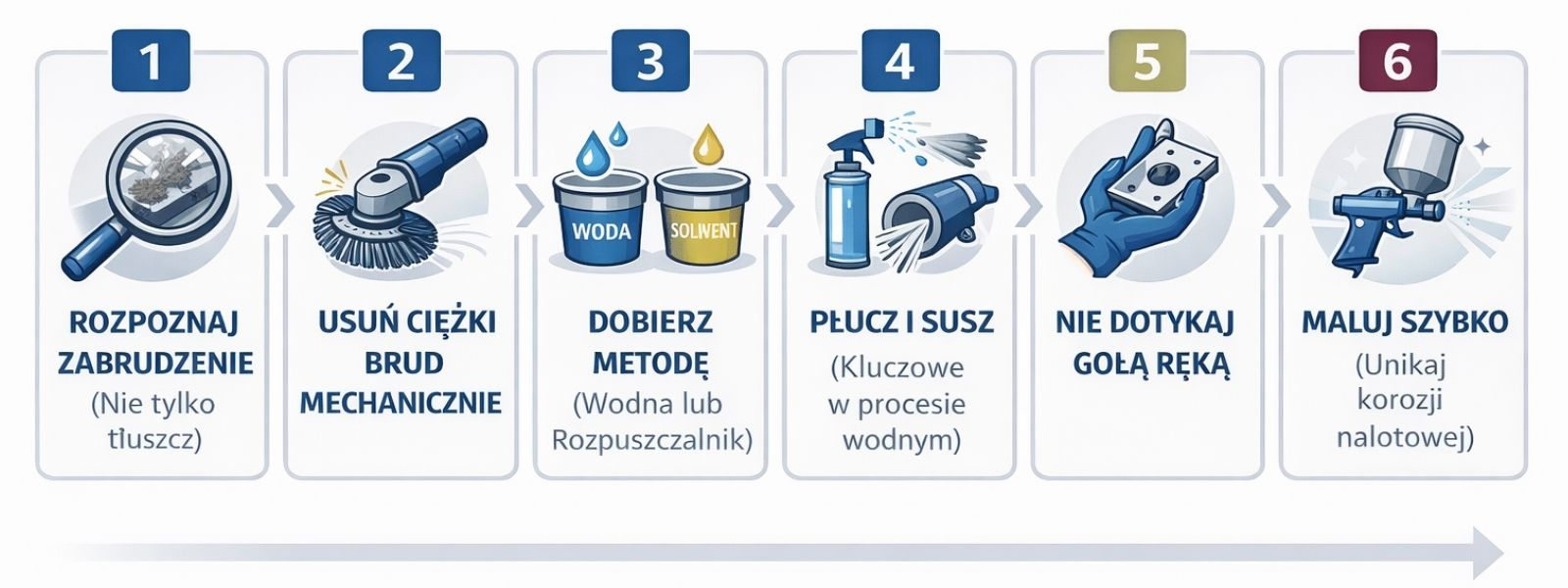
How should you prepare the surface step by step?
First, identify the type of contamination. Do not guess that it is only grease. Check whether there is salt, dust, residues from previous stages, or oxides.
Remove heavy dirt mechanically or in a pre-cleaning stage. Thick grease, assembly paste, or loose deposits should not go straight into the final degreasing step.
Select the cleaning method. Solvent for light contamination and final degreasing, water-based cleaning for mixed contamination and wherever salt removal is important.
If the process is water-based, ensure actual rinsing and complete drying. This is not a minor detail, but a condition for the success of the entire operation.
Do not touch the prepared surface with a bare hand and do not place it in a dirty area. In practice, many errors appear דווקא after proper cleaning.
If the part is to be painted later, control the time between preparation and paint application. The longer the interval, the greater the risk of recontamination or flash rust.
Video (practical) – 2 materials from our YouTube channel on metal bonding that may interest you:
FAQ - what should you use to degrease a surface before painting?
Can you degrease metal with vinegar before painting?
For a technical process, it is better not to do so. Household products do not provide predictability and do not solve typical industrial problems such as coolants, greases, salt, or post-processing contamination.
What is the strongest degreaser?
There is no single honest answer. The strongest product will not always be the best one. For steel, alkaline chemistry may work well, but for aluminum or galvanized surfaces, overly aggressive cleaning may do more harm than good. That is why the better question is: which product will be effective and safe for my metal and my process?
When should you apply a degreaser?
A degreaser is applied after removing heavy preliminary contamination and just before the next preparation stage or painting. The shorter the time between degreasing and paint application, the lower the risk of recontaminating the surface.
Sources
Comprehensive analysis of degreasing and metal surface preparation processes before the application of paint coatings: theory, technology, and industrial standards
Product selection table – Melkib / BONDERITE / LOCTITE product materials
Adhesion in Paint and Coatings: Theories, Types & Test Methods
Surface Prep Standards – A Quick Summary – AMPP
Flash Rust: Causes, Formation and Prevention Methods
ISO 12944-4: Surface Preparation Standards
Avoid Plating Failures: How to Perform a Proper Water Break Test
Dyne test | Measuring Surface Energy

About the author:
Maciej Klus, Product Manager at Melkib.
On a daily basis, he supports manufacturing plants in dealing with failures and optimizing bonding processes. He believes that a “good adhesive” is only half the success – the rest is a repeatable process.