





Composite materials make it possible to reduce weight, combine different functions and design structures that would be difficult to produce from one homogeneous material. The challenge appears at the joining stage: drilling and point fasteners can introduce local stress concentrations, while thermal joining is not suitable for every composite system.
Adhesive bonding is therefore one of the key joining technologies for composites. It can distribute loads over a larger area, join dissimilar materials and preserve a clean external surface. The result, however, depends on the matrix, reinforcement, surface condition, adhesive chemistry, joint design and production process.
Key takeaways
- Bonding can join composites without drilling holes or adding visible point fasteners.
- A bonded overlap can distribute load over a larger area than a rivet or bolt, but the joint must be designed to minimise peel and cleavage.
- There is no universally best adhesive for composites. Epoxy, acrylic/MMA and polyurethane systems each have different strengths and limitations.
- The composite matrix matters as much as the fibre: an epoxy laminate behaves differently from PP-, PPS- or PEEK-based composite material.
- Release agents, peel-ply residues, dust and surface contamination can determine whether the bond succeeds or fails.
- For production, adhesive selection must be validated on the real laminate, surface preparation and service conditions.
Why choose adhesive bonding for composites?
Mechanical fasteners concentrate load around holes and introduce local discontinuities into the laminate. Adhesive bonding uses a larger joint area and can therefore transfer load more gradually when the geometry is designed correctly.
It is also useful in multi-material structures. A composite can be bonded to another composite, aluminium, steel, glass, wood or a suitable plastic without requiring the materials to be weld-compatible.
Main advantages
- No drilled holes in the laminate – useful where local fibre damage or stress concentration should be limited.
- Distributed load transfer – especially in overlap joints with a sufficiently large bonding area.
- Joining dissimilar materials – for example composite-to-metal structures.
- Low thermal input – no welding-level heat is introduced into the assembly.
- Good appearance – the joint can remain hidden inside the assembly.
- Additional functions – depending on the adhesive, the joint can also contribute to sealing, vibration damping or electrical isolation.
Limitations that must be considered
- surface preparation becomes part of the controlled production process,
- the assembly may need fixturing until handling strength is reached,
- working time and cure time must fit the production takt,
- adhesive squeeze-out can affect appearance and finishing operations,
- inspection of a finished bond is more difficult than inspection of some mechanical joints,
- temperature, moisture, chemicals and long-term loads can affect durability.
What exactly are we bonding when we say “composite”?
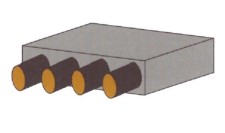
A composite contains at least two distinct constituent materials that work together. In fibre-reinforced plastics, the two most important elements are the matrix and the reinforcing fibres.
- The matrix surrounds the reinforcement, transfers load between fibres and protects them from the environment.
- The fibres provide much of the strength and stiffness in their principal directions.
This is why the word “composite” alone is not enough for adhesive selection. A glass-fibre epoxy laminate and a carbon-fibre PEEK laminate can require completely different bonding strategies.
Common thermoset matrices
- epoxy resin,
- unsaturated polyester (UP),
- vinyl ester (VE),
- phenolic resin,
- selected polyurethane systems.
Common thermoplastic matrices
- polypropylene (PP),
- polyamide (PA),
- polyetherimide (PEI),
- polyphenylene sulphide (PPS),
- polyether ether ketone (PEEK).
Surface preparation: the most important process variable
3M’s structural-adhesive guidance notes that thermoset laminates such as epoxy and carbon-fibre composites can often be bonded successfully, but contamination and residual release agent must first be removed. Glossy surfaces may also require controlled abrasion.
A practical preparation sequence can include:
- Identify the actual laminate and surface. Check matrix chemistry, gel coat, paint, peel ply and mould-release system.
- Remove gross contamination before abrasion. Do not grind oil or release agent into the surface.
- Abrade only when required by the validated process. Use clean abrasives dedicated to the bonding operation.
- Remove dust after abrasion. Vacuuming and an approved cleaner are preferable to spreading dust with a contaminated cloth.
- Apply primer or activation only where the adhesive system requires it.
- Bond within the defined preparation window. Avoid touching or recontaminating the prepared surface.
Hexcel likewise emphasises that surface condition is critical to structural bonding and that contamination after pretreatment can reduce joint performance.
Peel ply requires validation too
Peel ply can create a convenient bonding surface, but it should not automatically be treated as a guarantee of adhesion. The peel-ply material, resin system and removal method can influence the final surface, and residues may remain. Qualification testing should therefore use the actual peel-ply process planned for production.
Which adhesive chemistry should be used?
There is no single correct family for every composite assembly. 3M’s current composite-bonding guidance lists epoxy, acrylic and polyurethane structural adhesives as relevant technologies, each with different process and performance characteristics.
| Adhesive family | Typical strengths | What to verify |
|---|---|---|
| Epoxy | High structural strength, good temperature and chemical resistance, broad use with metals and thermoset composites. | Cure time, stiffness, peel resistance, surface preparation and thermal-expansion mismatch. |
| Acrylic / MMA | Fast cure options, useful bonding of many dissimilar materials and good production efficiency. | Working time, odour/HSE, bond-line stiffness, compatibility with the actual composite matrix and primer requirements. |
| Polyurethane | Greater flexibility, good impact behaviour and useful multi-material bonding. | Temperature and chemical resistance, moisture sensitivity during processing and required bond-line properties. |
For example, Melkib MMA Power 10 is a two-component methacrylate adhesive listed by Melkib for composites, thermoplastics, thermosets and metals. The current product page specifies a 1:1 mix ratio and versions with approximately 3- or 10-minute open time.
That does not make MMA automatically the best choice for every composite. The final selection should reflect the actual laminate, second substrate, joint geometry, load, environment and production time.
Melkib MMA Power 10 – two-component methacrylate adhesive for composites and multi-material assemblies
Joint design matters as much as adhesive selection
Bonded joints perform best when the geometry allows the adhesive to work mainly in shear or compression and minimises edge peel and cleavage.
When designing a composite joint, check:
- available overlap length and bonding area,
- stiffness difference between the two adherends,
- bond-line thickness,
- local bending at the overlap edges,
- thermal-expansion mismatch,
- impact and fatigue loading,
- water or chemical exposure,
- the required service temperature range.
Carbon-fibre composites bonded to metals
Carbon fibres are electrically conductive. When carbon-fibre composite is joined to a susceptible metal and moisture or another electrolyte is present, galvanic corrosion can become a design issue. A continuous adhesive layer can contribute to electrical isolation, but the complete joint — including edges, fasteners and damaged coating areas — must be assessed.
How to make composite bonding repeatable in production
- Identify the laminate. Record matrix, reinforcement, surface finish and supplier.
- Define the surface-preparation standard. Cleaning, abrasion, peel ply, primer or activation must be measurable and repeatable.
- Select adhesive working time around the real assembly sequence.
- Control mixing and dispensing. For 2K products, check ratio, mixer and purge procedure.
- Control bond-line geometry. More adhesive does not automatically mean more strength.
- Fixture the part until safe handling strength is reached.
- Define cure before full loading.
- Validate representative joints. Use actual production materials and relevant ageing conditions.
- Manage changes. A new laminate supplier, release agent or surface finish can require requalification.
Video: composite bonding in practice
The two videos from the existing English article are retained. They are presented one below the other so the content remains readable on desktop and mobile.
Bonding – application and process
Adhesive selection and technology comparison
FAQ – bonding composites
Are MMA adhesives always the best choice for composite bonding?
No. MMA systems can be very effective, particularly where fast production and multi-material bonding are important, but epoxy or polyurethane adhesives may be a better fit depending on temperature, chemical exposure, flexibility and joint design.
Why can release agent cause bonding problems?
Release agents are designed to prevent adhesion to the mould. Residue on the finished laminate can therefore reduce adhesive wetting and bond strength. The bonding surface must be prepared using a validated process.
Do all thermoplastic composites bond poorly?
No. Bondability depends on the matrix chemistry and surface condition. Low-surface-energy matrices such as PP can be particularly demanding, while other thermoplastics may require different pretreatments or dedicated adhesive systems.
Should a glossy composite surface always be sanded?
Not automatically. Abrasion can be useful for many thermoset composite surfaces, but the correct method depends on the laminate, coating, fibre architecture and adhesive. The process should be confirmed by testing.
Why does thermal expansion matter?
Different materials expand by different amounts when temperature changes. In a bonded multi-material assembly this creates stress in the adhesive layer, so adhesive flexibility, geometry and temperature range must be considered together.
Can adhesive bonding prevent galvanic corrosion between carbon fibre and aluminium?
A continuous non-conductive adhesive layer can help electrically separate the materials, but the complete design must prevent conductive contact and electrolyte access. Fasteners, exposed edges and coating damage can still create galvanic paths.
Choosing an adhesive for a composite assembly?
Send the composite matrix and reinforcement, the second substrate, joint geometry, load, temperature, environmental exposure and required working time. These details are more useful than the generic description “composite”.
Technical sources
- Melkib – current Polish counterpart of this article.
- Melkib – current English article page.
- Melkib – MMA Power 10 50 ml.
- 3M – Adhesive Bonding of Composites With Structural Adhesives.
- 3M – Surface Preparation and Pretreatment for Structural Adhesives.
- Hexcel – Adhesive Bonding Technology: Surface Preparation.