




Conveyor Belt & PU/PVC Drive Belt Repair: Repair Methods + H.B. FULLER System Selection
A practical guide for Maintenance & Reliability teams and service crews: belt joining methods, step-by-step repair procedures for rubber, steel and PU/PVC, H.B. FULLER system selection and the process conditions that determine whether a repair will actually last.
Joining methods: what to choose in Maintenance & Reliability?
In day-to-day practice, three main approaches are used for joining and repairing belts: mechanical fasteners, hot vulcanization and adhesive bonding, also known as cold bonding. Each method can be appropriate when matched to the actual risk, belt construction, accessibility and available downtime window.
| Method | What you get | Best use case | Risks / limitations |
|---|---|---|---|
| Mechanical | Rapid intervention with minimal use of chemical products. | Emergency repairs, limited tool access and situations where the belt has to return to service quickly. | Joint geometry and long-term durability depend strongly on the belt type and fastening system. |
| Hot vulcanization | A durable process in which heat and pressure are used to create the joint. | Demanding operating conditions where a vulcanizing press can be installed and sufficient downtime is available. | Requires equipment, logistics, heating and cooling time and appropriate HSE procedures. |
| Cold bonding | Enables joining and local repair without a vulcanizing press and can reduce downtime in many service applications. | Local or mobile repairs and applications where installation of a press is difficult. | Highly dependent on process control, including surface preparation, temperature, humidity, dew point, mixing and pressure. |
Cost analysis: repair vs replacement and downtime cost
In maintenance, the largest cost is often not the belt itself but production downtime, service logistics and the cost of restarting the line. That is why the key question is not simply whether a belt can be repaired, but whether the repair will restore stable operation or merely allow the line to complete the current shift.
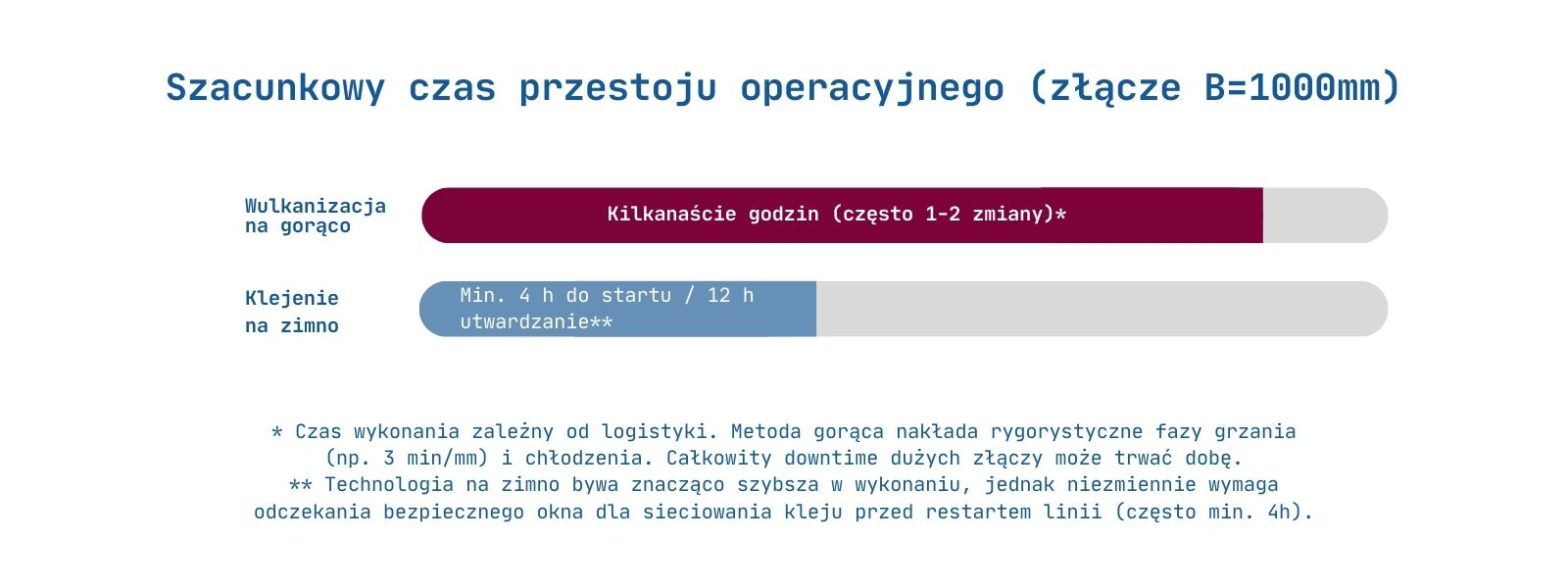
How should downtime be interpreted for bonding and vulcanization?
Two different values are often confused: the time required to make the joint and the time after which the belt can safely return to operation.
For example, one referenced cold-bonding procedure specifies a minimum restart time of 4 hours and a recommended curing period of 12 hours. These values should not be treated as universal product parameters; the actual process must follow the current documentation for the specific adhesive system.
| Technology | What determines the time? | Reference process parameters |
|---|---|---|
| Cold bonding | Temperature, humidity, drying of individual coats, pressure, restart time and full cure. | Minimum 4 h before restart and 12 h recommended cure in the referenced cold-bonding process instruction. |
| Hot vulcanization | Heating, pressure, cooling, preparation and press installation. | 3 min/mm of thickness at 145°C and do not open the press before 60°C in the referenced hot-process instruction. |
What can realistically be repaired – and when is it better to stop?
Rubber belts: rubber–rubber
Typical repairs include cuts, punctures, cover damage, edge repairs, inserts and restoration of damaged profiles. One of the first questions is whether the rubber in the repair zone is still structurally sound – without severe oxidation, oil saturation or extensive degradation.
Rubber–metal: pulley lagging and steel lining
This is a separate process category. The condition of the steel, corrosion and oxide removal, surface preparation and – where specified for the system – use of an appropriate primer are critical.
PU/PVC synthetic conveyor and drive belts
PU and PVC require a system selected specifically for the substrate and application. A common service mistake is assuming that an adhesive intended for rubber will also be suitable for synthetic belts.
Depending on the H.B. FULLER system, the complete process may include primer + adhesive + hardener + cleaner or thinner.
When does repair stop being cost-effective?
If a long section of the belt is permanently degraded – for example by fatigue cracking, cover deterioration, oil absorption or brittle layers – a local repair may only postpone replacement. In this situation, a planned belt replacement may be more economical than a sequence of repeated interventions.
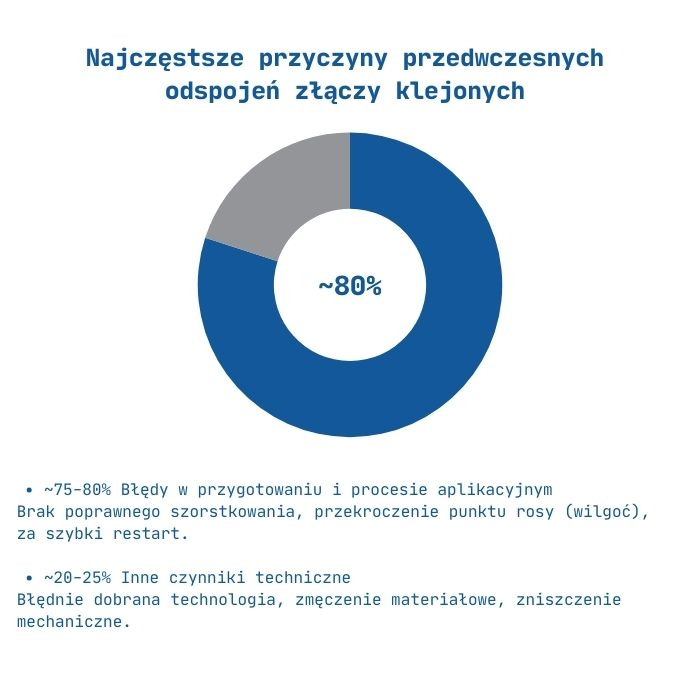
Why bonded joints fail: mechanics and common mistakes
1. Dew point and condensation – the practical +3°C rule
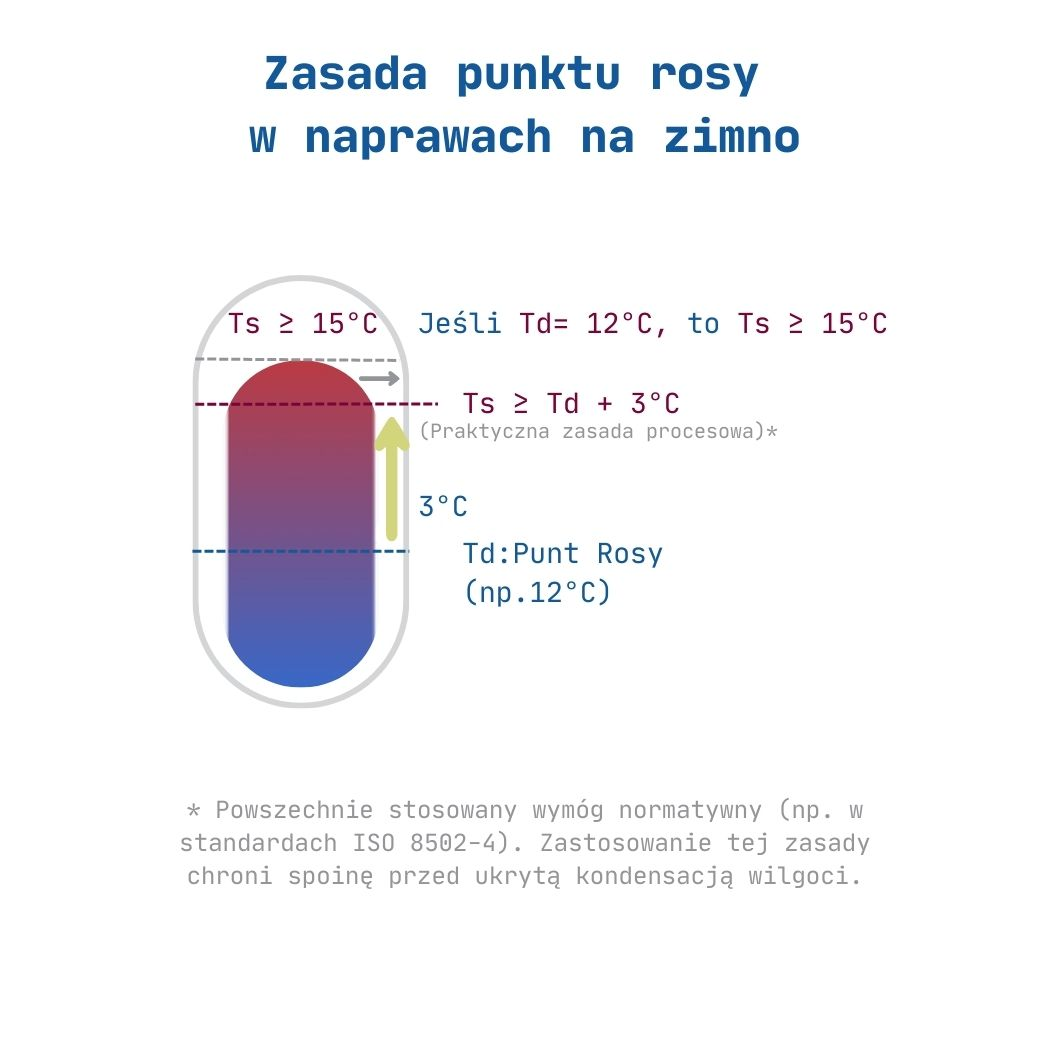
A microscopic film of moisture on the surface can severely impair adhesion. A practical control rule is to maintain the temperature of the belt or steel substrate at least 3°C above the calculated dew point:
Ts ≥ Td + 3°C
Measure ambient temperature and relative humidity, determine the dew point and then measure the actual substrate temperature. If the required margin is not maintained, the process conditions must be corrected before bonding begins.
2. Polishing the rubber instead of producing a matte surface
Excessive tool speed or incorrect abrasion technique can glaze the rubber. Instead of a properly developed surface, a smooth layer is created that provides poor conditions for bonding. The target is an even, matte surface without burns or loose dust.
3. Mixing and coat uniformity
The adhesive must be homogeneous and, where a hardener is required, both components must be mixed according to the specified ratio and procedure. Application thickness and uniformity also need to be controlled.
4. Trapped air and insufficient pressure
Air trapped inside the joint creates local defects. Joining and rolling should therefore be carried out in a controlled direction, normally from the centre towards the edges, while maintaining the pressure required by the process.
Repair SOP step by step: conditions, preparation, bonding and pressure
Phase 0: start-up checklist
- Measure ambient temperature, relative humidity and belt or steel surface temperature.
- Calculate the dew point and confirm Ts ≥ Td + 3°C.
- Check that the surface is free of oil, moisture and loose dust.
- Check abrasion tools, rollers and pressure or clamping equipment.
- Verify the current TDS and SDS: mixing ratio, process times, ventilation, flammability and other HSE requirements.
Phase 1: mechanical surface preparation
- Rubber: remove degraded surface material, roughen to a uniform matte finish and remove dust.
- Steel: remove rust, scale and other non-load-bearing layers; where required, use abrasive blasting, followed by dedusting and cleaning.
- PU/PVC: prepare the surface according to the TDS of the selected system and apply the specified activation or primer where required.
Phase 2: cleaning and degreasing
Use a clean wipe and avoid transferring removed contamination back onto the prepared surface. Allow the cleaner to evaporate completely before continuing with the next process stage.
Phase 3: priming
Use only the primer specified for the selected adhesive system and substrate. For rubber–steel or PU/PVC applications, the correct primer can be an integral part of the complete system rather than an optional additional product.
Phase 4: adhesive application
Define the process before work begins: adhesive-to-hardener ratio, mixing procedure, number of coats, drying criterion, open time and joining pressure.
In many rubber-bonding procedures, multiple thin coats are used. Each coat must reach the state specified by the manufacturer before the next coat or joining stage begins.
Phase 5: joining and pressure
- Join the surfaces without trapping air.
- Roll or press the joint uniformly according to the procedure.
- Do not restart the belt before the minimum restart time specified for the system.
- Observe the full curing period before exposing the joint to the loads for which full cure is required.
Flammability and underground applications: selecting a solvent-based system
Solvent-based adhesive systems can differ significantly in their fire-safety characteristics. This affects ventilation, ignition-source control, site procedures and suitability for particular industrial or underground applications.
| Area | Flammable system | Reduced-flammability system |
|---|---|---|
| HSE / fire safety | Requires appropriate control of ventilation, ignition sources and workplace conditions according to the SDS and local procedures. | May simplify some application scenarios, but all SDS requirements and site-specific rules still apply. |
| Outdoor / demanding conditions | Process performance depends on the specific product and controlled environmental conditions. | Certain systems are designed for demanding service or mining applications; suitability must be confirmed from current technical documentation. |
| Application cost | Consumption depends on the selected system, number of coats and substrate. | Consumption also depends on the complete specified procedure and cannot be compared only by pack price. |
H.B. FULLER system selection: rubber, steel and PU/PVC
The safest way to select products for belt repair is to treat them as a complete system: primer where required, adhesive, hardener and cleaner or thinner. This reduces the risk of combining products that were not designed to work together.
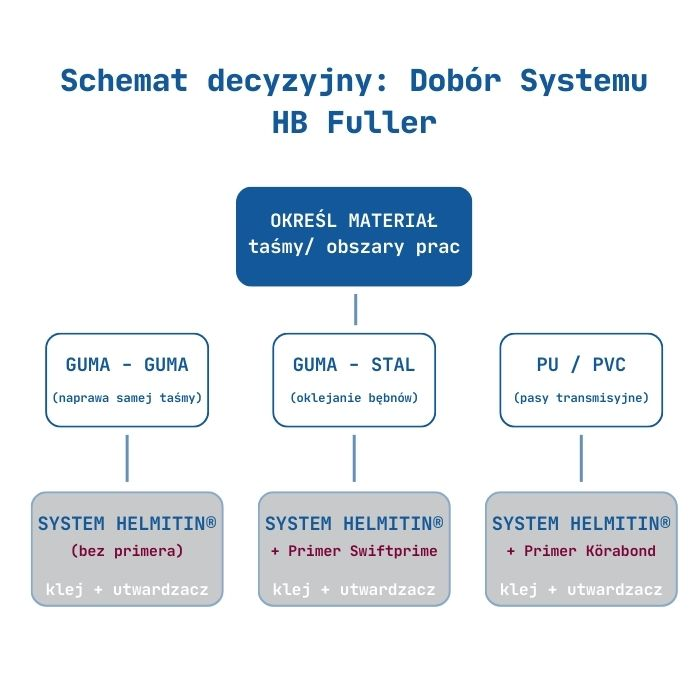
H.B. FULLER offers several industrial product families used in belt and rubber applications, including technologies under the HELMITIN, SWIFT, ULTRAFLEX and KÖRABOND brands. The exact combination must always be verified against current manufacturer documentation.
H.B. FULLER procedures for SBR rubber belts: multi-coat bonding and a 35° stepped bevel
Joining and repairing SBR rubber belts – multi-coat model
H.B. FULLER technical materials for SBR rubber applications describe processes based on mechanical surface preparation, application of several controlled adhesive coats, drying between coats, joining and pressure.
Two rules are particularly important:
- apply thin and even coats,
- allow each coat to reach the state specified in the applicable technical procedure before moving to the next stage.
Operational SOP template
- Prepare the SBR surface. Roughen it uniformly to a matte finish and remove dust and loose particles.
- Prepare the adhesive system. Mix adhesive and hardener, where required, according to the current TDS.
- Apply the first coat. Apply a thin, even layer and allow it to reach the required drying state.
- Apply subsequent coats. Repeat according to the product-specific procedure.
- Join the surfaces. Avoid trapping air.
- Apply pressure. Roll or press the joint uniformly across its full width.
Repairing a damaged belt: 35° stepped bevel
For certain rubber-belt repair procedures, the damaged section is prepared using a 35° stepped bevel, also referred to as a stair-step taper.
The principle is to create corresponding stepped surfaces on the belt and repair insert so that the assembled section maintains a uniform geometry as far as possible.
This geometry can:
- increase the effective bonding area,
- reduce stress concentration along a single joint line,
- improve load distribution during operation.
Once the geometry is prepared, subsequent stages follow the specified surface-preparation, coating, joining and pressure procedure.
Minimum quality-control requirements
- The adhesive must be homogeneous, without visible separation or unmixed material.
- Adhesive and hardener must be mixed in the correct ratio and used within the specified pot life.
- Individual adhesive coats should be controlled and uniform.
- Surfaces must be clean and dry before joining.
- Pressure must be applied uniformly across the joint.
- Restart and full-cure times must follow the applicable process documentation.
SOP visuals and service materials: what is worth including?
1. Time to restart
A clear distinction between application time, joining time, restart time and full cure helps maintenance teams plan downtime correctly and prevents premature loading of the repair.
2. Dew-point checklist: Ts ≥ Td + 3°C
A simple measurement sheet can turn an abstract rule into a clear GO / NO-GO decision before repair work begins.
3. Joint cross-section
A schematic can show the specified layer sequence, for example steel → primer → adhesive system → rubber or PU/PVC → primer → adhesive → pressure, depending on the technology.
4. Common repair mistakes
A short visual checklist is useful for reinforcing the process variables that most often affect repeatability: contamination, condensation, surface preparation, mixing, drying and pressure.
Technical consultation and solution selection
The most expensive belt repair is often one performed with an incorrectly selected system or without proper process control.
Melkib can support the selection of an H.B. FULLER system, including primer, adhesive, hardener and cleaner or thinner where required, and help define the process for the actual operating conditions.
Preparing a conveyor-belt repair or PU/PVC belt bonding process? Provide the belt material, construction, operating temperature, environmental conditions and type of damage. This makes it much easier to narrow down the appropriate technology before testing.
FAQ – conveyor belt bonding and repair
Is cold bonding only an emergency repair?
No. Cold bonding can also be used for planned repairs when the adhesive system, substrate preparation, environmental conditions, pressure and curing time are correctly controlled. Suitability must always be verified for the actual belt and operating conditions.
How many adhesive coats should be applied to rubber?
There is no universal number for every adhesive. H.B. FULLER procedures for selected SBR systems use multi-coat processes, but the exact number of coats, drying conditions and joining window must follow the current TDS or process instruction for the selected system.
Why can a primer be required for PU/PVC?
A primer can modify or activate the substrate surface and form part of the specified bonding system. The need for primer depends on the exact belt material and adhesive technology.
Why is the dew point important during belt repair?
If the substrate temperature approaches the dew point, condensation can form on the surface. Even a thin moisture film can interfere with adhesion, which is why controlled repair procedures commonly require a safety margin between substrate temperature and dew point.
Can the belt be restarted as soon as the adhesive feels dry?
No. Surface dryness, working time, handling strength, restart time and full cure describe different stages. The belt should only be restarted according to the minimum time specified for the selected adhesive system and process.
When should a belt be replaced instead of repaired?
Replacement should be considered when damage is extensive, the belt structure is degraded over a long section, repeated repairs no longer provide stable operation or the remaining belt condition makes another local repair economically unjustified.
Technical sources
- H.B. Fuller – HELMITIN® 14030, current product documentation / Enhanced TDS.
- H.B. Fuller – HELMITIN® 14031, current product documentation / Enhanced TDS.
- H.B. Fuller – ULTRAFLEX™ product documentation, including ULTRAFLEX™ 4830.
- H.B. Fuller – Hardener 49631, current technical documentation.
- H.B. Fuller – HELMITIN® 694, current technical documentation.
- H.B. Fuller – HELMITIN® 676/2, current technical documentation.
- H.B. Fuller – Adhesives and Sealants for the Mining Industry.
- NILOS – current cold-bonding systems and vulcanization materials.
- NILOS – Product Catalog 2025.
- ISO 8502-4:2017 – Guidance on the estimation of the probability of condensation prior to paint application.