





How much load can a cylindrical joint retained with LOCTITE 638 withstand? In this article, we show a practical press-out test of a ring-and-shaft assembly and explain how the result should be interpreted.
The test is useful because it shows the potential of an anaerobic retaining compound in a real coaxial assembly. At the same time, it is important not to turn one press reading into a universal product strength value. The result depends on the diameter, engagement length, fit, gap, surface preparation, cure, temperature and material.
Key takeaways
- LOCTITE 638 is a high-strength anaerobic retaining compound for close-fitting cylindrical metal parts.
- In the Melkib press-out test, the press indication corresponded to approximately 900 kgf, or about 8.8 kN of force.
- This is a result for one specific specimen, not a universal load rating for LOCTITE 638.
- Without the shaft diameter and engagement length, the test cannot be converted reliably into average bond shear stress.
- For a cylindrical bonded area, the simplified average shear stress is calculated from τ = F / (π × d × L).
- LOCTITE 603, 638 and 660 are all retaining compounds, but they are intended for different gaps and repair situations.
How does LOCTITE 638 work?
LOCTITE 638 is a one-component anaerobic retaining compound designed for cylindrical metal assemblies such as shafts, gears, pulleys, sleeves and bearing-related components.
The material cures when it is confined between close-fitting metal surfaces and oxygen is excluded from the joint. According to Henkel, the current product is high strength, works on active and passive metals, fills gaps in the approximately 0.15–0.25 mm range and has a service-temperature range of -55°C to 180°C.
Press-out test of a retained ring-and-shaft joint
The Melkib test used a metal ring and shaft assembled with a loose fit and retained with LOCTITE 638. After curing, the joint was placed in a press and loaded until the components separated.
Video: how much load can LOCTITE 638 handle?
What was the result?
The original article described the result as “nearly 900 kg”. For force, this wording is imprecise. If the press scale corresponded to approximately 900 kilogram-force (kgf), the equivalent force is:
900 kgf × 9.80665 N/kgf ≈ 8,826 N ≈ 8.8 kN
So the technically clearer statement is: this particular joint required approximately 8.8 kN of press-out force to separate.
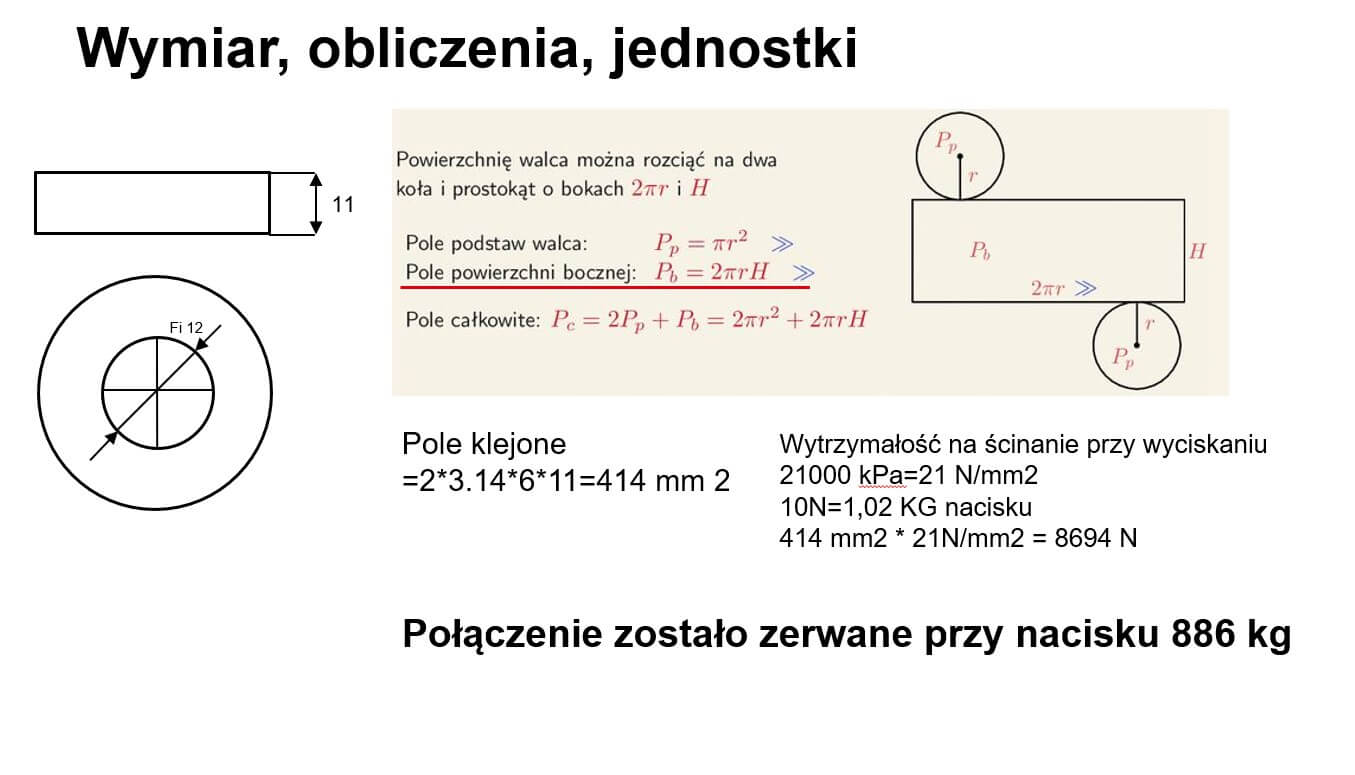
Can the 8.8 kN result be converted into shear strength?
Not from the information available in the article alone.
For a simplified cylindrical retaining joint, the bonded area can be estimated as:
A = π × d × L
where:
- d – bonded diameter,
- L – engagement length.
The average shear stress would then be:
τ = F / (π × d × L)
Because the original article does not provide the specimen diameter and engagement length, calculating a numerical shear stress would require guessing. The press-out force should therefore remain reported as approximately 8.8 kN for this particular test specimen.
How does the test relate to Henkel product data?
Henkel publishes standardised laboratory data for retaining compounds. These values are useful for comparing products, but they should not be treated as a direct prediction of the press-out force of a real shaft-and-ring assembly.
| Product | Typical application direction | Gap fill | Fixture time | Operating temperature | Published shear strength on steel |
|---|---|---|---|---|---|
| LOCTITE 638 | High-strength general-purpose cylindrical retention | 0.15–0.25 mm | 4 min | -55°C to 180°C | 31 N/mm² |
| LOCTITE 603 | Close-fitting cylindrical parts, press/interference fits and small-clearance slip fits | Up to 0.15 mm | 10 min | -55°C to 150°C | 26 N/mm² |
| LOCTITE 660 | Worn cylindrical parts and larger gaps | 0.25–0.50 mm | 15 min | -55°C to 150°C | 23 N/mm² |
These figures come from manufacturer-controlled test methods and conditions. They are not equivalent to the press-out force measured in the Melkib demonstration.
When should you choose LOCTITE 638, 603 or 660?
LOCTITE 638
Use it as a starting point when high-strength retention is required for cylindrical parts and the gap fits within the product’s specified range. Henkel currently lists high strength, good oil tolerance, passive-metal performance and operating temperatures up to 180°C.
LOCTITE 603
LOCTITE 603 is a low-viscosity, high-strength retaining compound intended for close-fitting cylindrical parts. Henkel specifically describes it for bearings, bushings and shafts and for augmenting press/interference fits or slip-fitted assemblies with small clearances.
LOCTITE 660
LOCTITE 660 is a high-viscosity paste intended especially for worn bearing seats, keys, splines, tapers and other cylindrical assemblies where a larger bond gap exists. Henkel specifies a 0.25–0.50 mm gap-fill range.
LOCTITE retaining compounds for cylindrical parts: 638, 603 and 660
What most affects the strength of a retained cylindrical joint?
| Factor | Why it matters |
|---|---|
| Gap and fit | The adhesive must fill the actual clearance and cure throughout the bond line. Different products are designed for different gap ranges. |
| Bonded diameter | It determines the circumference of the cylindrical bonding area. |
| Engagement length | A longer bonded length generally increases the available bonded area. |
| Surface preparation | Oil, rust, dirt and residues can reduce process consistency even when the product has some contamination tolerance. |
| Metal activity | Active and passive metals can produce different cure rates; activator may be appropriate where the TDS recommends it. |
| Cure time and temperature | Fixture time is not the same as full cure. The joint should not be fully loaded before the required cure is achieved. |
| Service temperature | Strength changes with temperature and must be checked against the product’s performance data. |
| Dynamic loading | Vibration, shock, rotation, fatigue and thermal cycling can matter more than one static press-out test. |
How to assemble a retaining joint repeatably
- Check the geometry and gap. Do not select the product only by colour or strength label.
- Remove old retaining compound and contamination.
- Clean and degrease the surfaces. Use a cleaner compatible with the metals and process.
- Use activator only when needed. Passive metals, low temperature or slow cure may justify activation according to the product TDS.
- Apply enough compound to wet the full cylindrical area. Avoid both dry areas and uncontrolled flooding.
- Assemble using the method recommended for the fit. Slip fits and press fits can require different application techniques.
- Allow sufficient fixture and cure time. Do not confuse fast fixture with full mechanical performance.
- Validate the actual joint. For critical equipment, test the real geometry and service conditions.
Additional videos: selecting and applying retaining compounds
The three supporting videos from the existing article are retained because they help translate the press test into practical maintenance and production work.
Anaerobic adhesives for bearings and coaxial parts
LOCTITE 603 – how to retain a bearing correctly
LOCTITE 660 – retaining worn cylindrical parts
FAQ – LOCTITE 638 and bearing retaining compounds
Is “nearly 900 kg” the standard strength of LOCTITE 638?
No. In the test, the press indication corresponded to approximately 900 kgf, which is about 8.8 kN of force. That value applies only to the tested specimen and cannot be treated as a universal product rating.
Can the test result be expressed in N/mm²?
Only if the bonded diameter and engagement length are known. For a simplified cylindrical joint, average shear stress can be estimated from τ = F / (π × d × L).
Can LOCTITE 638 replace an interference fit?
Retaining compounds can increase the load-transfer capability and stability of cylindrical assemblies and can be used with different fit strategies. The correct fit still has to be designed for the application rather than removed from the engineering calculation.
What is the main difference between LOCTITE 603 and 638?
LOCTITE 603 is a lower-viscosity product for close-fitting cylindrical parts and small clearances. LOCTITE 638 is higher viscosity, offers a wider published gap range and a higher current operating-temperature limit.
When should LOCTITE 660 be used?
When the problem involves worn cylindrical parts and a larger gap that falls within the product’s specified range. The condition of the component still needs to be checked to confirm that adhesive repair is technically appropriate.
Why can a retained joint fail even when the correct product was used?
Common causes include contamination, excessive or unsuitable gap, incomplete cure, incorrect application, passive surfaces with slow cure, temperature outside the validated range or service loads that were not included in the original design.
Need to select a retaining compound for a real shaft-and-housing fit?
Provide the shaft diameter, engagement length, measured clearance, materials, operating temperature and expected load. These parameters make it possible to compare the joint geometry with the correct retaining-compound technology.