




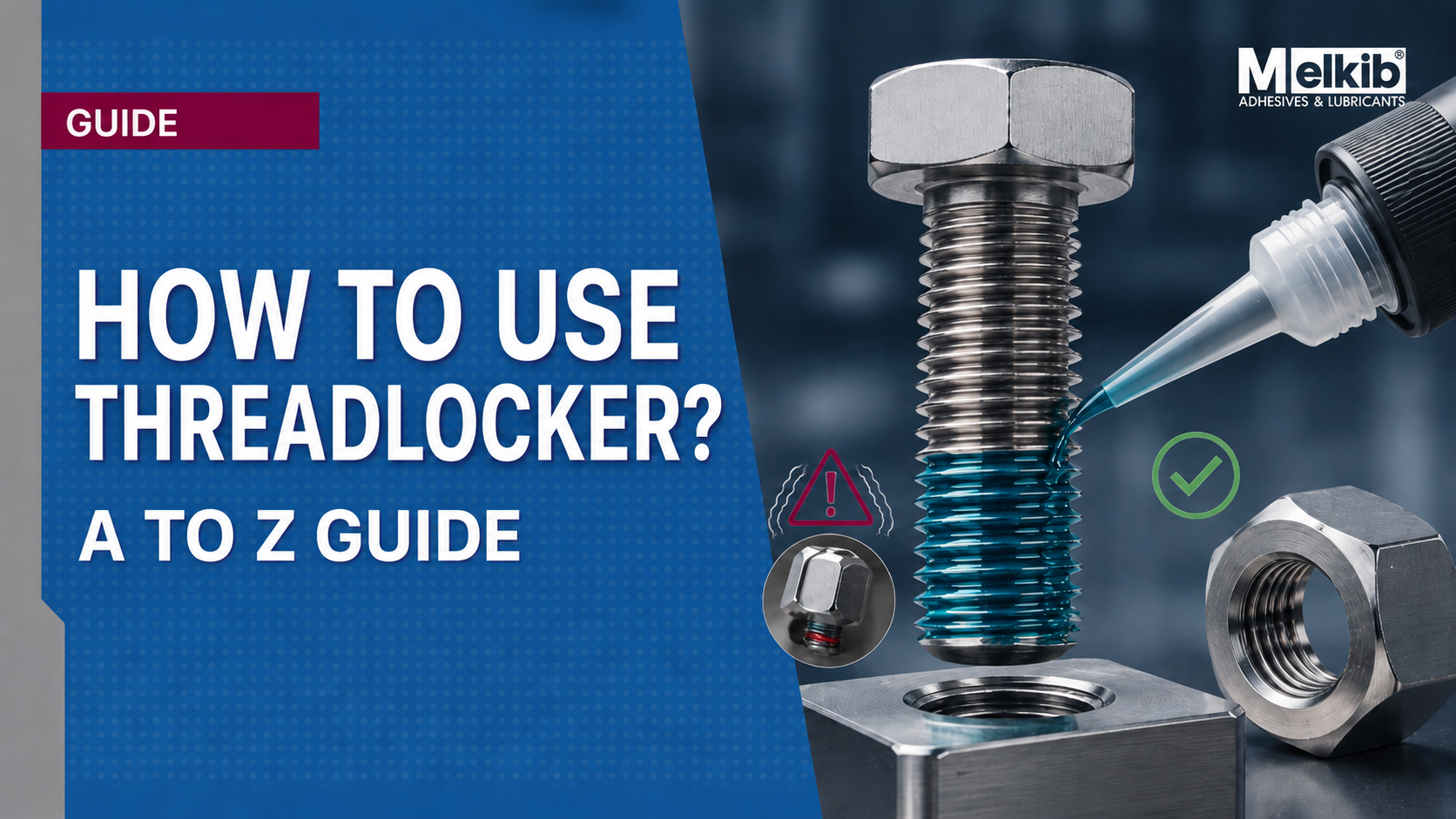
Threadlockers, also known as anaerobic adhesives, are a practical way to secure threaded connections in machines, equipment and installations. Even a correctly tightened bolt can gradually lose preload under the influence of vibration, impact, dynamic loads and temperature changes. The consequences can be costly: micro-movement, leaks, noise, loss of accuracy, repeated maintenance interventions and, ultimately, failure and downtime.
A correctly selected and properly applied threadlocker fills the free spaces between the threads, limits micro-movement, prevents self-loosening and can additionally seal the joint and protect the threaded gap against corrosion. However, a product that is incorrectly selected or applied may fail to work, make servicing more difficult or create problems during disassembly.
In this guide, we explain what anaerobic threadlockers are, what benefits they offer, how to select the right grade for the application and how to apply threadlocker step by step so that the process is repeatable and serviceable. If you are implementing this technology in a plant, treat it as part of the SOP: always verify the TDS and SDS of the specific product and perform a trial on the actual joint.
Key takeaways
- Select a threadlocker according to the required strength, thread size, material, operating temperature and planned disassembly – not by colour alone.
- Medium-strength products are usually used for serviceable connections, while high-strength products require a planned disassembly procedure.
- The thread must be clean and degreased, and the cleaning agent should evaporate completely before the adhesive is applied.
- In blind holes, apply the product inside the hole as well, so that it is not pushed out of the working zone while the fastener is screwed in.
- Fixture time is not the same as full cure. Always check the exact time before putting the joint into service in the TDS.
- Threadlockers for preventing bolt loosening and pipe thread sealants may both use anaerobic technology, but they perform different primary functions.
What are anaerobic threadlockers?
Anaerobic adhesives are usually one-component products that cure when air is excluded and they come into contact with metal. They remain liquid in the bottle because they are exposed to oxygen. Once a bolt is assembled with a nut or threaded hole, the product is confined in the gap between the mating threads and the curing process begins.
In practice, a threadlocker does not work like a conventional contact adhesive. Its task is to fill microscopic gaps, limit micro-movement, stabilise the connection and prevent self-loosening caused by vibration, impact and cyclic loading.
The key aspects of how an anaerobic adhesive works are:
- Exclusion of oxygen: the product cures only after it is confined in the gap between mating threads.
- Contact with metal: the metal surface helps initiate the curing process. The reaction is usually faster on active metals than on passive metals.
- Filling thread clearances: the adhesive occupies spaces that would otherwise remain empty, reducing micro-movement.
- Locking and sealing: once cured, the product can help protect the connection against loosening, leakage and moisture entering the threaded gap.
It is important to remember that not every anaerobic product has the same strength and not every product serves the same purpose. One product may be intended for small adjustment screws, another for standard serviceable connections, and another for studs, structural bolts or pipe threads where sealing is the primary requirement.
Why use an anaerobic threadlocker?
A threaded joint works correctly when it maintains the appropriate preload. Problems begin with transverse vibration, impact and micro-movement. The bolt can then gradually lose clamping force even if it was initially tightened to the correct torque.
An anaerobic threadlocker helps limit this problem because it fills the gap between the threads and stabilises the connection after curing. In practice, this means fewer joints returning to the maintenance department after several days or weeks of operation.
In maintenance, the benefits are usually seen not immediately on the workbench, but over time – as the number of repeat interventions falls:
- Protection against loosening: reduced loosening caused by vibration, typically in drives, gearboxes, fans, pumps, presses and structures exposed to vibration.
- Joint stabilisation: less micro-movement in the thread and a lower risk of the connection working loose.
- Thread sealing: the product fills free spaces and can help limit the migration of liquids or gases through the thread.
- Reduced crevice corrosion: filling the gap makes it more difficult for moisture and contamination to enter.
- Repeatable assembly: with a well-defined procedure, it is easier to maintain a consistent standard in production and maintenance.
Types of threadlockers – purple, blue, red and green
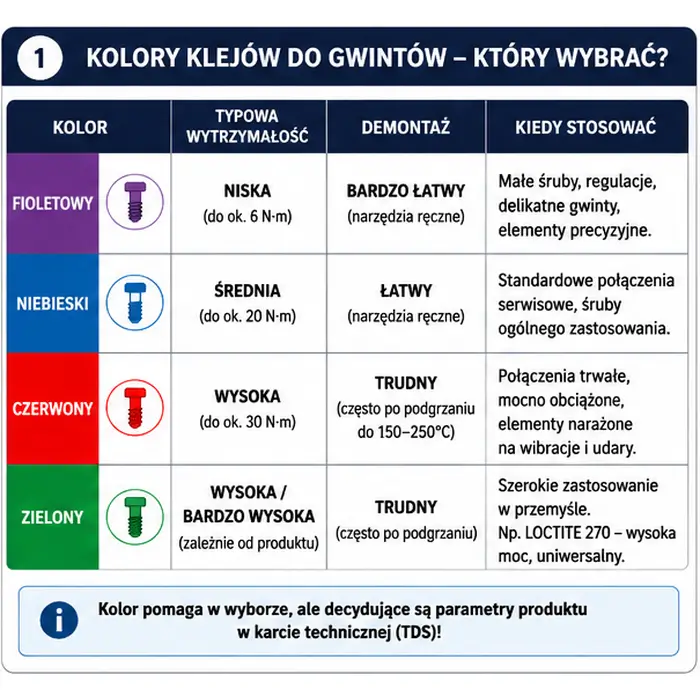
The colour of a threadlocker can help with quick identification, but it should not be the only selection criterion. The technical data sheet of the specific product is what matters: strength, viscosity, maximum thread diameter, temperature resistance, curing time and disassembly method.
Purple threadlocker – low strength
Purple threadlockers are mainly intended for small screws, adjustment screws, precision components and connections that must be dismantled without risking damage to the thread. They are a good choice where the locking compound must protect against light vibration without creating a connection that is difficult to disassemble.
Blue threadlocker – medium strength
Blue threadlocker is a common choice for standard serviceable connections. It secures the thread against loosening but usually allows later disassembly with hand tools. This is why it is widely used in maintenance, machine assembly, pumps, equipment, gearboxes and connections that may require inspection.
Red threadlocker – high strength
Red threadlockers are generally associated with high strength and more difficult disassembly. They are used for heavily loaded connections where permanent locking is more important than quick servicing. Before using a red threadlocker, check whether future disassembly will be possible and whether it could damage the bolt, thread or housing.
Green threadlocker – it does not always mean the same thing
The green colour requires clarification because different product groups use it. LOCTITE 270 is a green, high-strength threadlocker designed for permanent locking of metal threaded connections. LOCTITE 290 is also green, but performs a different function: it has low viscosity and penetrating properties, so it is used on already assembled connections where the product should wick between the threads by capillary action without prior disassembly.
Practical conclusion: do not assume that every green threadlocker represents the same type of product. Green may indicate either a high-strength permanent threadlocker or a penetrating product for already assembled connections. The technical data sheet of the specific product is decisive.
How to select a threadlocker
Threadlocker selection should be based on operating conditions rather than simply the colour of the bottle. In maintenance, it can be tempting to think, “use the strongest one and it will be safe.” That is a mistake. A product that is too strong may later prevent normal servicing or cause the bolt to shear during disassembly.
1. Will the connection need to be dismantled?
If the bolt will be removed during inspections, choose a low- or medium-strength product. If the connection is intended to be permanent, a high-strength product can be considered, but the disassembly method should be planned in advance, often involving heat or a dedicated procedure.
2. What is the thread size?
Small screws require particular care. A high-strength product on a small thread can create a joint stronger than the fastener itself. For larger threads, the viscosity of the product and its ability to fill the gap also matter.
3. What materials are the components made of?
Carbon steel, brass and bronze usually promote faster curing of anaerobic adhesives. Stainless steel, aluminium, zinc-plated, chromium-plated or passivated surfaces may require more time or the use of an activator. Do not guess – check the manufacturer's recommendations in the TDS.
4. What is the operating temperature?
Every threadlocker has a specified operating temperature range. If the connection is located near an engine, furnace, turbine, compressor or high-temperature installation, the actual temperature must be compared with the product's technical data sheet.
5. Does the thread also need to seal?
If the main problem is leakage of the medium, a conventional bolt threadlocker is not always the best solution. Dedicated thread sealants are commonly used for pipe threads and hydraulic or pneumatic installations. It is worth separating two objectives: preventing loosening and sealing pipe connections.
6. Does the process need to be repeatable across shifts?
If the threadlocker will be used regularly by several people or across several shifts, a simple procedure is needed: cleaning, application point, quantity, tightening torque, time before commissioning and inspection method. Without this, the same product can produce different results depending on who used it and under what conditions.
How to apply threadlocker correctly – step by step
Most problems are caused not by a “faulty adhesive” but by the process: contaminated threads, incorrect dosage, an unsuitable strength grade or loading the connection too soon. Follow this procedure.
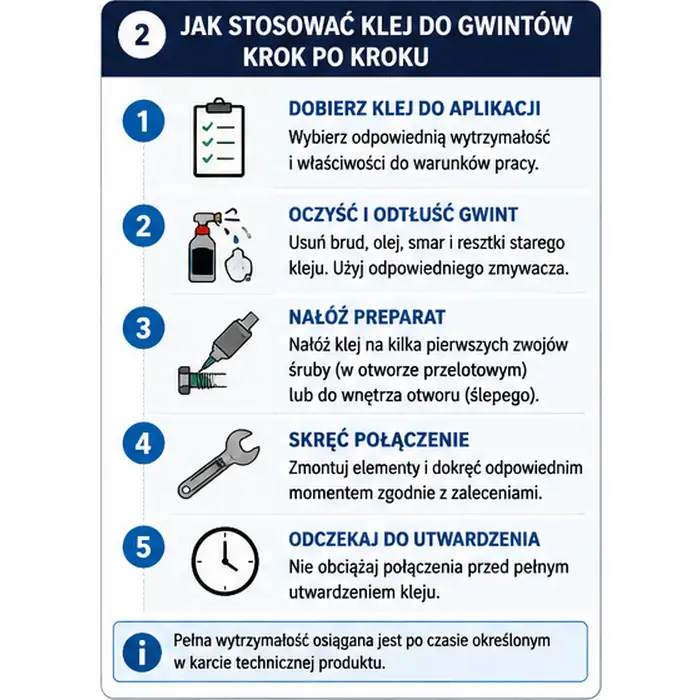
Step 1. Check whether the threadlocker is suitable for the application
First determine whether the connection is metallic, whether it will be exposed to vibration, whether it will need to be dismantled later and at what temperature it will operate. Typical anaerobic threadlockers are intended mainly for metal threads. For plastics, unusual coatings, passive surfaces or very high temperatures, check the product technical data sheet.
Step 2. Select the correct strength
Medium-strength threadlockers are most commonly selected for connections that will be serviced. Low-strength products are used for small screws and delicate threads. High-strength products are used for permanent and heavily loaded connections, but only when disassembly has been included in the service procedure.
Step 3. Clean and degrease the thread
Remove oil, grease, coolant, dust, swarf, corrosion and residues of old adhesive. In industrial applications, it is best to use a technical cleaner and then wait until the cleaning agent has completely evaporated. If the thread is heavily contaminated or corroded, simply wiping it with a cloth will usually not be enough.
Step 4. Check the thread material
Anaerobic adhesive usually cures faster on active metals. On stainless steel, aluminium, zinc, chromium or passivated surfaces, curing may take longer. In these situations, check the TDS to see whether the manufacturer recommends an activator.
Step 5. Apply the threadlocker in the correct place
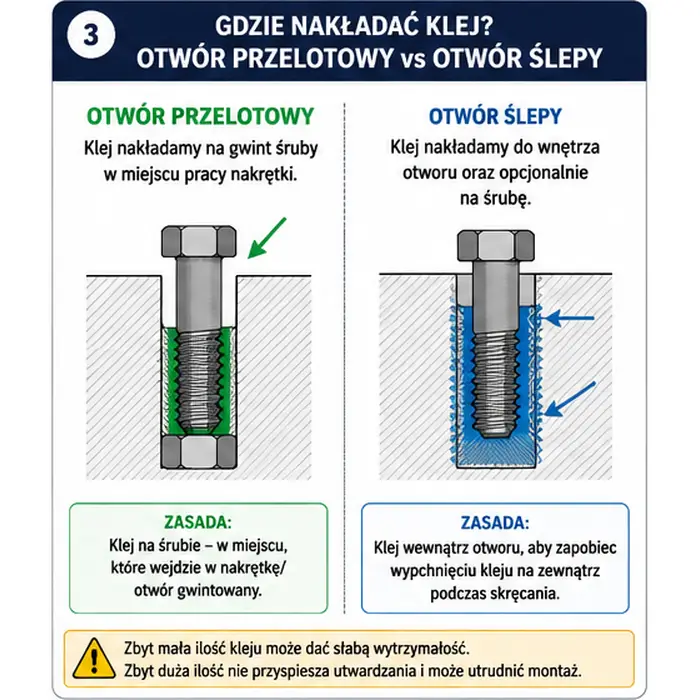
For through-bolt connections, the product is usually applied to the external thread of the bolt in the area where the nut will be positioned after assembly. There is no need to flood the entire bolt. It is sufficient to cover several threads in the working zone of the connection.
For blind holes, it is also worth applying the product inside the hole rather than only onto the bolt. If the product is placed only on the tip of the bolt, compressed air can push it out during assembly and it may not reach the correct working zone of the thread.
Step 6. Assemble the connection to the correct torque
Assemble the components and tighten them to the required torque according to the assembly procedure. Threadlocker stabilises the connection but does not replace correct assembly. If a specific torque is required, tightening should be completed immediately rather than after several minutes.
Step 7. Do not disturb the connection while it is curing
Once the components have been assembled, the bolt should not be “retightened” a few minutes later. This movement can interrupt the bond-forming process that has already started in the thread. If the connection is critical, do not load it immediately – distinguish between fixture time and full cure time.
How long does threadlocker take to cure?
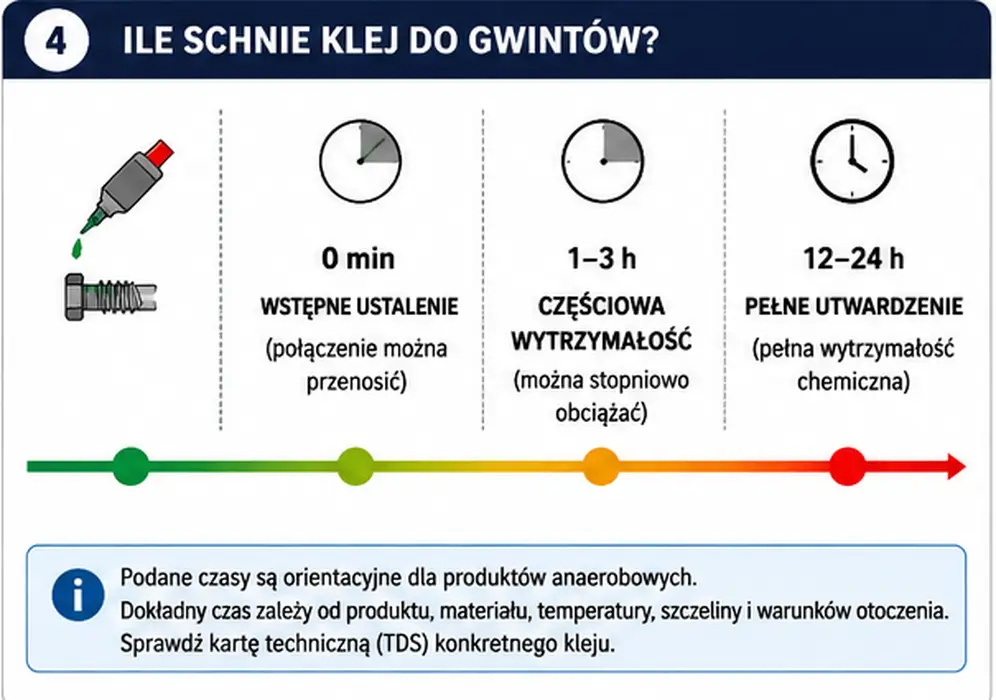
There is no single answer for every product. The time depends on the type of adhesive, gap, material, temperature, surface cleanliness and possible use of an activator. In practice, three stages should be distinguished:
- Fixture time: the point at which the connection has achieved initial stability.
- Partial strength: the stage at which the connection may be gradually loaded if this is permitted by the technical data sheet and assembly procedure.
- Full cure: the point at which the product reaches its final performance properties.
The most common mistakes that cause threadlocker to fail
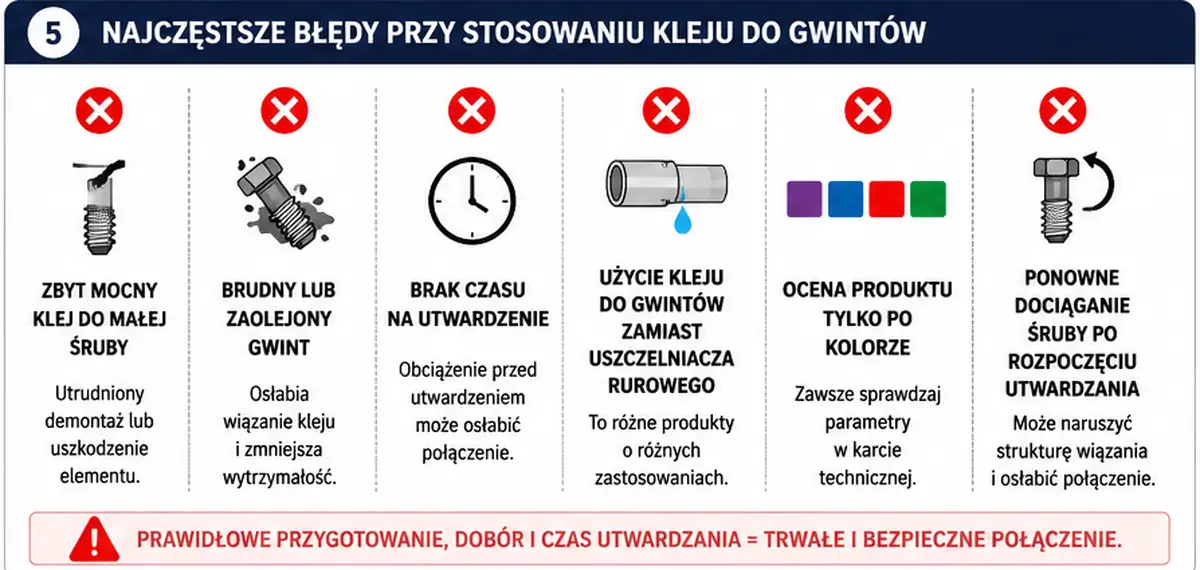
The same causes of problems recur in maintenance practice. Usually, the issue is not that “the adhesive was bad”, but that the product was incorrectly selected, the surface was contaminated or insufficient curing time was allowed.
- No degreasing: oil, grease, coolant, dust and residues of old adhesive reduce contact between the product and the metal. The connection may look secured but fail to achieve the expected strength.
- Using a product that is too strong: this is a common maintenance mistake. An excessively strong threadlocker can make disassembly difficult, especially on small screws, aluminium components or where access for heating is limited. The strongest product is not always the best choice.
- Loading the connection too soon: a connection assembled with threadlocker should not immediately be treated as if it had reached full strength. For critical applications, check the full cure time in the TDS.
- Incorrect application point: in blind holes, threadlocker applied only to the tip of the bolt can be pushed out during assembly. The product then does not work where it should and the connection is not locked consistently.
- Confusing threadlocker with pipe thread sealant: both products may be anaerobic, but they do not necessarily serve the same purpose. Threadlocker prevents bolts from loosening. Pipe thread sealant is designed primarily to provide sealing in installations.
- Using one product for everything: one threadlocker does not solve every problem. A small adjustment screw, a pump bolt, an engine housing stud and a pipe thread in a hydraulic system all have different requirements.
LOCTITE products from Melkib – when does each one make sense?
Below are four products that cover the process from surface preparation, through two threadlocking strength levels, to pipe thread sealing. This distinction is intentionally process-focused – always verify the details in the TDS.
LOCTITE SF 7063 (ID 3526)
A technical cleaner and degreaser for preparing surfaces before anaerobic products are used. In practice, it helps remove oils and contamination that are among the most common causes of poor process repeatability. The key rule: after application, wait until the cleaner has completely evaporated.
LOCTITE 243 (ID 3541)
A common maintenance choice for connections that need protection against loosening while remaining serviceable. It works well as a standard in many machine assemblies where the priority is a balance between reliable locking and the possibility of later disassembly.
LOCTITE 270 (ID 3544)
A solution for permanent and more critical connections where a high level of protection against self-loosening is the priority. In these applications, disassembly is planned as a service operation, and both product selection and the procedure should always be based on the TDS.
LOCTITE 577 (ID 1844)
A dedicated anaerobic sealant for threaded connections used where thread sealing is the primary objective. This is a different selection logic from conventional bolt threadlocking – here, sealing the connection in the installation is the starting point.
Products – quick links
...
FAQ – common maintenance questions
How do you apply threadlocker?
Clean and degrease the thread, select a product with the required strength, apply it to several threads in the working area of the connection, assemble the components to the correct torque and leave the connection to cure. For blind holes, apply the product inside the hole as well.
How do you disassemble a connection secured with threadlocker?
It depends on the strength grade. Low- and medium-strength products can usually be removed with hand tools. High-strength products may require heating the connection or another service procedure specified in the TDS. Always consider the component material, the surroundings of the connection and the risk of damaging adjacent parts.
How long does threadlocker take to cure?
The time depends on the product, temperature, material, gap and surface preparation. In practice, two parameters are particularly important: fixture time and full cure time. For many anaerobic products, full cure is assumed after approximately 24 hours, but the exact time must be checked in the technical data sheet.
When should threadlocker be used?
Threadlocker is worth using where the connection is exposed to vibration, impact, variable loads, the risk of leakage or corrosion in the threaded gap. Typical applications include pumps, gearboxes, engines, production machinery, mechanical equipment, structures and maintenance components.
Which threadlocker should be selected for serviceable connections?
A medium-strength product is most commonly selected, for example blue LOCTITE 243, because it secures the connection against loosening while usually allowing later disassembly with hand tools.
Is green threadlocker strong?
Often yes, but the specific product must be checked. LOCTITE 270 is a green, high-strength threadlocker. There are also green penetrating products designed, for example, for already assembled connections. Colour helps with identification but does not replace the technical data sheet.
Does threadlocker replace a spring washer?
Threadlocker works differently from a mechanical locking element: it stabilises the joint inside the threaded gap and limits micro-movement. In many applications, it may be more effective than a spring washer alone, but the decision should be based on design requirements, operating conditions and the assembly SOP.
Decision summary
Threadlocker should be selected technically rather than “by colour” or according to the rule that “the strongest must be best”. Medium-strength products are usually suitable for serviceable connections. Low-strength products are better for small screws. High-strength products, such as green LOCTITE 270, can be used for permanent and heavily loaded connections, but future disassembly must be planned.
The process has the greatest impact on effectiveness: a clean thread, the correct product, the correct application point, tightening to the required torque and sufficient curing time. If the connection operates in a critical area of a machine, the decision should not be based solely on habit or the colour of the product.
Do you need help selecting a threadlocker for a specific connection?
If you are not sure which threadlocker is suitable for your application, provide the Melkib team with information about the component materials, thread size, operating conditions, service requirements and expected machine start-up time. This will make it possible to select a product and procedure that reduce the risk of the same failure returning.
Sources
- Henkel Adhesive Technologies – threadlocking solutions
- MA-PRO – whether threadlockers are worth using and how to apply them
- Power Rubber – anaerobic threadlockers
- G. H. Junker, “New Criteria for Self-Loosening of Fasteners Under Vibration”, SAE Technical Paper 690055, 1969: DOI 10.4271/690055
- H. Gong, X. Ding, J. Liu et al., “Review of research on loosening of threaded fasteners”, Friction, 2022: DOI 10.1007/s40544-021-0497-1