




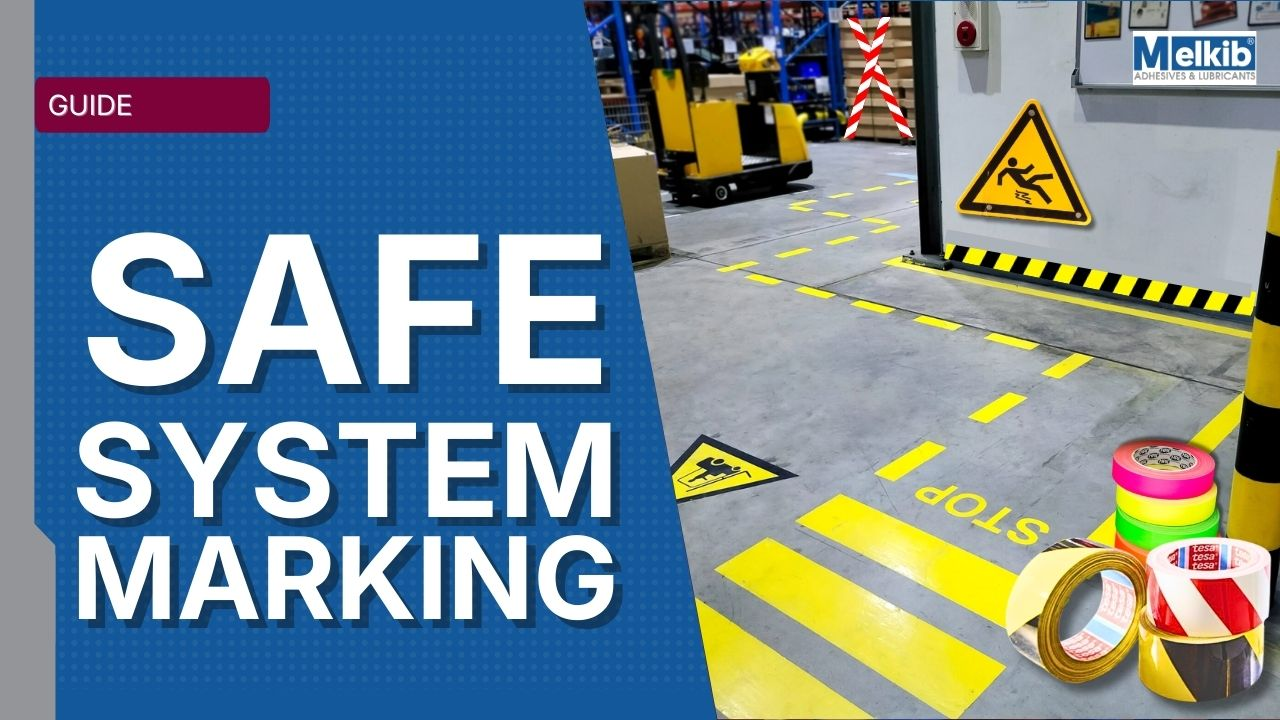
In modern production plants and warehouses, more and more operational decisions are made “from the floor level”. Floor lines, marked storage areas, stair edges, pillars in contrasting colours and additional cable markings tell employees where they can move, where materials may be stored and which areas involve increased risk. If this visual system is inconsistent, partly worn away or each department has created its own rules, both occupational safety and process flow suffer.
In this guide, we show how to use TESA marking and safety tapes in a structured way: TESA 60760 floor marking tape, TESA Signal Universal 58133 / 58134 warning tape, TESA 60951 anti-slip tape, TESA 4671 gaffer tape, as well as specialist solutions such as TESA 4169, TESA 4863, TESA 4590, TESA Signal Non Adhesive 58137 and TESA 73210 ACXplus. Using these examples, we build a coherent marking system for a production hall, warehouse or logistics centre.
You can find the products discussed in the Melkib range, including the categories marking tapes and anti-slip tapes.
Key takeaways
- A marking system should combine colours, tape types and specific applications into one consistent occupational safety and 5S standard.
- TESA 60760, TESA 4169 and TESA Signal Universal serve different purposes, from temporary floor marking to permanent marking of obstacles and hazard areas.
- Where visual marking alone is not enough, an anti-slip tape such as TESA 60951 or a suitable HPX Safety Grip variant can improve footing.
- TESA 4671 and HPX gaffer tapes are useful for cables and temporary installations, while TESA 4863 is a process solution for roller wrapping.
- Before applying tape, the substrate should be clean, degreased and dry, and the lines should follow the site’s adopted marking standard.
- Markings require regular inspection: worn lines, lifted edges and damaged sections should be identified during routine safety checks.
Why invest in a TESA marking tape system?
Marking and warning tapes are more than just “coloured lines on the floor”. A well-designed marking system:
- improves safety — it guides pedestrians away from machine operating zones and forklift traffic and highlights particularly hazardous areas,
- organises the workspace — it clearly shows where storage areas, workstations and transport aisles begin and end,
- speeds up work — clearly defined routes and zones reduce time spent looking for goods and help reduce mistakes and traffic conflicts,
- supports safety, 5S and Lean audits — it is immediately visible whether the hall layout follows the agreed standard,
- reduces the cost of changes — tape is usually easier to relocate or replace than repainting the floor.
Depending on the product, self-adhesive TESA tapes can be used not only on floors but also on walls, pillars, railings, door frames, barriers and equipment, as well as for cable marking and temporary fixation. This helps turn the workplace into a more readable visual map for employees and visitors.
Tape instead of paint — when can TESA be the better choice?
Painted lines make sense when the layout is virtually fixed and production processes are expected to remain unchanged for years. In practice, however, many facilities evolve continuously: machines are added, forklift routes change and shipping volumes grow.
In such environments, TESA marking tapes can offer several practical advantages:
- shorter downtime — preparing the substrate and applying tape is usually faster than grinding, painting and waiting for paint to dry,
- cleaner installation — no paint overspray and no waiting for a wet coating to cure,
- easier modification — lines can be moved, extended or partly removed when the layout or material flow changes,
- consistent appearance — the whole facility can use one defined family of tapes and colour rules.
This is why many companies treat marking tapes not only as a safety tool but also as part of Lean and 5S, supporting clear zones and visual workplace standards.
A logical colour system — the foundation of effective marking
Tape alone is not enough for clear visual management. You also need a simple, documented colour system consistent with the site’s safety rules, safety signage and 5S procedures. Floor tape colours should not replace mandatory signs, pictograms or evacuation signage.
According to the manufacturer, colour variants of TESA 60760 can be used for hazard warning and for marking mobile and stationary objects, while selected colour combinations correspond to prescribed safety marking guidelines. In practice, each colour should have one clear meaning in the site procedure and should be used consistently throughout the facility.
How to plan a TESA tape marking system — step by step
1. Map risks and traffic flows
Start with an up-to-date picture of the facility. Walk through the site with the layout and mark:
- machine operating zones and equipment with moving parts,
- forklift and vehicle routes,
- pedestrian routes and places where pedestrian and vehicle traffic intersect,
- access to fire protection equipment, electrical cabinets, first-aid points and emergency exits,
- areas where hazardous situations or near-misses occur most often.
On this basis, determine where you need continuous lines, storage fields, strong warning markings and anti-slip protection.
2. Select TESA and HPX tape types for specific tasks
In practice, one facility may need several product groups:
- TESA 60760, TESA 4169 and TESA Signal Universal (58133 / 58134) marking and warning tapes — respectively for temporary floor marking, permanent high-traffic floor marking and permanent highlighting of obstacles and hazard areas,
- TESA 60951 anti-slip tape and HPX Safety Grip — for places where underfoot grip needs to be physically increased,
- TESA 4863 “Printer’s Friend” — for roller wrapping in printing, textile and other web-processing applications,
- TESA 4671 gaffer tape and HPX FO5025 gaffer tape — for temporary applications, marking and fixing when a flexible backing and matt surface are useful,
- TESA 60953 Anti-slip Fluorescent — for improved footing and visibility in dark or poorly lit areas,
- TESA 4590 filament tape — for bundling, palletising, heavy carton closure, transport securing and fixing,
- TESA Signal Non Adhesive 58137 — for temporary cordoning-off and marking of hazard areas without an adhesive layer,
- TESA electrical insulation tapes in small rolls — for cable identification and small electrical tasks according to the site’s colour-coding standard.
When selecting a specific tape, check whether the manufacturer defines it as a temporary, semi-permanent or permanent solution and which substrates are recommended.
3. Substrate preparation and application
Regardless of tape type, the basic rules are similar:
- remove old tape and loose paint residues that could reduce adhesion,
- thoroughly vacuum and degrease the surface,
- make sure the floor is dry and in suitable technical condition,
- use chalk lines or lasers during installation to keep lines straight,
- press the tape along its full length and avoid air bubbles, especially around curves and at the ends.
After application, allow the adhesive system time to build adhesion to the substrate before exposing the marking to intensive forklift traffic.
TESA 60760, TESA 4169 and TESA Signal Universal — the backbone of the marking system
TESA 60760 is a floor marking tape with a soft PVC backing and modified natural-rubber adhesive. It is hand-tearable and is intended primarily for moderate, temporary marking applications, including identifying and marking mobile and stationary objects.
TESA 4169 is designed for permanent floor marking in high-traffic areas. The manufacturer specifies very good abrasion resistance and suitability for indoor and outdoor applications. It is suitable, among other uses, for marking work areas and locations where the marking needs to remain on the substrate over the long term.
TESA Signal Universal 58133 / 58134 uses a strong PP backing with a solvent-free adhesive system. The manufacturer intends it for permanent marking of obstacles and hazard areas. The yellow-black and red-white variants follow prescribed warning colour codes, and the tape offers high UV resistance.
A practical application guide:
- TESA 60760 — moderate, temporary marking of floors and objects,
- TESA 4169 — permanent floor marking, particularly in high-traffic areas,
- TESA Signal Universal (58133 / 58134) — permanent highlighting of obstacles and hazard areas.
...
TESA 60951 anti-slip tape and specialist solutions — safety on steps and in processes
There are places where visual information alone is not enough — physical grip must also be improved. This is where anti-slip tapes are used, particularly the black-yellow TESA 60951.
This tape has a PVC backing coated with mineral particles and an acrylic adhesive. The manufacturer specifies the black-yellow version for marking very slippery surfaces and for applications where secure footing is required. Under normal use conditions, the anti-slip effect can last for approximately 1–2 years.
Typical applications for TESA 60951 include:
- step and stair edges in production halls, warehouses, mezzanines and platforms,
- loading ramps and work platforms where water, mud or process contamination may occur,
- wash-down zones and areas with increased moisture where slip risk is higher.
For representative areas such as office stairs, reception areas or showrooms, you can consider semi-transparent HPX Safety Grip, which provides an anti-slip surface without fully covering decorative materials such as stone, glass or wood.
Anti-slip performance in production processes — TESA 4863 “Printer’s Friend”
Anti-slip performance is not limited to pedestrian safety. In printing plants, packaging lines and many web-processing operations, it is important that material does not slip on rollers and that sticky residues do not accumulate unnecessarily.
TESA 4863 PV3 “Printer’s Friend” is a specialist fabric tape with a silicone surface designed for roller wrapping. Its embossed surface provides a reliable non-slip effect on smooth substrates and is highly resistant to sticky substances. It is useful when looking at “anti-slip” not only from the pedestrian-safety perspective but also from the viewpoint of the production process.
...
TESA 4671 and HPX gaffer tapes — managing cables and temporary installations
Production halls and warehouses also have another common risk: loose leads, cables and temporary installations. A cable routed “just for a moment” across a walkway can quickly become a trip hazard.
TESA 4671 is a strong cloth tape based on a woven rayon backing and natural-rubber adhesive. It is conformable, easy to handle and adheres well even to many rough surfaces.
Depending on the application and site rules, it can be used for tasks such as:
- temporary cable fixing along floors or walls so that cables are kept under control,
- temporary securing and marking during tests, maintenance work and line rearrangement,
- general-purpose temporary fixing where a strong cloth tape and matt finish are useful.
Its less reflective surface is also useful around inspection stations or when documenting processes with photographs or video.
If you need a matt finish in bright fluorescent colours, consider HPX Gaffer Tape Fluo 6100, including FO5025. HPX specifies this tape for studios and theatres where low light reflection is important, while the fluorescent colours can also support high-visibility temporary marking.
For small electrical tasks and colour-coding cables, classic TESA electrical insulation tapes in small rolls can be used according to the site’s electrical marking standard.
...
TESA Signal Non Adhesive 58137 — temporary barriers without adhesive
Not every marking needs to be permanent from the start. In the event of a breakdown, spill, damaged rack or service work, the priority is often to quickly cordon off the hazard area.
TESA Signal Non Adhesive 58137 is a non-adhesive warning tape made from PE film, designed by the manufacturer for temporary marking of obstacles and hazard areas. It carries red-white printing on both sides, the print is abrasion-resistant, and the manufacturer specifies UV resistance for at least three months.
Because it has no adhesive layer, the tape can be stretched between posts, barriers or other fixing points to create temporary visual segregation. It does not replace permanent barriers or mandatory engineering controls where these are required.
TESA 60953 and TESA 60760 Neon Green — they are not the same
tesa documentation distinguishes two different solutions. TESA 60953 Anti-slip Fluorescent is a fluorescent anti-slip tape intended for locations where secure footing is required in dark or poorly lit areas. The manufacturer states that it remains bright for a prolonged period and can provide a warning function in dark surroundings.
TESA 60760 Neon Green, on the other hand, should be treated as a highly visible colour variant of marking tape. A bright neon colour does not automatically mean glow-in-the-dark performance. For that reason, “neon” and “fluorescent/phosphorescent” should not be used interchangeably when selecting a tape.
...
Mounting transparent signs and markings — TESA 73210 ACXplus
Visual management is not limited to floor lines. Signs, labels and information elements mounted on appropriately selected substrates are equally important.
TESA ACXplus 73210 is a transparent double-sided tape with a 1000 µm acrylic foam core. The manufacturer designed it primarily for bonding transparent and translucent materials such as glass, acrylic and polycarbonate. Listed applications include transparent signs and nameplates as well as transparent decorative panels.
The tape may eliminate the need for drilling in selected mounting applications, but it should not be assumed to be suitable for every wall, enclosure, coating or plastic. For responsible applications, the substrate, load and service conditions should be checked and an application test should be carried out.
TESA 4590 filament tape — bundling, palletising and transport securing
TESA 4590 is a unidirectional filament tape based on glass filaments laminated to PET film. The manufacturer intends it for industrial applications requiring high longitudinal tensile strength and low elongation.
Main applications include bundling and palletising, heavy carton closure, transport securing, fixing and end tabbing. It should not be presented as a manufacturer-specified tape for hazard marking or as impact protection for rack corners.
...
Quick reference: selected TESA tapes for marking and safety
The table below summarises the most important solutions discussed in this article and helps match the tape to the task.
| Product / group | Main application discussed in the article |
|---|---|
| TESA 60760 | Moderate, temporary marking of floors and mobile or stationary objects. |
| TESA 4169 | Permanent floor marking in high-traffic areas. |
| TESA Signal Universal 58133 / 58134 | Permanent marking of obstacles, pillars, barriers, ramp edges and hazard areas. |
| TESA 60951 | Steps, stairs, ramps, platforms and other areas where improved footing is required. |
| TESA 60953 | Anti-slip protection in dark and poorly lit areas with a warning function in darkness. |
| TESA Signal Non Adhesive 58137 | Temporary non-adhesive cordoning-off and marking of obstacles and hazard areas. |
| TESA 4671 / HPX gaffer | Temporary cable control, marking and fixing during tests and maintenance work. |
| TESA 4863 Printer’s Friend | Roller wrapping and reduction of material slippage in production processes. |
| TESA 73210 ACXplus | Bonding transparent signs, nameplates and selected visual-management elements. |
| TESA 4590 | Bundling, palletising, heavy carton closure, transport securing and fixing. |
Common mistakes when marking with tapes
Even high-quality TESA tapes will not create a safe system if the marking is designed and maintained inconsistently. Common problems include:
- too many colours and tape types — each department orders something different and employees no longer know what a colour means,
- routes without clear logic — pedestrian paths end in dead ends or cross forklift routes in critical locations,
- no designated storage areas — pallets and containers are left in walkways because no dedicated floor space is marked,
- incorrect tape selection — packaging tape used instead of gaffer tape for temporary cable control, ordinary marking tape used instead of anti-slip tape on slippery steps, or a temporary floor-marking tape used where a permanent high-traffic solution is needed,
- no inspection routine — worn lines and lifted tape edges remain in place until the next incident or audit.
Summary: one system, specific TESA and HPX tapes
Effective facility marking is not one roll of tape but a coherent system in which every tape has a role suited to the working conditions. TESA 60760 is primarily intended for moderate, temporary marking, while TESA 4169 is designed for permanent floor marking in high-traffic areas. TESA Signal Universal is used for permanent marking of obstacles and hazard areas, whereas TESA Signal Non Adhesive 58137 allows an area to be cordoned off quickly without adhesive.
Where improved footing is required, TESA 60951 can be used, and in poorly lit locations the specialist TESA 60953 variant adds a fluorescent warning function. TESA 4863 is a process solution for roller wrapping, TESA 4590 is intended for bundling and transport securing, and TESA ACXplus 73210 is primarily intended for transparent and translucent mounting applications.
Need help selecting a marking system for a production hall or warehouse?
If you are not sure where to start or which tapes to select, contact us. Based on the working conditions, floor type and traffic intensity, we can help you choose solutions for a coherent marking system that supports safety, audits and everyday work.
FAQ about marking, warning and anti-slip tapes
Which TESA tape should I choose for forklift routes and pedestrian paths?
Floor marking tapes such as TESA 60760 can be used for moderate, temporary marking in a suitable colour. If the marking is expected to remain in a high-traffic area over the long term, TESA 4169 is the more appropriate product family. Pedestrian and vehicle routes can use different colours, but they should follow one documented and consistent site colour system.
What is the difference between TESA 60760 and TESA Signal Universal 58133 / 58134?
TESA 60760 is a PVC floor-marking tape intended primarily for moderate, temporary marking. TESA Signal Universal 58133 / 58134 is a PP-backed warning tape intended for permanent marking of obstacles and hazard areas.
Which tapes should be used where there is a slip risk?
For steps, ramps, platforms and slippery areas, use a purpose-designed anti-slip tape such as TESA 60951. It combines a visible black-yellow pattern with a mineral-coated surface that improves footing. In areas where appearance is important, a semi-transparent anti-slip product such as HPX Safety Grip may also be considered, provided the substrate and operating conditions are suitable.
What is TESA 4671 gaffer tape useful for?
TESA 4671 is a strong cloth tape suitable for a broad range of temporary fixing and marking applications. Its conformability, strong adhesion and less reflective surface make it useful for cable control, event and stage work, temporary installation tasks and process documentation. The suitability of any cable-fixing method should always be assessed against site rules and trip-risk requirements.
What is the difference between TESA 60953 and TESA 60760 Neon Green?
TESA 60953 Anti-slip Fluorescent is a specialist anti-slip tape intended, among other applications, for dark and poorly lit areas. tesa states that it remains bright for a prolonged period and can provide a warning function in darkness.
TESA 60760 Neon Green is instead a highly visible colour variant of temporary marking tape. The word “neon” alone does not mean that the tape glows in the dark. Mandatory safety signs, pictograms and site regulations must still be taken into account when designing safety marking.
How often should tape markings be inspected?
At a minimum, the condition of the marking should be checked during routine safety inspections, with a periodic review of the entire marking system at an interval suited to traffic intensity and operating conditions. Worn, lifted or damaged tape should be replaced promptly, especially in higher-risk areas.
Can TESA tapes be used in food and pharmaceutical plants?
In many cases they can be used in such facilities provided the selected product is suitable for the application, the manufacturer’s instructions are followed and the substrate is properly prepared and maintained. Where sanitary requirements are high, the selected tape and method of use should be reviewed with the site’s safety and quality teams, particularly where there is any risk of tape fragments entering the product or process.
Technical sources
- tesa® 60760 — official tesa product page
- tesa® 4169 — official tesa product page
- tesa® Signal Universal — official tesa product page
- tesa® Signal Non Adhesive 58137 — official tesa product page
- tesa® Professional 60951 Anti-slip Black/Yellow — official tesa product page
- tesa® Professional 60953 Anti-slip Fluorescent — official tesa product page
- tesa® 4671 — official tesa product page
- tesa® Printer’s Friend 4863 PV3 — official tesa product page
- tesa® 4590 — official tesa product page
- tesa® ACXplus 73210 — official tesa product page
- HPX Safety Grip 9600 — official HPX product page
- HPX Gaffer Tape Fluo 6100 / FO5025 — official HPX product page