





Stainless steel can be joined not only by welding. In a properly designed assembly, adhesive bonding can reduce heat input, limit thermal distortion, improve the appearance of the finished part and make it possible to join stainless steel to selected plastics, composites or other dissimilar materials.
Bonding is not a one-to-one replacement for welding. The correct choice depends on the joint geometry, materials, loads, service environment, production process and inspection requirements. For bonded joints, surface preparation and process repeatability are especially important.
Key takeaways
- Stainless steel is a family of iron-based alloys containing at least about 10.5% chromium; its corrosion resistance comes from a thin passive surface film.
- Bonding is worth considering when aesthetics, low thermal impact, load distribution and joining dissimilar materials are important.
- Welding remains preferable where joint geometry, temperature, inspection requirements or structural design favour a welded connection.
- For bonding, the decisive factors are adhesive selection, joint design, controlled surface preparation, bond-line thickness and curing conditions.
- Surface-energy or wettability tests can help assess a prepared surface, but they do not identify the stainless-steel grade and cannot replace representative bond testing.
- The current Melkib product selection retained from the Polish article uses IDs 2907, 3643, 1969 and 3522.
What is stainless steel?
Stainless steel is not one material but a family of corrosion-resistant steels. The common defining feature is a chromium content of at least about 10.5% by mass. Chromium forms a very thin, chromium-rich passive film that protects the underlying metal and can reform after minor damage when suitable conditions are present.
This does not make every stainless-steel grade immune to corrosion. Resistance depends on the alloy, surface condition and environment. Chlorides, crevices, high temperature, contamination and unsuitable chemicals can still cause pitting, crevice corrosion or other forms of attack.
Where is stainless steel used?
Depending on the grade, stainless steels are used in tanks, process equipment, food and beverage installations, medical instruments, marine components, architectural elements, railings, machinery, heat-resistant equipment and many other applications.
Stainless steel is widely used in hygienic equipment because suitable grades offer good corrosion resistance and can be designed for effective cleaning. However, HACCP does not prescribe stainless steel as the mandatory material for every food-contact component. Material selection must satisfy the hygiene, cleanability, corrosion-resistance and food-contact requirements of the actual application.
Welding or bonding stainless steel? Quick comparison
| Criterion | Welding | Adhesive bonding |
|---|---|---|
| Heat input | A thermal joining process that can create a heat-affected zone and distortion depending on the method and component. | Does not introduce welding-level heat into the joint; many structural systems cure near room temperature. |
| Joint appearance | The weld is visible unless it is subsequently ground, polished or otherwise finished. | The bond line can be hidden inside an overlap, giving a clean external appearance. |
| Dissimilar materials | Feasibility depends strongly on the materials and welding process. | Can join stainless steel to selected metals, plastics and composites when the adhesive and surface preparation are suitable. |
| Load transfer | Loads are transferred locally through the weld geometry. | A well-designed overlap can distribute stress over a larger bonded area. |
| Production control | Requires a qualified procedure, equipment and suitably qualified personnel for the application. | Requires controlled cleaning, dispensing, assembly, bond-line geometry, cure and quality checks. |
| Typical limitation | Heat effects, distortion, access, finishing and method-specific welding defects. | Cure time, surface sensitivity, peel/cleavage loading, temperature/chemical limits and process discipline. |
Stainless-steel welding methods
The stainless-steel grade, thickness, joint design and required properties are important before a welding procedure is selected. The original article included the following weldability reference table.

TIG / GTAW
Gas tungsten arc welding is widely used for stainless steels, particularly where control, weld quality and appearance are important. The process uses a non-consumable tungsten electrode and an externally supplied shielding gas. Depending on the application, it may be performed manually or with different levels of automation.
TIG is particularly useful for thin material and controlled welds, although productivity and penetration can be lower than with some alternative processes.

PAW – Plasma Arc Welding
Plasma arc welding uses a constricted arc to obtain high energy density. The original textbook source cited in this article reported approximate arc temperatures of around 6,000 °C for TIG and up to about 20,000 °C for a constricted plasma arc. It also described keyhole plasma welding of approximately 3–15 mm material in one pass and welding speeds approximately 40–80% higher than TIG under the compared conditions.
These values are retained as historical textbook parameters, not universal process limits. Actual temperatures, weldable thickness, penetration and travel speed depend on equipment, current, plasma gas, joint geometry, material grade and the qualified welding procedure.
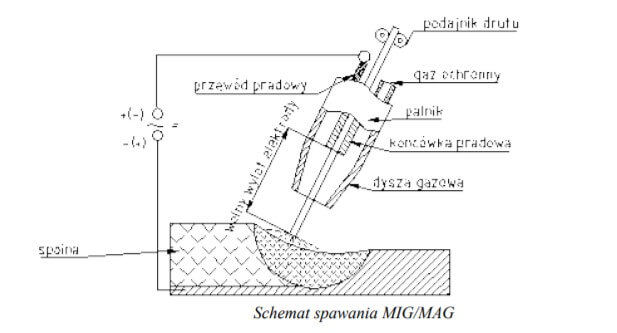
GMAW – MIG / MAG
Gas metal arc welding uses a continuously fed consumable wire electrode and externally supplied shielding gas. The arc is established between the wire and workpiece, so unlike TIG the electrode itself becomes filler metal.
For stainless steel, shielding-gas selection and filler-metal choice are part of the welding procedure and depend on the grade and required weld properties.
FCAW – Flux Cored Arc Welding
FCAW uses a continuously fed flux-cored electrode. Depending on the process variant, shielding can be provided by the flux system and/or an external shielding gas. It can offer high deposition rates but requires the correct wire and procedure for the stainless-steel grade.
SMAW / MMA
Shielded metal arc welding uses a consumable coated electrode. The decomposition of the coating contributes to shielding and slag formation. The process is flexible and uses comparatively simple equipment, but productivity is generally lower than continuously fed wire processes and thin material requires particular control.
Other processes
- LBW – laser beam welding,
- EBW – electron beam welding.
Limitations of welding stainless steel
Welding offers a broad range of robust joining methods, but the limitations depend on the selected process. Typical considerations include:
- the need for suitable welding equipment and competent personnel,
- heat input and possible distortion of thin or precision parts,
- visible welds and possible post-weld finishing,
- access requirements around the joint,
- process-specific risks such as spatter, porosity or incomplete fusion,
- the effect of welding and post-weld condition on corrosion performance,
- energy use and fume-control requirements.
When can adhesive bonding replace welding?
Bonding can be a realistic alternative where the geometry allows an overlap joint and the adhesive can carry the expected loads throughout the required service life. It is especially attractive when:
- a visible weld would reduce the required appearance quality,
- thermal distortion must be minimised,
- stainless steel must be joined to a different material,
- loads can be distributed over a relatively large bonded area,
- the design benefits from sealing or vibration damping in addition to joining.
Bonding is less attractive where the joint is dominated by peel or cleavage, must operate above the adhesive’s validated temperature range, requires immediate full load without a curing stage, or where inspection and regulatory requirements specifically favour welding or mechanical fastening.
Surface preparation for bonding stainless steel
A repeatable preparation process is more important than a generic instruction to “sand and degrease”. A robust starting sequence is:
- Identify the actual surface. Check the stainless-steel grade where relevant, but also the finish, oxide condition, polishing compounds, protective films, oils and other contamination.
- Remove gross contamination. Heavy oil, dirt and process residues should not be ground into the surface.
- Abrade where the adhesive process requires it. Controlled abrasion can increase effective surface area and remove weak surface layers, but the abrasive must not introduce contamination from carbon steel or other incompatible materials.
- Clean after abrasion. Remove dust and residues with a cleaner compatible with both the substrate and adhesive system.
- Use primer or activation only when specified. Some adhesive systems require additional treatment; others are formulated for direct bonding to properly prepared metal.
- Bond within the validated process window. Avoid touching the prepared surface or allowing it to become recontaminated before adhesive application.
Adhesive selection: what matters besides “2K”?
Two-component structural adhesives are widely used for metal bonding, but component count alone does not determine whether a product is suitable for stainless steel. Selection should include:
- stainless-steel grade and surface finish,
- the second substrate in a dissimilar-material joint,
- bond-line thickness and gap-filling requirement,
- shear, peel, impact and fatigue loads,
- temperature and thermal cycling,
- water, humidity and chemical exposure,
- working time, fixture time and full cure,
- required inspection and production throughput.
Current product selection retained from the Melkib article
...
For a broader selection, see Metal adhesives in the current English Melkib store.
Do not use one universal curing time or equipment cost
The older version of this article quoted a handling time of about 25 minutes and fixed price ranges for dispensing guns. These values should not be treated as general properties of stainless-steel bonding.
Fixture time can range from seconds to many hours depending on adhesive chemistry, formulation, temperature, gap and substrate. Dispensing equipment can range from a simple manual applicator to metering and mixing systems integrated into an automated line. For process planning, use the TDS of the selected adhesive and the actual production volume rather than a generic time or historical equipment price.
Video: stainless-steel bonding in practice
The two videos from the original article are retained because they show the practical workflow and joint testing.
Step-by-step bonding process
Tests and conclusions
FAQ – bonding stainless steel
When does bonding have an advantage over welding?
Bonding is particularly useful when low heat input, aesthetics, joining dissimilar materials or distributed load transfer are important and the joint can be designed with a suitable overlap.
Can any stainless steel be bonded?
Many stainless-steel surfaces can be bonded successfully, but the exact grade, surface finish, contamination, pretreatment, adhesive chemistry and service environment affect durability. Representative testing is recommended for important applications.
Is sanding always required?
No. Abrasion is a common preparation step for many structural adhesive processes, but it is not a universal rule. Follow the selected adhesive system’s preparation procedure and validate the actual surface condition.
Can a surface-energy test identify the stainless-steel grade?
No. Such a test can indicate wettability or surface condition but does not identify alloy composition. Material identification and bond qualification are separate tasks.
Is acetone always suitable for degreasing?
No. It may be suitable for some bare metals but can damage certain plastics, coatings and other substrates. The cleaner must be selected for the complete assembly and the adhesive process.
How long before a bonded part can be moved?
There is no universal 25-minute rule. Use the product-specific fixture or handling time under the actual process temperature and substrate conditions.
Choosing an adhesive for stainless steel?
Define the stainless-steel surface, the second substrate, joint geometry, loads, temperature, environment and required production time before comparing individual products.
Technical sources
- Melkib – current Polish counterpart of this article.
- Melkib – current English article page.
- worldstainless – Introduction to stainless steels.
- Euro Inox / worldstainless – Stainless Steel in the Food and Beverage Industry.
- Andrzej Klimpel, Spawanie, zgrzewanie i cięcie metali, WNT, 1999. Legacy welding source retained from the original article.
- J. Górka, S. Stano, “Microstructure and properties of hybrid laser arc welded joints (laser beam-MAG) in thermo-mechanical control processed S700MC steel”, Metals 8.2 (2018). Legacy reference retained from the original article.
- J. Yan, M. Gao, X. Zeng, “Study on microstructure and mechanical properties of 304 stainless steel joints by TIG, laser and laser-TIG hybrid welding”, Optics and Lasers in Engineering 48.4 (2010), 512–517. Legacy reference retained from the original article.
- R. W. Arnold, E. C. Combe, J. H. Warford Jr., “Bonding of stainless steel brackets to enamel with a new self-etching primer”, American Journal of Orthodontics and Dentofacial Orthopedics 122.3 (2002), 274–276. Legacy reference retained from the original article.