





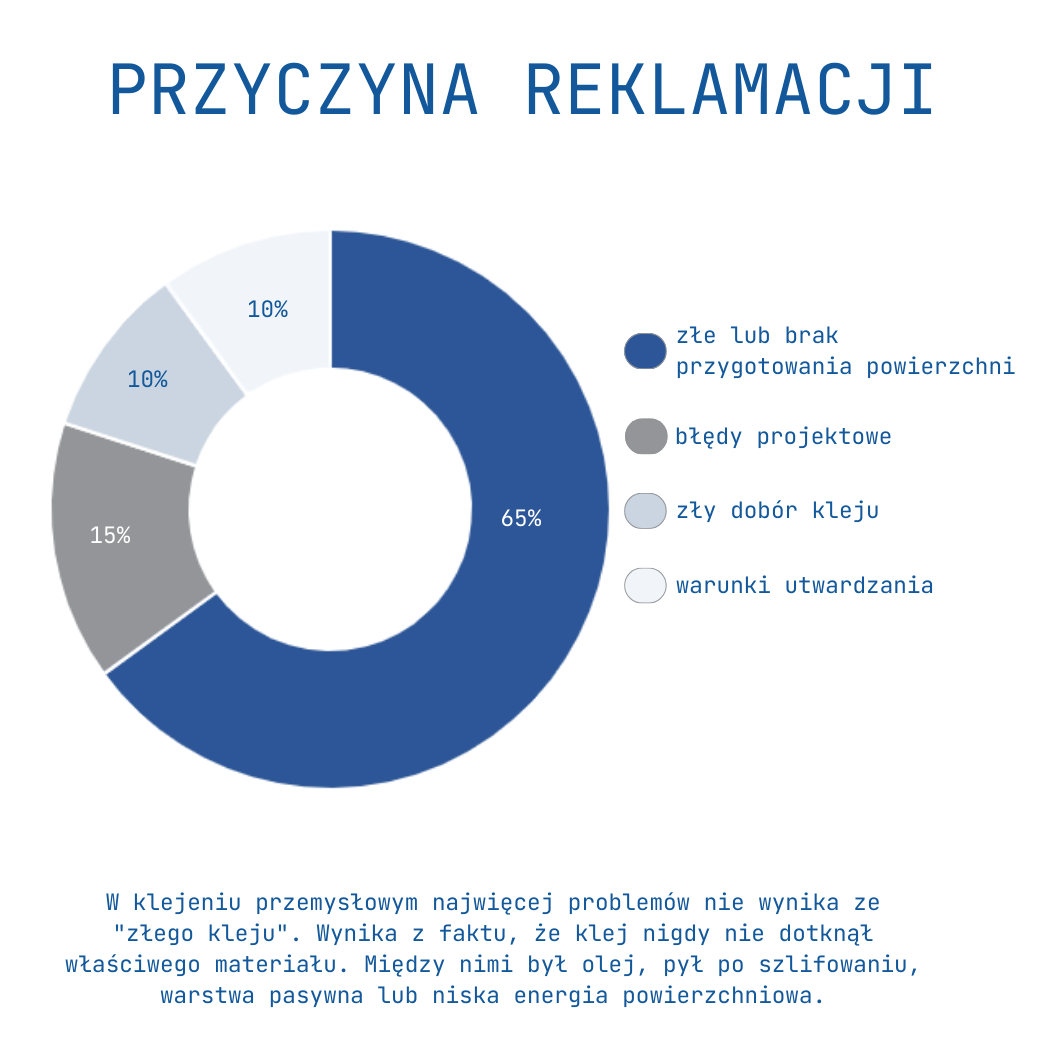
If an adhesive joint works reliably in one batch and fails in the next, changing the adhesive is not always the right first response. In many production problems, the root cause is surface condition, contamination or lack of process repeatability.
The most useful shop-floor rule is simple: perform the final cleaning consistently and do not touch the bond area afterwards. If the part must be handled, use clean gloves and handle it outside the prepared bonding zone.
Key takeaways
- Cleaning, wetting and adhesion are different parts of the bonding process and all must be controlled.
- Use fresh, low-lint wiping material instead of repeatedly redistributing contamination over the part.
- Mechanical abrasion is useful only when it is appropriate for the substrate, coating and adhesive system.
- The water-break test is mainly a qualitative cleanliness check for suitable high-energy surfaces such as metals; it is not a universal test for PE or PP.
- DYNE pens can help monitor surface treatment of plastics, but they do not prove long-term bond durability.
- Plasma and corona activation can improve the wettability of low-surface-energy plastics, but the effect can decay with storage time.
- Primer and activator are not interchangeable terms and should be used only where the selected adhesive system requires or benefits from them.
1. Minimum surface-preparation process before bonding
For an adhesive to form a reliable joint, it must make sufficiently intimate contact with the substrate. This requires appropriate wetting and a clean, stable surface capable of supporting adhesion.
Oil, silicone, mould-release agents, machining fluids, sanding dust, corrosion products and condensation can interfere with that contact.
A practical starting sequence is:
- Identify the substrate and coating.
- Remove gross contamination.
- Degrease with a compatible cleaner.
- Use mechanical or chemical pretreatment only where it is justified and validated.
- Remove dust and residues after pretreatment.
- Perform the final cleaning step.
- Do not touch the prepared bond area.
- Apply primer, activator, plasma or corona only when required by the selected process.
- Bond within the validated time window.
2. Degreasing without spreading contamination
One of the most common cleaning mistakes is repeatedly wiping the component with the same contaminated cloth. Once the wiping material is dirty, it can redistribute oil or silicone instead of removing it.
The two-wipe technique
For maintenance work and short production runs, a practical method is:
- First wipe: remove the main contamination with a compatible cleaner and a clean wiping surface.
- Second wipe: use fresh wiping material to remove the remaining cleaner and contamination.
Change to a clean part of the wipe frequently. After final cleaning, keep hands and tools away from the prepared bond zone.
Cleaners for surface preparation before bonding
3. Simple process-control checks: water-break and DYNE
Water-break test – useful, but not universal
A water-break test can be used as a rapid qualitative check for hydrophobic contamination on suitable surfaces. ASTM F22 describes it mainly as an in-process cleanliness check for surfaces such as metals before operations including adhesive bonding.
A continuous water film can indicate that hydrophobic contamination has been removed. A break or strong local beading can indicate contamination.
However, do not use this logic as a universal pass/fail criterion on low-surface-energy plastics. Clean PE or PP naturally resist wetting by water, so beading alone does not prove the presence of oil or silicone.
What are DYNE pens?
DYNE pens or surface-tension test inks are used to estimate the wetting behaviour of a surface. They are particularly useful for monitoring plastics before and after processes such as corona or plasma treatment.
Surface energy influences how easily an adhesive can wet a substrate. PE and PP are examples of low-surface-energy materials that are difficult to wet with many conventional adhesive systems.
How to use DYNE pens as a process check
- Prepare and dry the test area according to the normal process.
- Do not touch the area after preparation.
- Use a test value appropriate for the material and the supplier’s test procedure.
- Apply the test liquid or marker consistently and observe the wetting behaviour for the specified time.
- Record the result together with activation parameters and time since treatment.
- Use the result to monitor process consistency rather than as proof of final bond durability.
4. Abrasion and dust removal – when do they help?
Mechanical pretreatment can be valuable when a joint carries significant load or when the existing surface contains a weak layer such as oxide, scale, degraded coating or contamination that cannot be removed by cleaning alone.
Depending on the material, the process may use:
- abrasive paper or pads,
- controlled blasting,
- machining,
- another validated mechanical treatment.
After abrasion, remove particles thoroughly and perform the specified final cleaning. Bonding directly onto sanding dust creates an uncontrolled interface.
For plated, coated or composite parts, first confirm that abrasion will not remove a functional layer or damage the substrate.
5. Plasma and corona activation – why the time window matters
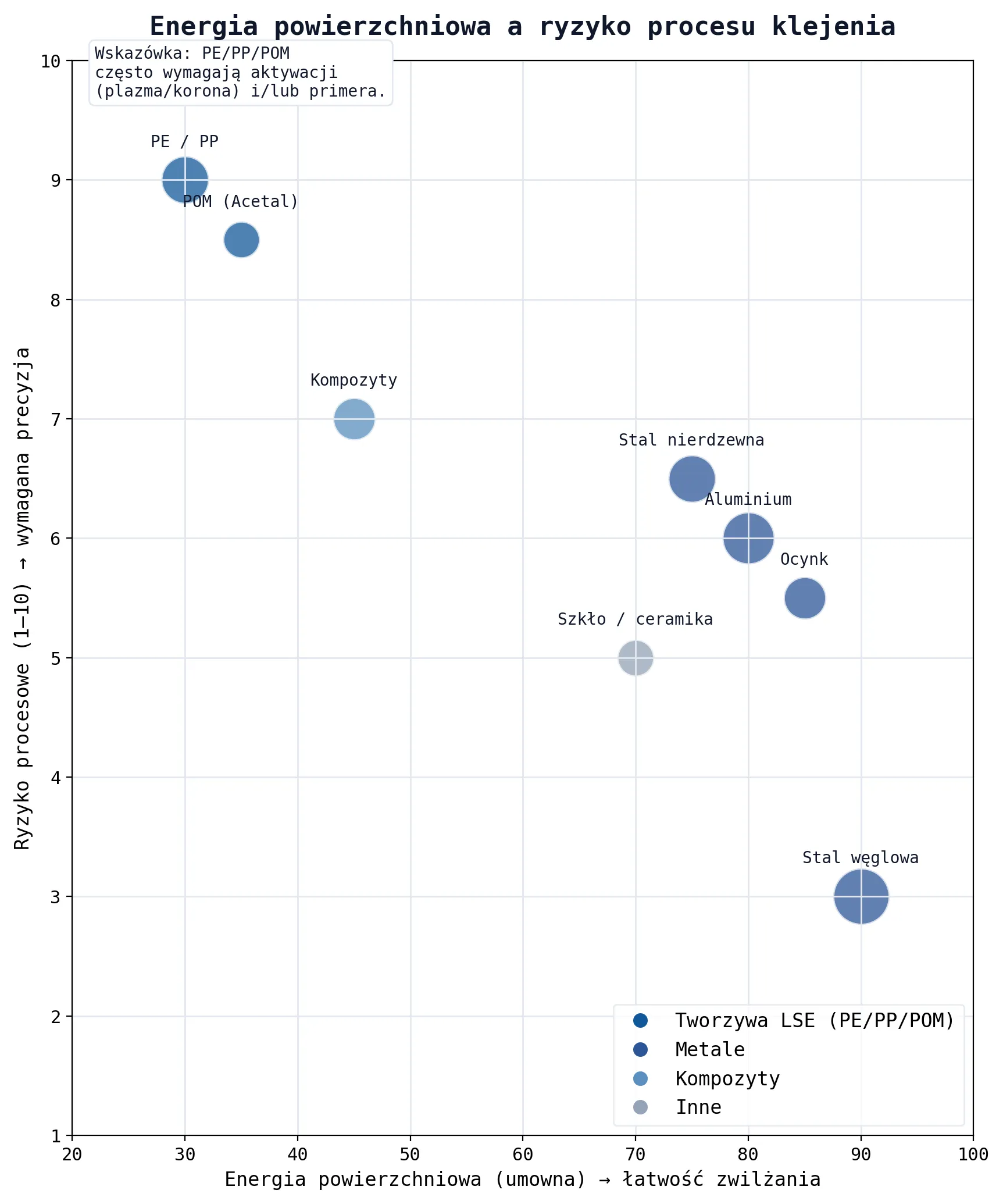
For materials such as PE and PP, the main challenge may be low surface energy rather than visible dirt. Corona or plasma treatment can modify the surface and improve wetting by an adhesive.
POM can also be difficult to bond and may benefit from a validated activation process, but it should not be treated as identical to PE or PP. Adhesive chemistry, grade, additives and part history all matter.
The effect of plasma or corona treatment can diminish over time because the polymer surface can partially recover toward its original state. For this reason, bonding should take place within a validated treatment-to-bonding window.
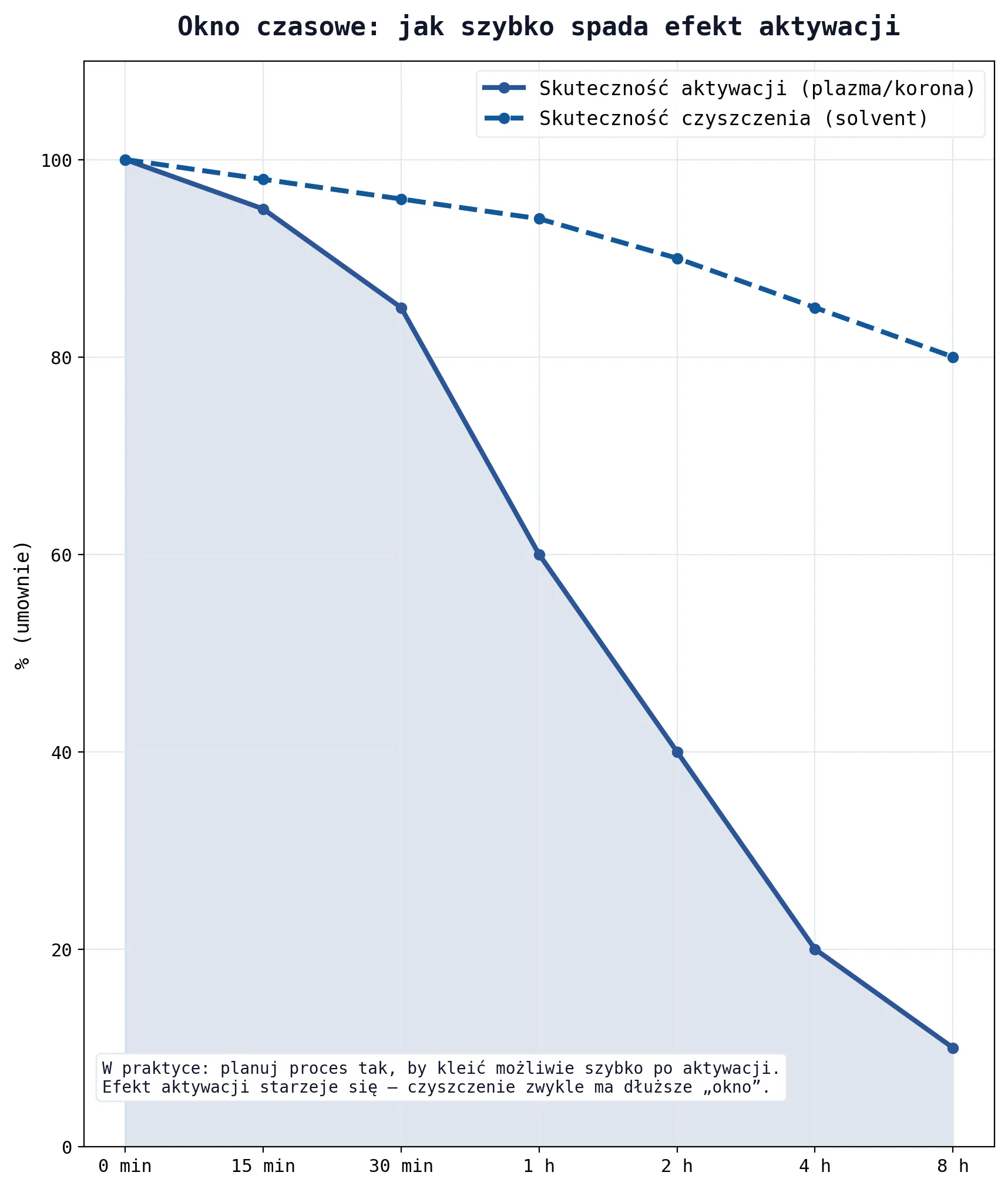
The permitted time is not a universal number. It depends on the polymer, activation method, treatment parameters, storage environment and required bond performance.
6. Primer or activator – what is the difference?
The terms are sometimes used loosely in production, but they do not always describe the same function.
| Product type | Typical function | Example |
|---|---|---|
| Adhesion primer | Modifies or conditions the substrate to improve adhesion of a specified adhesive technology. | LOCTITE SF 770 for difficult-to-bond, low-energy surfaces used with LOCTITE instant adhesives. |
| Cure activator | Accelerates or promotes cure of a specified adhesive chemistry. | LOCTITE SF 7649 for anaerobic adhesives on passive or inactive surfaces, at low temperature or with larger gaps. |
| System-specific primer / activator | Performs a defined preparation function within one manufacturer’s application system. | TEROSON BOND ALL-IN-ONE PRIMER in the TEROSON windscreen-bonding system. |
PE and PP with cyanoacrylate
LOCTITE SF 770 is intended to make polyolefin and other low-surface-energy materials suitable for bonding with LOCTITE instant adhesives. Whether it is required depends on the exact adhesive and substrate combination.
Passive metals with anaerobic adhesives
LOCTITE SF 7649 is designed to promote anaerobic cure on passive or inactive surfaces, at low temperature and with larger bond gaps. It should be used when the selected process needs faster or more reliable cure under those conditions, not automatically on every stainless-steel or aluminium joint.
Automotive glass with polyurethane glazing systems
TEROSON BOND ALL-IN-ONE PRIMER is part of the TEROSON BOND windscreen application system and can serve as a glass primer and activator or to reactivate cut-back polyurethane beads where specified by the system procedure.
Painted and coated surfaces
Before adding an adhesion promoter, verify that the coating itself is firmly attached to the substrate. A strong adhesive cannot compensate for paint or powder coating that delaminates from the base material.
Primers and activators for selected adhesive systems
7. Practical matrix: substrate and minimum preparation approach
| Material | Starting preparation sequence | When additional treatment may be needed | Main process risk |
|---|---|---|---|
| Carbon steel | Remove contamination → degrease → abrade if required → remove dust → final clean → bond | Primer or chemical pretreatment where required by the adhesive or durability target | Oil, corrosion, sanding dust or handling after cleaning |
| Zinc-plated steel | Degrease → assess plating → use only validated mechanical treatment → final clean → bond | Anaerobic activator where cure speed on the actual plated surface is insufficient | Damaging the plating or variability between coating batches |
| Stainless steel | Degrease → validated abrasion or pretreatment where required → final clean → bond | Anaerobic activator where passive surface, temperature or gap slows cure | Assuming every stainless-steel surface behaves identically |
| Aluminium | Degrease → validated mechanical or chemical pretreatment → final clean → bond within controlled time | Primer or activator according to adhesive chemistry and durability requirement | Oxide condition, alloy variability and excessive delay after preparation |
| Brass and copper alloys | Remove machining residues → degrease → optional validated abrasion → final clean → bond | Product-specific treatment only where required | Machining oil or oxidation |
| Glass / ceramic | Use compatible cleaner → dry completely → avoid touching → bond | System-specific primer for applications such as PU direct glazing | Fingerprints, cleaner residue or moisture |
| Paint / powder coating | Clean → verify coating adhesion → optional validated abrasion → final clean → bond | Adhesion promoter where confirmed by the adhesive system | The adhesive bonds to a coating that later detaches from the substrate |
| PE / PP | Clean with compatible agent → use LSE-compatible adhesive and/or validated activation or primer → bond within controlled window | Corona, plasma or polyolefin primer depending on adhesive technology | Low surface energy and uncontrolled delay after activation |
| POM | Clean → select adhesive/process for POM → consider validated activation → bond and test | Plasma or other treatment may be required depending on system | Difficult and variable adhesion |
| GFRP / CFRP composites | Remove release agents → clean → controlled abrasion where appropriate → remove dust → final clean → bond | Plasma or other activation where validated | Release-agent residue, resin smear or damage to fibres |
| Wood | Remove dust → sand where required → remove dust again → bond at controlled moisture level | Primer only where required by the adhesive system | Dust, moisture variation and excessive adhesive absorption |
8. Surface-preparation mistakes that generate complaints
Repeatability problems often appear as “random adhesive failure” even though the chemistry has not changed.
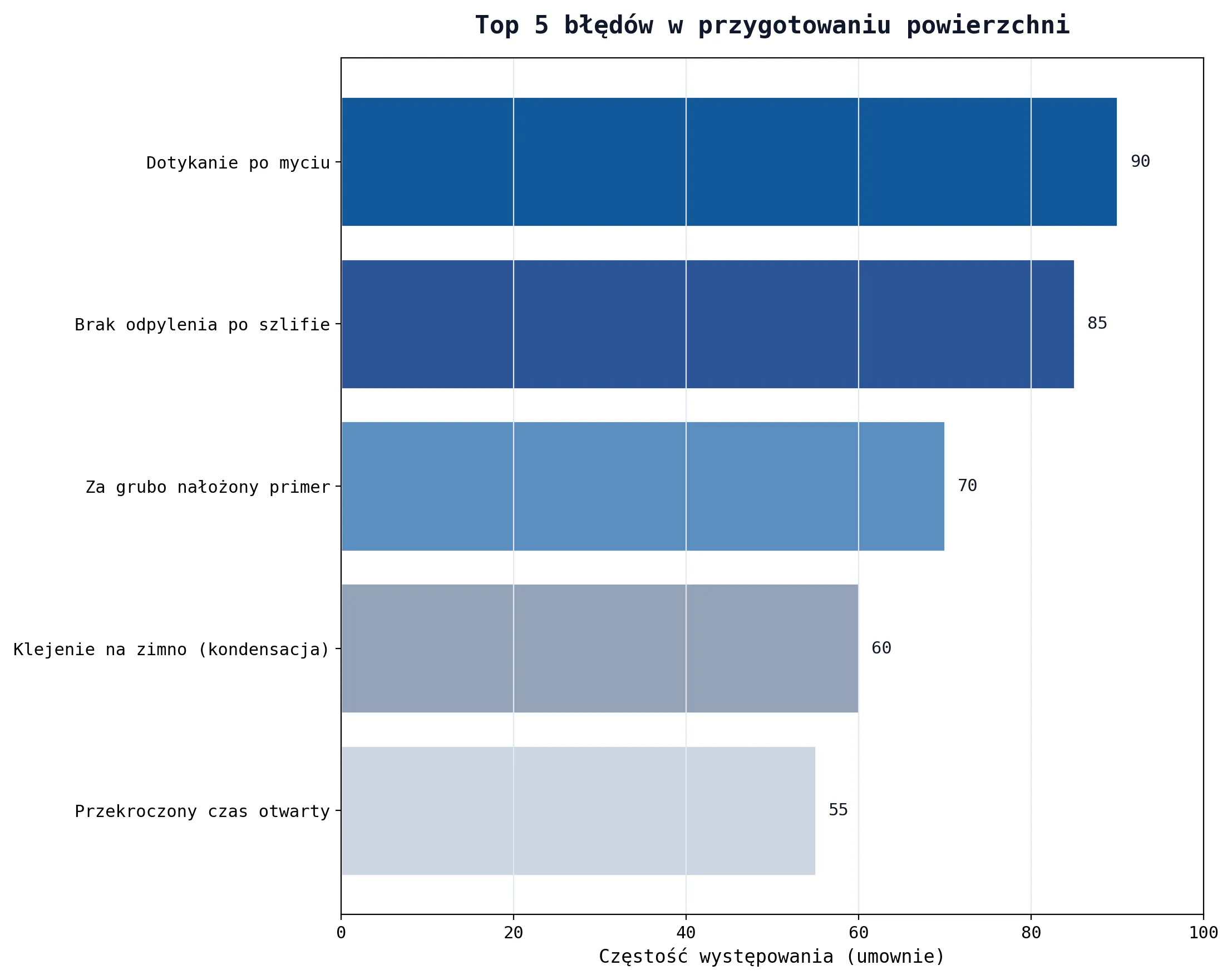
- Touching the bond zone after final cleaning. Handle the part outside the prepared area.
- Leaving sanding dust on the surface. Remove particles and perform the specified final clean.
- Applying primer too heavily. Follow the required application quantity and flash-off procedure in the product TDS.
- Bonding a cold part below the local dew point. Condensation can create an invisible barrier at the interface.
- Exceeding the validated time after plasma or corona activation. Keep treatment-to-bonding time controlled.
Maintenance and production checklist
- One documented cleaning standard for each relevant substrate.
- Fresh, low-lint wiping material and a defined wipe-change rule.
- No touching of the prepared bond zone.
- Dust removal after mechanical preparation.
- Controlled part temperature and no condensation.
- For activated plastics: recorded treatment parameters and treatment-to-bonding time.
- Primer and activator applied only according to the selected adhesive system.
- Water-break or DYNE checks used only where the method is appropriate.
- Final validation performed on the real materials and joint geometry.
FAQ – surface preparation before bonding
How should steel be degreased before bonding?
Use a cleaner compatible with the adhesive process and fresh low-lint wiping material. Remove the bulk contamination first, then perform a final cleaning step without reusing a dirty wipe. Avoid touching the bond zone afterwards.
Why can bonding behave differently on zinc plating than on plain steel?
Zinc coatings vary in chemistry, passivation and surface condition. The process should therefore be validated on the actual plated part. Avoid uncontrolled abrasion that could remove the protective layer.
How can cyanoacrylate bonding to PE or PP be improved?
Use a system designed for low-surface-energy plastics. Depending on the adhesive, this may include a polyolefin primer such as LOCTITE SF 770, plasma or corona treatment, or an adhesive specifically formulated for LSE materials.
How long can a part wait after plasma or corona treatment?
There is no universal time. The effect depends on polymer type, treatment parameters and storage conditions. Define a validated maximum treatment-to-bonding time and keep it consistent in production.
Must aluminium always be abraded before epoxy bonding?
No universal rule applies. Loaded and durability-critical joints often need a controlled mechanical or chemical pretreatment, but the correct procedure depends on alloy, surface condition, adhesive and service environment.
Is the water-break test suitable for PE and PP?
Not as a universal cleanliness test. PE and PP have naturally low surface energy and can bead water even when clean. Water-break testing is more useful as a qualitative hydrophobic-contamination check on suitable high-energy surfaces such as metals.
Primer or activator – which should be used?
Choose according to the adhesive chemistry and manufacturer’s procedure. A primer typically prepares the substrate for adhesion, while an activator can promote cure of a particular adhesive system. They are not interchangeable by default.
Need to stabilise a bonding process?
Prepare the substrate type, coating, contamination source, adhesive, production conditions and photographs of the joint. This makes it possible to identify whether the process needs better cleaning, activation, primer, a different adhesive or simply tighter process control.
Technical sources
- Melkib – current Polish counterpart: Przygotowanie powierzchni do klejenia — na co trzeba zwrócić uwagę?
- Melkib – current English article page
- ASTM F22-21 – Standard Test Method for Hydrophobic Surface Films by the Water-Break Test
- 3M – Introduction to Surface Energy
- Henkel – LOCTITE SF 770
- Henkel – LOCTITE SF 7649
- Henkel – TEROSON BOND ALL-IN-ONE PRIMER