





How do you choose the right gear oil? Start with the gearbox manufacturer's requirements, then identify whether you are dealing with an automotive transmission or an industrial gearbox. These two groups use different viscosity classifications, service categories and OEM specifications.
This guide explains how to select viscosity, additive system and base oil, how to distinguish API GL-4 from GL-5, when PAG or PAO may be appropriate, what to check before mixing lubricants, and how cleanliness and operating temperature affect gearbox life.
Key takeaways
- Do not select a gear oil by viscosity alone. Start with the OEM specification for the exact gearbox or axle.
- Automotive gear oils commonly use SAE viscosity grades and API service designations, while industrial gear oils typically use ISO VG and requirements such as DIN 51517-3 CLP or gearbox-manufacturer specifications.
- GL-4 and GL-5 are different service categories, not a simple “lower vs higher quality” scale. In synchronized transmissions, the required friction behaviour and OEM approval are decisive.
- PAO and PAG synthetic oils can provide advantages in demanding industrial service, but PAG lubricants are often incompatible with mineral-oil/PAO systems and may require a controlled changeover.
- ISO 4406 is a method for coding solid-particle contamination in hydraulic fluids. The acceptable cleanliness target is defined by the equipment or system requirements.
- Do not assume that two oils are safely mixable just because they share a viscosity grade or a similar specification. Compatibility must be confirmed.
1. First define the application: automotive or industrial?
The first decision is whether the lubricant is intended for a vehicle transmission/axle or for an industrial gearbox. The terminology and requirements overlap only partially.
Automotive gear oils – typical categories
- API GL-4 – commonly specified for many manual transmissions and transaxles.
- API GL-5 – commonly used for hypoid final drives and axles operating under severe sliding and load conditions.
- GL-5 LS – gear oils formulated for limited-slip differentials where the OEM requires limited-slip friction performance.
- MTF / OEM manual-transmission fluids – products designed around the synchronizer, friction and durability requirements of a specific transmission.
- ATF – automatic-transmission fluids and, in some vehicle designs, other hydraulic or steering applications.
- DCT/CVT fluids – dedicated fluids for dual-clutch and continuously variable transmissions where specified by the manufacturer.
...
Industrial gear oils – typical categories
- CLP according to DIN 51517-3 – EP industrial gear oils for enclosed gear units where this requirement is specified.
- PAO synthetic gear oils – often selected for extended service, temperature extremes, efficiency or demanding continuous-duty applications.
- PAG gear oils – often used in selected worm gears and other applications where the gearbox manufacturer recommends polyglycol technology.
- Special-purpose industrial gear oils – including products designed for micropitting resistance, food-industry requirements or specific OEM approvals.
- AGMA classifications – used in many North American industrial applications alongside viscosity and performance requirements.
...
2. Choose viscosity from temperature, speed and load
Viscosity strongly influences lubricant-film thickness, churning losses, heat generation and start-up behaviour. Oil that is too viscous can increase energy losses and temperature; oil that is too thin may not provide the required film under load.
Automotive viscosity – SAE grades
Automotive gear oils are commonly identified by SAE grades such as 75W-80, 75W-90, 80W-90 or 75W-140. The winter grade describes low-temperature performance, while the second number relates to viscosity at elevated operating temperature. Selection should follow the vehicle or axle manufacturer's specification.
Industrial viscosity – ISO VG
Industrial oils commonly use the ISO VG system defined by ISO 3448. Typical gear-oil grades include ISO VG 68, 100, 150, 220, 320, 460 and higher.
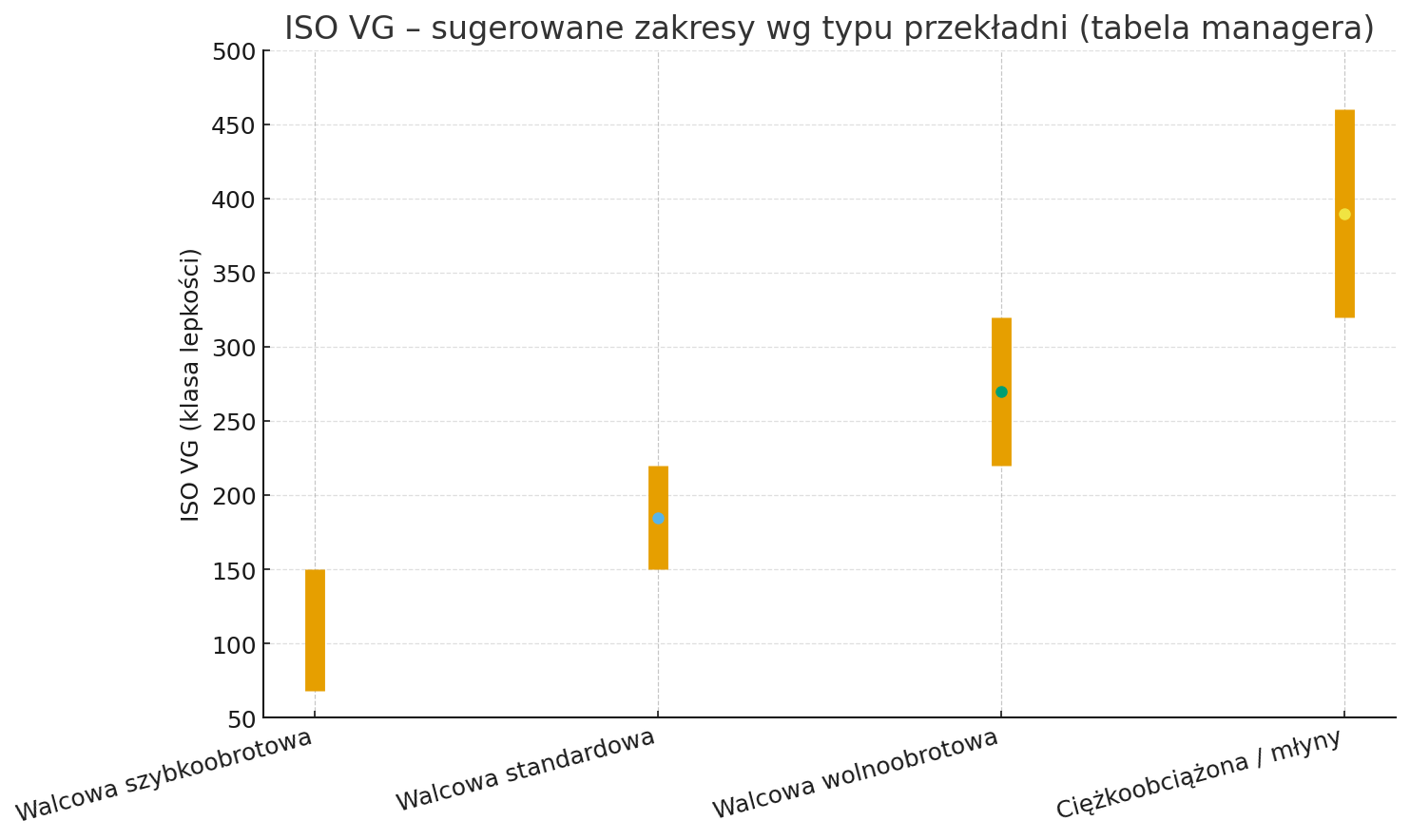
| Operating case | Typical speed / load | Illustrative ISO VG range | What to check |
|---|---|---|---|
| High-speed cylindrical gear | Above about 1500 rpm, moderate load | 68–150 | Churning losses, bearing lubrication and operating temperature. |
| Standard cylindrical gear | Approx. 500–1500 rpm, medium load | 150–220 | Balance between film thickness and power losses. |
| Slow-speed cylindrical gear | Below about 500 rpm, higher load | 220–320 | Film thickness, load and start-up temperature. |
| Very heavily loaded / very slow drive | Low speed, severe load | 320–460 or higher | OEM viscosity recommendation, micropitting protection and thermal behaviour. |
3. GL-4 vs GL-5 – choose the service category, not the “stronger” oil
API Publication 1560 defines gear-lubricant service designations for automotive manual transmissions, transaxles and axles. GL-4 and GL-5 describe different operating-service requirements; they should not be treated as a simple quality ladder.
Many synchronized manual transmissions require GL-4, MTF or a specific OEM fluid because synchronizer operation depends on the correct friction characteristics. Hypoid axles often require GL-5 because of their severe sliding contact and load.
| Application | Typical direction | Critical check |
|---|---|---|
| Synchronized manual transmission | GL-4, MTF or dedicated OEM fluid | Synchronizer friction performance and OEM specification. |
| Hypoid axle / final drive | Often GL-5 | SAE grade and axle-manufacturer approval. |
| Limited-slip differential | GL-5 LS or approved LS fluid where required | Required friction modifier and differential design. |
| DCT or CVT | Dedicated transmission fluid | Exact OEM specification; do not substitute conventional gear oil. |
4. Base oil: mineral, semi-synthetic, PAO or PAG?
Mineral gear oils are widely used where temperatures, service intervals and efficiency requirements are moderate.
Synthetic PAO oils can provide improved low-temperature behaviour, oxidation resistance and service life in applications for which the gearbox manufacturer permits them.
PAG oils can offer very good friction and thermal behaviour in selected industrial gears, including some worm-gear applications. However, PAG oils frequently require special attention to compatibility with previous lubricants, seals, paints and service procedures.
A change from mineral/PAO oil to PAG should not be treated as a simple drain-and-fill operation unless the lubricant and gearbox manufacturers confirm the procedure.
5. UTTO and STOU – when one fluid serves several systems
Some agricultural and construction machines use one common fluid for transmissions, hydraulic systems, wet brakes and clutches. UTTO and STOU products are designed for specific combinations of these duties.
Use such a fluid only when the machine manufacturer requires or permits the relevant specification. “Universal” does not mean interchangeable with ATF, conventional gear oil or hydraulic oil in every machine.
6. Hydrostatic transmissions and cleanliness
Hydrostatic systems can be highly sensitive to viscosity, air release and contamination. The correct fluid depends on the pump, motor, valve system and OEM specification.
ISO 4406:2021 provides a code for expressing the level of solid-particle contamination in hydraulic fluids. It does not by itself define which cleanliness class a particular hydrostatic system needs. The target cleanliness level should come from the machine, pump or component manufacturer.
Maintain filters, breathers and filling equipment so that clean oil is not contaminated during storage or service.
7. Mixing and changing gear oils
Do not assume two oils are safely mixable just because they have the same ISO VG or SAE grade. Different base oils and additive systems may affect viscosity, air release, demulsibility, friction behaviour or seal compatibility.
- Check lubricant-manufacturer compatibility guidance.
- Check the gearbox OEM's changeover requirements.
- Pay particular attention when changing between PAG and mineral/PAO technologies.
- For automotive transmissions, do not mix GL categories, ATF, MTF, DCT or CVT fluids unless the OEM specifically permits it.
- If compatibility cannot be confirmed, use an appropriate controlled changeover or flushing procedure rather than an improvised top-up.
8. Practical examples
Worm gearbox
Some worm gearboxes use high-viscosity mineral, PAO or PAG oils. Sliding, operating temperature and material compatibility are particularly important. Use the gearbox manufacturer's viscosity and lubricant-technology recommendation.
Hypoid axle
Commonly requires an SAE automotive gear oil meeting the specified API or OEM service requirement. Limited-slip differentials may additionally require an LS formulation.
Synchronized manual transmission
Use the exact OEM fluid specification, often GL-4/MTF or another dedicated transmission-fluid requirement. Shift quality depends on more than EP load-carrying capability.
Industrial planetary or heavily loaded gearbox
Often uses an ISO VG industrial gear oil such as CLP or a synthetic product. In severe service, check micropitting resistance, bearing compatibility and gearbox OEM approval.
9. Symptoms of incorrect selection or degraded oil
Symptoms that justify investigation include:
- increased gearbox noise,
- difficult or rough shifting in vehicle transmissions,
- higher operating temperature,
- foaming, deposits or persistent cloudiness,
- burnt odour or unusually rapid darkening,
- abnormal wear particles or rising wear-metal levels in oil analysis.
Appearance alone does not prove that an oil is unserviceable. In critical industrial gearboxes, trend-based oil analysis can be more useful than judging the lubricant only by colour.
10. Checklist before ordering gear oil
- Identify the gearbox. Vehicle transmission, axle, worm gearbox, helical unit, planetary drive, HST or another system.
- Find the OEM requirement. Record the required SAE or ISO VG grade and the exact service specification or approval.
- Check operating temperature. Include both cold start and stabilized operating temperature.
- Check speed and load. These influence the required film thickness and viscosity.
- Check materials and friction elements. Synchronizers, wet brakes, clutches, bronze worm wheels and seals may impose additional requirements.
- Identify the current lubricant. This is essential before changing base-oil technology.
- Check cleanliness requirements. For filtered or hydrostatic systems, follow the OEM target contamination level.
- Confirm drain interval and monitoring strategy. Decide whether condition monitoring or oil analysis is justified.
11. Quick decision table
| Application | Typical viscosity system | Typical specification direction |
|---|---|---|
| Manual vehicle transmission | SAE | GL-4 / MTF / OEM-specific fluid. |
| Hypoid axle | SAE | Often GL-5; LS where required. |
| Industrial enclosed gearbox | ISO VG | CLP / AGMA / OEM specification. |
| Worm gearbox | ISO VG | Mineral, PAO or PAG according to OEM design. |
| Hydrostatic transmission | OEM-defined | Dedicated fluid with required viscosity, filtration and cleanliness target. |
Gear oils available from Melkib
The current English Melkib category contains automotive and industrial gear oils from multiple manufacturers. Filter by viscosity and then verify the exact specification and approvals on the product documentation.
...
Need help choosing the right gear oil?
Send us the gearbox or machine designation, the current lubricant, operating temperature, required viscosity and OEM specification. This is much safer than selecting an oil only from a product name or viscosity number.
FAQ – gear oil selection
Can I replace GL-4 with GL-5?
Not automatically. Use the specification required by the transmission or axle manufacturer. A synchronized transmission may require GL-4, MTF or a dedicated OEM fluid because synchronizer friction behaviour matters.
Is 75W-90 always better than 80W-90?
No. They have different low-temperature and viscosity characteristics. The correct grade depends on the OEM specification and operating climate.
When should I switch to synthetic gear oil?
Consider synthetic oil when it is permitted by the gearbox manufacturer and the application benefits from improved low-temperature behaviour, oxidation resistance, longer service intervals or efficiency. The base-oil change itself must also be compatible with the existing system.
Can ordinary gear oil be used in a hydrostatic transmission?
Do not assume so. Hydrostatic systems require a fluid that meets the pump, motor and machine manufacturer's requirements for viscosity, anti-wear performance, air release, filtration and cleanliness.
Can different gear oils be mixed?
Only when compatibility and the OEM requirements have been confirmed. The same nominal viscosity does not prove chemical or functional compatibility.
How often should industrial gearbox oil be changed?
Follow the gearbox and lubricant manufacturers' recommendations. Actual service life depends on oil type, temperature, contamination, load and operating hours. Critical equipment may use oil analysis to optimize drain intervals.
How can I tell if gear oil is worn out?
Watch for abnormal temperature, noise, foaming, deposits, burnt odour and changes in wear-particle levels. In critical assets, laboratory analysis provides stronger evidence than colour alone.
Will switching to a thicker oil always improve protection?
No. Excess viscosity can increase churning losses, heat and poor cold-start lubrication. Use the viscosity specified or calculated for the gearbox and operating temperature.
Does a limited-slip differential need special oil?
Often yes. Many limited-slip designs require an LS fluid or an approved friction-modifier system. Follow the differential manufacturer's specification.
Can PAG gear oil be used in any gearbox?
No. PAG is a specific base-oil technology that must be approved for the gearbox, seals, coatings and changeover procedure. It is often not compatible with residual mineral or PAO oil.
Does oil analysis make sense for smaller gearboxes?
It depends on the cost and criticality of the asset. For inexpensive non-critical units, routine replacement may be more economical. For critical or high-value drives, trend analysis can detect contamination and wear before failure.
Can gear oil freeze?
At low temperature, viscosity rises and the lubricant can become difficult to pump or circulate even before reaching its pour point. Select the low-temperature grade from the OEM requirement and the expected ambient conditions.
Which OEM specifications should I check?
For vehicles, examples include transmission- or axle-specific requirements from manufacturers such as ZF, MAN, Scania, Volvo, Mercedes-Benz, Ford or Caterpillar. For industrial gearboxes, follow the exact requirements of manufacturers such as SEW-EURODRIVE, NORD or Flender where applicable.
What if I do not have the gearbox documentation?
Record the gearbox type, speed, load, operating temperature, construction materials and current oil. Then consult the gearbox manufacturer, lubricant supplier or a technical specialist before changing viscosity or lubricant technology.
Technical sources
- ISO 3448:1992 – Industrial liquid lubricants — ISO viscosity classification
- API Publication 1560, 9th Edition – Lubricant Service Designations for Automotive Manual Transmissions, Manual Transaxles, and Axles
- ISO 4406:2021 – Hydraulic fluid power — Method for coding solid-particle contamination levels
- Current Polish Melkib article used as the editorial reference
- Current English Melkib gear-oil category