





How can wooden elements be added to a finished railing without drilling into the steel and without visible screws? This was the challenge faced by Medispaw while completing a railing for an end customer.
After the structure had already been installed, it became necessary to reduce the gaps between the railing elements. Beech wood was selected for the inserts. Because the steel had already been powder coated and the work had to be carried out directly at the customer’s site, the solution needed to be fast, clean and free from mechanical interference with the finished structure.
The joint was made using LOCTITE EA 3430 – a transparent, two-component epoxy adhesive.
Project at a glance
- Materials bonded: powder-coated steel and beech wood.
- Requirement: installation on a finished railing, without drilling or visible mechanical fasteners.
- Solution: adhesive bonding with LOCTITE EA 3430.
- Result: reduced railing gaps while preserving the appearance of the finished structure.
Why was adhesive bonding chosen for this project?
The railing had already been manufactured and powder coated. Drilling would have meant an additional operation on a finished component, with a risk of locally damaging the coating and the need to use visible screws, rivets or other mechanical fasteners.
Adhesive bonding made it possible to install the wooden inserts without drilling holes and without changing the appearance of the exposed steel surface. This was particularly important because the modification was carried out on site, after the railing had already been installed at the customer’s premises.
Why was LOCTITE EA 3430 used?
LOCTITE EA 3430 is a two-component epoxy adhesive for general assembly work. Henkel lists metal, wood, ceramics and rigid plastics among suitable substrate types, and the cured adhesive forms an ultra-clear bond line.
Three properties were particularly useful in this application: the ability to join two different materials, relatively fast fixture, and a clear bond line that helps maintain the appearance of the finished railing.
| Property | Value |
|---|---|
| Technology | Two-component epoxy adhesive |
| Mix ratio by volume | 1:1 |
| Mixed colour | Ultra clear |
| Work life | Approximately 7 minutes |
| Fixture time | Approximately 15 minutes |
| Example substrates | Metal, wood, ceramics and rigid plastics |
LOCTITE EA 3430 – transparent epoxy adhesive for assembly work
How were the beech wood and powder-coated steel prepared?
For this type of assembly, the most important factor is not the amount of adhesive but the preparation of both surfaces and the correct fit of the insert.
The wooden inserts were first dry-fitted into the existing gaps. This made it possible to check their final position and the available contact area before any adhesive was applied.
The painted surface should be clean, dry and free from grease. Any cleaner used must be compatible with the specific powder coating. The wood should be free from dust and loose fibres and must be sufficiently dry before bonding.
If mechanical preparation of the bonding area is required by the validated process, it should be carried out only where the treated surface will remain hidden after assembly and without unintentionally removing the protective coating down to bare steel.
Installation step by step
After fitting and cleaning the surfaces, the two-component adhesive was prepared, a controlled amount was applied to the bonding area, and the wooden inserts were positioned in their final locations.
Adhesive quantity is especially important in a visible assembly. Excess product does not automatically increase bond strength, but it can squeeze out onto visible surfaces and make it more difficult to achieve a clean finish.
After positioning, each element should be held in the correct location until the adhesive develops sufficient handling strength. The joint should only be fully loaded after the curing time required for the adhesive system and the actual application conditions.
Project photos – before and after installation

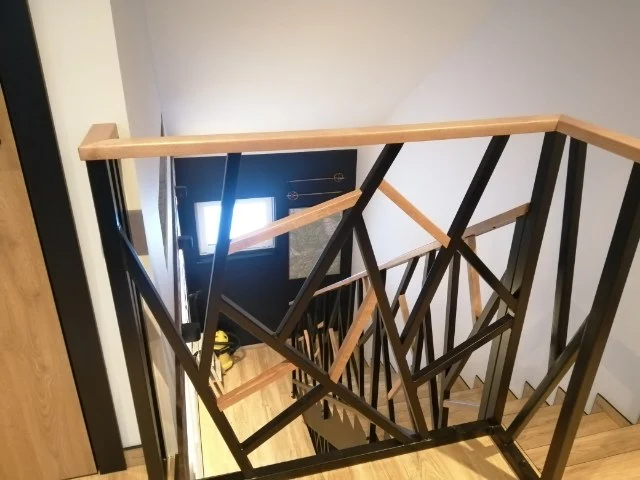
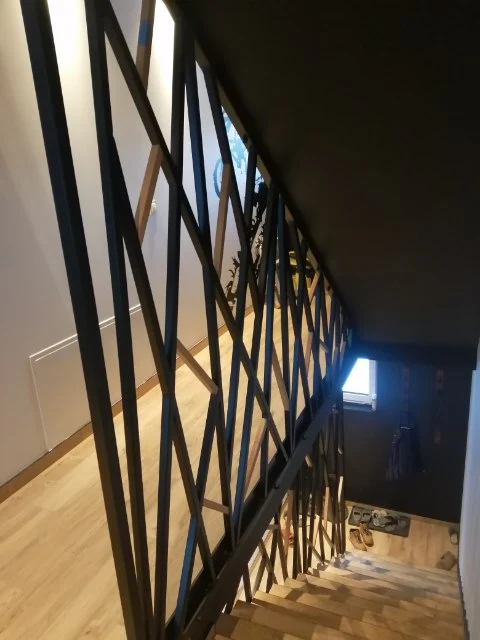
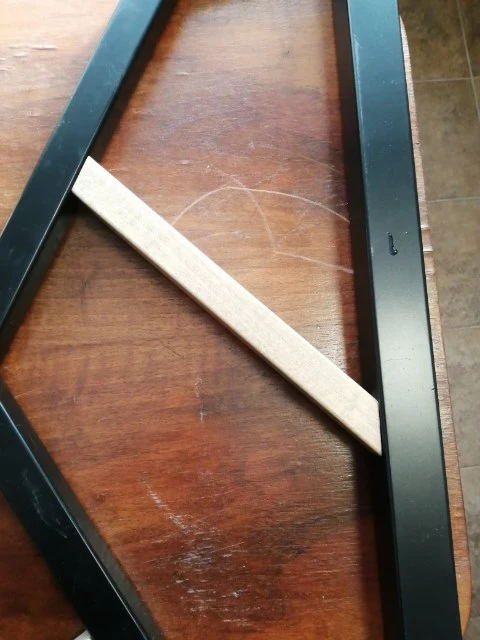
What can be learned from this project?
This example shows that adhesive bonding does not compete with mechanical fastening only in terms of joint strength. It can also solve a technological and aesthetic problem.
Installing the inserts without drilling made it possible to preserve the finished coating, avoid visible fasteners and modify the railing after it had already been installed at the customer’s site.
The project also shows why adhesive selection should not be based only on generic material descriptions such as “steel and wood”. In this case, one actual bonding surface was beech wood, while the other was the specific powder-coating layer applied to the steel. These are the surfaces that form the real adhesive joint.
FAQ – bonding wood to powder-coated steel
Can wood be bonded directly to powder-coated steel?
Yes, but in that case the adhesive bonds to the powder coating. The assessment must therefore include both the adhesion of the adhesive to the coating and the adhesion of the coating itself to the steel.
Does powder coating need to be sanded before bonding?
Not always. The surface must first be clean and appropriately prepared. Mechanical preparation should be used only when it is necessary and has been validated for the specific coating. Unnecessary sanding through to bare steel can damage the corrosion-protection layer.
Is LOCTITE EA 3430 suitable for wood and metal?
Yes. Henkel lists wood and metal among the substrate types suitable for this adhesive. In a real application, however, any surface finish — such as powder coating — also has to be included in the assessment.
Why was a transparent adhesive selected?
The railing was already a finished decorative component. A clear bond line helped preserve the appearance of the assembly and reduced the visual impact of any small, controlled squeeze-out.
Can the same method be used outdoors?
LOCTITE EA 3430 is described by Henkel as water-resistant, but an outdoor application must be assessed as a complete system: wood species and protection, powder coating, temperature range, moisture exposure, environmental conditions and joint geometry. The adhesive name alone is not enough to approve an outdoor application.
Project contractor
“Medispaw” Bielsko-Biała – Adam Chrobak
Tel. 573 481 352
Facebook: Medispaw
Do you have a similar assembly challenge?
If you need to join wood, metal, plastic or a coated component without additional screws or drilling, describe the materials, surface condition, joint geometry and service conditions. These details make it possible to select an adhesive and a suitable surface-preparation process.