




Choosing a dispensing gun or static mixer for a two-component adhesive in a 50, 200, 400 or 490 ml cartridge? Cartridge capacity and a 1:1, 2:1 or 10:1 mix ratio are only the starting point. Cartridge design, outlet connection, plunger configuration, mixer geometry and adhesive properties also determine the right choice.
First confirm mechanical compatibility between the cartridge, dispenser and mixer, then verify dispensing performance and mixing quality. A mixer that fits the cartridge may still fail to produce a sufficiently homogeneous mixture. An unsuitable mixer can also create excessive backpressure, inconsistent flow and curing problems.
This guide explains the differences between MIXPAC A, B, C, F and K systems, how to interpret designations such as MAH, MBQX and MFQX, and how to select a suitable dispenser. It also explains when to consider alternative mixers available from Melkib and how to assess them before introducing them into production.
Choosing a 2K static mixer and dispensing gun: key principles
- Identical cartridge capacities do not mean identical systems. Two 50 ml cartridges may require different connections and mixers.
- Adhesive mix ratio and dispenser mechanical advantage are different parameters. A 10:1 designation describes the component ratio, whereas 25:1 may describe the dispenser mechanism.
- Dispenser compatibility does not establish mixer compatibility. One gun may accommodate several cartridge families that require different mixing nozzles.
- More mixing elements do not always produce a better result. Geometry, diameter, component viscosity and flow resistance also matter.
- Compare original Medmix mixers and Melkib alternatives by their specifications and performance. Similar product codes do not guarantee identical mixing quality.
- In series production, consider the cost of the whole process. Alongside nozzle price, account for adhesive waste, replacement time and the risk of defective bonds.
Why is cartridge capacity alone insufficient for selecting a mixer?
Consider two 50 ml cartridges containing a two-component adhesive with a 2:1 mix ratio. One has a MIXPAC A-System connection and the other a B-System connection. In certain configurations, both can be used with the same dispenser, such as the COX MR 50. This does not mean they can use the same mixer.
An A-System cartridge requires a suitable mixer, such as an MAH or MAQ. B-System options include MBH and MBQ mixers. Their connection designs and the way they feed the components into the mixing section differ.
The same issue arises with larger cartridges. Two 400 ml packs may require MCH or MFH mixers despite having the same component ratio.
A description such as “mixer for a 50 ml, 2:1 cartridge” is insufficient for reliable selection. Identify the connection system first, then check mixer specifications and suitability for the particular adhesive.
How does a complete two-component adhesive dispensing system work?
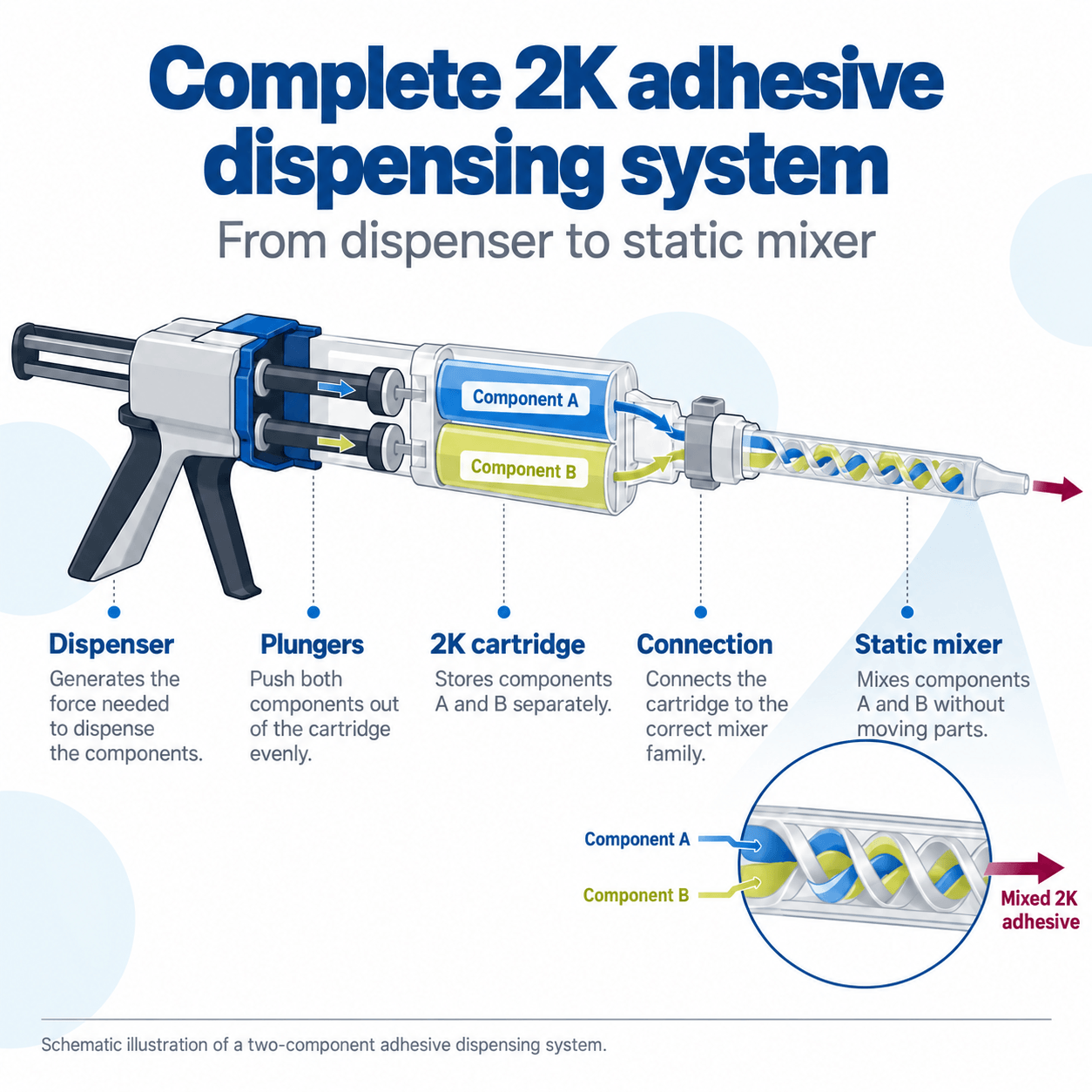
In a typical 2K cartridge system, components A and B are stored in separate chambers. The dispenser advances matching plungers, displacing both components in a ratio determined by the cartridge design and dispensing configuration.
The materials pass through the outlets into a static mixer. Fixed internal elements repeatedly divide, redistribute and recombine the component streams.
| Component | Function | Risks of incorrect selection |
|---|---|---|
| Cartridge and plungers | Store the components separately and allow them to be dispensed. | Incorrect ratio, leakage or cartridge damage. |
| Dispenser | Generates the force required to dispense the components. | Insufficient flow, overloading and inconsistent dispensing. |
| Connection | Connects the cartridge to the mixer and routes both components. | Failure to fit, leakage or component contamination. |
| Static mixer | Mixes the components as they flow through it. | An uneven mixture, excessive resistance or curing problems. |
| Outlet tip | Determines the application method and deposit shape. | Incorrect bead width or additional resistance. |
A static mixer cannot correct an incorrect dispensing ratio. If too much of one component enters the mixer, even an effective mixing geometry cannot restore the correct A:B ratio.
For general dispenser selection advice, see our article How to choose an adhesive dispenser. This guide focuses on compatibility within two-component systems.
How do you identify the cartridge and static mixer system?
Industrial 2K cartridge systems differ in outlet design, mixer attachment, capacity and available mix ratios.
The medmix MIXPAC range includes A, B, C, F, K and Blueline systems. The comparison below highlights their principal differences and links to relevant mixer families available from Melkib.
MIXPAC A, B, C, F and K systems: comparison and Melkib mixer links
| System | Example capacities | Characteristics | Mixers available from Melkib |
|---|---|---|---|
| A-System | 50 and 75 ml | Dedicated bayonet connection. | MAH, MAHX, MAQ – bayonet system |
| B-System | 25, 50 and 75 ml | Separate outlet channels that limit component contact before the mixer. | MBH, MBHX, MBQ, MBQX – B-System |
| C-System | 200 and 400 ml | Dedicated connection for larger cartridges, including bell connections. | MCH, MCHX, MCQ – bell connection |
| F-System | 200 and 400 ml | Connection with separate component feed channels. | MFH, MFHX, MFQ, MFQX – F-System |
| K-System | 2.5, 5 and 10 ml | System for small packs and dedicated dispensing assemblies. | MKH, MKHX – K-System |
| Blueline | 400 ml | System for demanding dispensing conditions, including high-viscosity materials. | Dedicated T-Mixers; select according to the manufacturer’s documentation. |
The table lists families and example configurations from the medmix MIXPAC Systems for Adhesives catalogue. It is not a comprehensive interchangeability chart. Individual systems include different connection and mixer variants.
A-System and B-System: how do 50 ml cartridge connections differ?
A-System works with suitable MAH and MAQ mixers, among others. B-System uses a different connection design with separate channels feeding the components into the mixer.
Separating the components reduces the risk of premature contact at the cartridge outlet. This matters when reactive material residues could cure at the connection.
Similar-looking mixers are not necessarily interchangeable. Check connection geometry, inlet design and the complete product designation.
C-System and F-System: how do larger cartridges differ?
C-System uses its own connection and corresponding mixer families, including MCH and MCQ. F-System has a different connection with separate component channels and works with suitable MFH and MFQ mixers, among others.
For a 400 or 490 ml F-System cartridge, do not select an MCH mixer simply because its length and diameter appear suitable.
Dedicated adapters can be used in some configurations, but compatibility of the complete assembly must be confirmed.
Ritter ACF: how can a connection also help protect the process?
Ritter offers the ACF system with coded connections and separate component channels. The design aims to reduce premature component contact and problems when storing or restarting a cartridge.
The system uses dedicated Helix and ORBIS mixers. The connection therefore serves both to secure the mixer and to help reduce dispensing errors.
For further information, see Ritter ACF Cartridge Systems.
How do you identify an unfamiliar 2K cartridge system?
If you do not know the connection designation, follow these steps:
- Identify the adhesive and manufacturer. Obtain the product’s technical data sheet.
- Read the capacity and mix ratio. For example, 50 ml at 2:1 or 490 ml at 10:1.
- Inspect the cartridge outlet. Check the attachment method and channel arrangement.
- Inspect the rear of the cartridge. The chamber and plunger layout can help identify the system.
- Find the existing mixer’s product code. The complete designation makes selection much easier.
- Compare the details with the catalogue. If any uncertainty remains, confirm compatibility with the supplier.
Do not force a mixer into place. If it cannot be seated and secured correctly, the connection may be incompatible.
How do you read MAH, MBQX, MCH, MFH and MFQX mixer codes?
Mixer designations provide information about the system, geometry, nominal diameter, number of elements and tip type.
For example, MAH, MBH and MFH identify corresponding Helix mixer families, while MAQ, MBQ and MFQ identify Quadro families.
In selected series, an additional X identifies a design variant often intended for 4:1 and 10:1 ratios. It does not automatically indicate higher quality or greater performance.
Example: MAH 05-17T
The designation Medmix MAH 05-17T can be interpreted as follows:
- MAH – Helix mixer for suitable A-System cartridges.
- 05 – nominal diameter family; the medmix catalogue specifies an internal diameter of 5.4 mm for this variant.
- 17 – number of mixing elements.
- T – stepped outlet tip, or Stepped Tip.
The nominal diameter code does not always equal the exact internal channel diameter. It should also not be confused with the outlet tip diameter.
Example: MBQX 05-16L
MBQX 05-16L is a B-System Quadro mixer intended for suitable 4:1 and 10:1 configurations.
The code 05 refers to the nominal diameter, 16 indicates the number of mixing elements, and L identifies a Luer-type tip.
Luer Slip and Luer Lock tips are not automatically interchangeable. If the application requires a particular dispensing needle, confirm its attachment method.
Melkib also offers the alternative mixer MXBQX516L for suitable B-System cartridges with 4:1 and 10:1 ratios.
Example: MFQX 08-24T
Medmix MFQX 08-24T is a Quadro mixer for suitable F-System cartridges with 4:1 and 10:1 ratios.
Its designation identifies nominal diameter family 08, 24 mixing elements and a type T stepped tip.
The alternative mixer available from Melkib carries the code MXFQX824T.
Similar designations help identify variants, but mechanical compatibility and mixing performance must be confirmed before changing the mixer.
How do you choose a dispensing gun for a two-component adhesive?
Once you have identified the cartridge, select a dispenser. Key factors include its dimensions, supported ratios, plunger compatibility and the force required to dispense the material.
A 2:1 adhesive mix ratio and an 18:1 dispenser ratio: what is the difference?
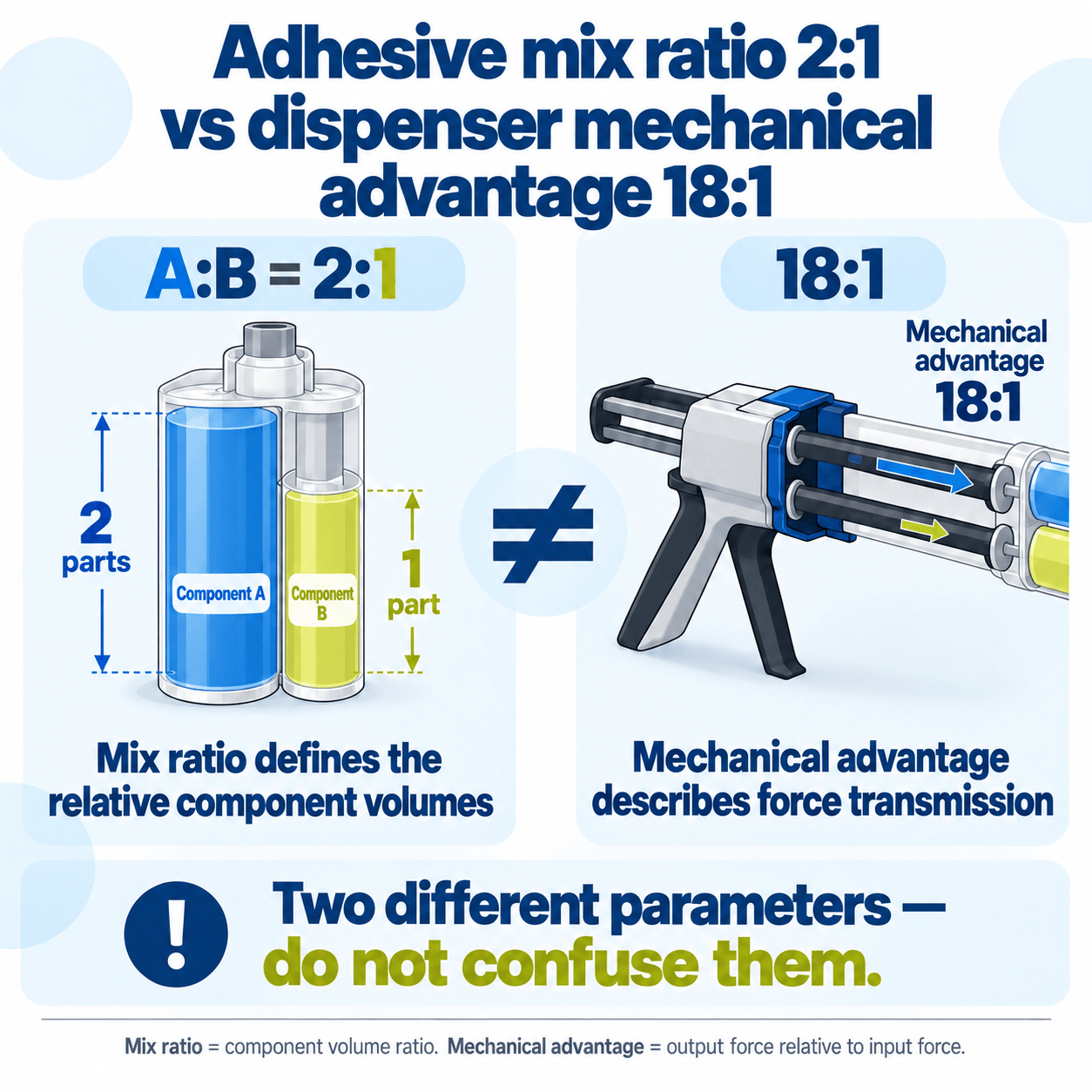
In typical 2K cartridges, the mix ratio describes the components by volume. A 2:1 ratio means two parts of one component to one part of the other. A 10:1 ratio means ten parts to one.
The volume ratio is not necessarily the same as the weight ratio. If the components have different densities, their ratio by mass will differ.
The dispenser’s mechanical advantage describes how its mechanism transfers the operator’s force to the plungers.
An 18:1 marking on a dispenser does not mean it is intended for an adhesive with an 18:1 mix ratio. A correctly configured model may support several cartridge ratios if the manufacturer specifies them.
Example COX dispensers: specification comparison
| Parameter | COX MR 50 | COX VBM 400 MR | COX VBM 400X MR |
|---|---|---|---|
| Cartridge format | 50 ml and selected 75 ml cartridges | 400 ml and suitable 490 ml variants | 400 ml |
| Mechanical advantage | 12:1 | 18:1 | 25:1 |
| Maximum thrust | 2.5 kN | 3.5 kN | 4.5 kN |
| Example mix ratios | 1:1, 2:1, 4:1, 10:1 | 1:1, 2:1, 4:1, 10:1 | 1:1, 2:1, 4:1, 10:1 |
The COX VBM 400 MR available from Melkib, for example, has an 18:1 mechanical advantage and a maximum thrust of 3.5 kN.
Do not confuse the VBM 400 MR with the VBM 400X MR. The latter has a 25:1 mechanical advantage and a maximum thrust of 4.5 kN.
The listed mix ratios apply to specific configurations. They do not mean that every cartridge of a given capacity fits every model.
Sources: COX MR 50 and COX VBM 400X MR.
Does greater dispensing force always mean a better gun?
No. Greater force can help dispense viscous materials, but it will not solve the problem of a blocked or incorrectly selected mixer.
If resistance results from an undersized nozzle, high viscosity or an unsuitable material temperature, using a more powerful gun may increase the risk of overloading the cartridge.
Never exceed the permissible load of any system component. A dispenser’s maximum thrust does not mean every cartridge can safely withstand that load.
Manual, pneumatic or battery-powered dispenser?
A correctly selected manual gun is often sufficient for repairs, short runs and occasional application.
For frequent dispensing or high-viscosity materials, consider a pneumatic or battery-powered dispenser. It can reduce operator effort and help maintain a consistent flow.
For series production requiring precise control of the dispensed quantity, a machine-based dispensing system may be appropriate.
Explore more options in our adhesive and sealant dispensing guns category.
How do you match a static mixer to adhesive properties?
A suitable mixer must meet three requirements: fit the cartridge, deliver the required mixing quality and allow dispensing at an acceptable resistance.
How does a static mixer work?
A static mixer has no rotating impeller. The components flow through fixed elements that repeatedly divide, deform and recombine the material streams.
Flow is laminar in many viscous industrial adhesives. Mixing relies primarily on redistributing the components and increasing the contact area between them.
In a simplified model, each successive element can double the number of material layers. After 12 elements, this gives 4,096 theoretical layers. It does not mean that a 12-element mixer is sufficient for every adhesive.
The mechanism is explained in medmix’s Introduction into Mixing Technology.
Helix, Quadro, T-Mixer, X-Grid and ORBIS: how do they differ?
| Type | Operating principle | Selection considerations |
|---|---|---|
| Helix | Helical elements divide and rotate the material streams. | Suitable for a wide range of applications; diameter and element count must be selected appropriately. |
| Quadro | Repeatedly divides and rearranges the streams within the channel. | Can provide effective mixing in a compact design. |
| T-Mixer | Uses a specially designed flow path. | Used in specific systems requiring suitable flow rates and mixing quality. |
| X-Grid | Moves material between the channel walls and its core. | Used, among other applications, for materials with more demanding mixing characteristics. |
| ORBIS | Dedicated geometry developed by Ritter. | Designed for effective mixing and reduced flow resistance. |
No single geometry is best for every 2K adhesive. Selection must account for the particular material, mixing quality, flow resistance and waste volume.

How many elements should a static mixer have?
The required element count depends on adhesive type, A:B ratio, component viscosities, rheological properties and mixer geometry.
There is no universal rule that every epoxy needs 24 elements or every acrylic needs 10.
Indicative element counts according to Nordson EFD
| Material type | Range given by Nordson EFD |
|---|---|
| Acrylic adhesives | 8–10 |
| Polyurethane foams | 10–24 |
| Epoxy adhesives | 15–24 |
| Silicones | 20–30 |
| Polysulfide materials | 24–32 |
| Polyurethanes | 24–36 |
Source: Nordson EFD – How to Select a Static Mixer for Two-Part Fluids.
These ranges are guidance, not universal requirements. The manufacturer of a particular adhesive may recommend a mixer outside them.
Do more elements always improve mixing?
No. A higher element count can improve homogeneity, but usually also increases flow resistance and, in many designs, mixer length and internal volume.
Two mixers with 24 elements each may perform differently if their diameters and geometries differ.
The right mixer delivers the required homogeneity at an acceptable dispensing resistance.
How do diameter and viscosity affect mixer selection?
A mixer’s internal diameter strongly influences flow resistance. With high viscosity and a high required flow rate, an excessively narrow mixer can cause a substantial pressure drop.
Symptoms include slow flow, increased dispensing force and inconsistent application.
Increasing the diameter may reduce resistance, but it also changes the mixing conditions and often the quantity of material retained inside the nozzle. Any such change therefore requires verification of mixing quality.
Why does the viscosity difference between components A and B matter?
If one component is a thick, heavily filled resin and the other has a much lower viscosity, the two materials may behave differently during flow.
This makes uniform component distribution more difficult, especially at strongly unequal volume ratios such as 10:1.
Many industrial adhesives also exhibit non-Newtonian behaviour: their viscosity can change with shear rate and temperature.
A single viscosity value from a technical data sheet is therefore not always sufficient for a complete mixer assessment.
Numerical studies of viscoelastic flow also demonstrate the importance of rheology, including Comparing flows of FENE-P, sPTT, and Giesekus model fluids in a helical static mixer. This research does not validate any particular commercial product.
How can you check whether a mixer mixes the adhesive correctly?
A compatible connection and steady flow alone do not fully establish process quality.
A uniform colour and the absence of visible streaks do not guarantee the correct ratio or the required bond strength.
Depending on the application, appropriate dispensing trials, cure checks and tests of bond properties may be necessary.
Mixer assessment also considers pressure drop, shear and retained material volume. For further information, see medmix – Parameters to Quantify Mixing Efficiency of Static Mixers.
Why is the adhesive difficult to dispense or failing to cure correctly?
Application problems may originate in the cartridge, plungers, dispenser, mixer, material temperature or system start-up procedure.
| Symptom | Possible cause | What to check |
|---|---|---|
| Mixer does not fit | Different connection system or incorrect variant. | Complete mixer code, outlet type and compatibility documentation. |
| Adhesive is difficult to dispense | High viscosity, low temperature or excessive mixer resistance. | Temperature, diameter, element count and dispenser capability. |
| Uneven flow | Plunger problems, trapped air or a blockage. | Cartridge seating, plunger condition and flow path. |
| Streaks in the mixture | Insufficient mixing or incorrect initial component flow. | Mixer, component ratio and start-up procedure. |
| Incorrect curing | Incorrect ratio, inadequate mixing, temperature or a material problem. | Technical data sheet, process conditions and dispensing quality. |
| No flow after a pause | Viscosity increase or cured material inside the mixer. | Pause duration, mixer condition and manufacturer’s recommendations. |
| Leakage at the connection | Incorrect assembly, damage or excessive pressure. | Component compatibility, attachment condition and flow resistance. |
Safety: stop dispensing if you suspect a blocked mixer, encounter excessive resistance or observe cartridge deformation. Do not exceed the system’s permissible force or pressure. Before disassembly, release the load as instructed by the equipment manufacturer and use the required protective measures.
Curing problems can also have other causes. See our guide Why do epoxy bonds fail in mass production?.
Start diagnosis with the symptom and check the entire system, rather than the mixer alone.
How do you start up a 2K cartridge with a static mixer correctly?
Even a correctly selected assembly can perform poorly if it is not prepared properly.
The initial flow may involve temporary deviations from the intended dispensing ratio. Adhesive manufacturers may therefore require the component flow to be balanced and an initial quantity of material to be discarded.
Practical system preparation procedure
- Check the adhesive. Confirm its shelf life, temperature and recommended application conditions.
- Confirm compatibility. Check the cartridge, mix ratio, plunger configuration and mixer.
- Inspect the packaging. Do not use a damaged or leaking cartridge.
- Prepare the outlets. Remove the closure and balance the initial component flow if required by the adhesive instructions.
- Fit the mixer. Check that it is seated correctly and the connection is secured.
- Purge the initial material. Discard the quantity specified by the manufacturer or the approved procedure.
- Check the mixture. Carry out the appropriate visual and process checks.
- Begin application. Maintain the established conditions and monitor pause durations.
Melkib video: how do you prepare a 2K adhesive for application?
This video demonstrates preparation of a two-component adhesive using Melkib methacrylate adhesives as examples. It covers balancing the initial component flow, fitting the mixing nozzle and preparing the bonding surface.
The video demonstrates specific products. The detailed start-up procedure and the quantity discarded during preparation must follow the requirements of the adhesive being used.
Do you always need to discard the first 5 or 10 ml of adhesive?
There is no universal quantity. The required volume depends on the cartridge, mixer, adhesive properties and preparation procedure.
For example, the documentation for 3M Scotch-Weld DP8610NS calls for levelling the initial piston positions and purging material through the mixer until a homogeneous mixture is obtained.
This does not mean the same procedure is suitable for every two-component material.
Does pot life determine the permissible dispensing pause?
Not always. Pot life may be measured for a specified material volume and temperature.
It does not necessarily equal the time the adhesive can remain in a mixer without a risk of blockage.
Where pauses are frequent, follow the manufacturer’s recommendations or establish a permissible idle time through process trials. Never force cured material through the mixer.
Source: 3M – Dispensing Guide for Scotch-Weld DP8610NS.
How much adhesive remains in the mixer, and how does it affect costs?
In series production, mixer selection affects material costs as well as quality.
Some adhesive remains inside the nozzle after application. If the mixer is replaced with its contents still inside, that material becomes waste.
Where replacement is frequent, compare mixer internal volumes as well as purchase prices.
A 3M example: two mixers for the same adhesive
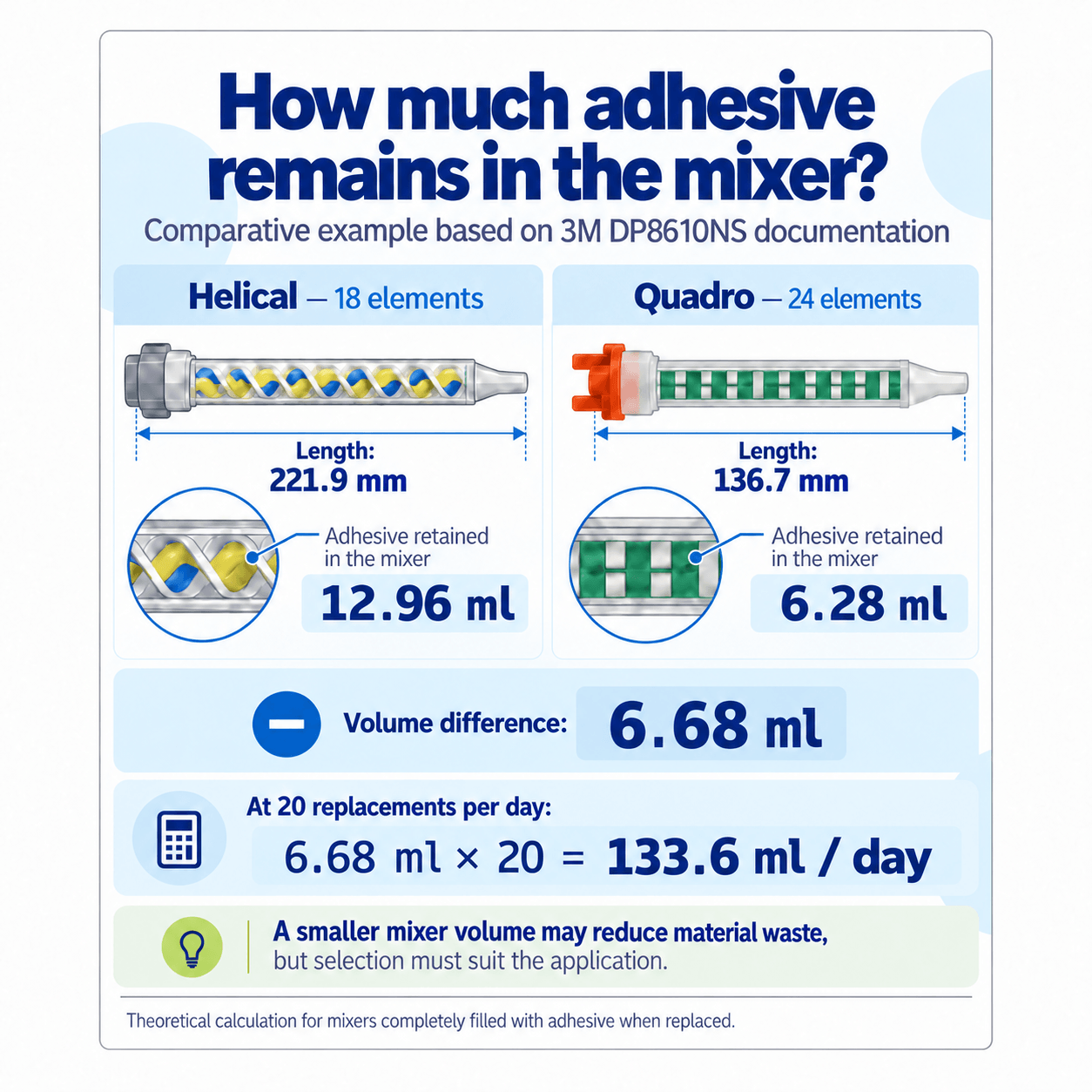
The documentation for 3M Scotch-Weld DP8610NS presents two different mixers for the larger cartridge format.
| Parameter | Helical | Quadro |
|---|---|---|
| Number of elements | 18 | 24 |
| Length | 221.9 mm | 136.7 mm |
| Internal volume | 12.96 ml | 6.28 ml |
| 3M product number | 7100015959 | 7100066351 |
Source: 3M – Dispensing Guide DP8610NS, Mixing Nozzles table.
In this specific comparison, the Quadro mixer has more elements but is shorter and has a smaller internal volume.
The difference is 6.68 ml per mixer.
How much material could mixer replacement save?
Assuming 20 replacements per day, a difference of 6.68 ml amounts to 133.6 ml per day. Over 22 working days, this is approximately 2.94 litres per month.
This is a theoretical calculation for two specific mixers that are completely filled with adhesive when replaced. Actual waste depends on the working method and how fully the nozzles are filled.
This example does not imply that every Quadro mixer is more economical than every Helix mixer.
How do you calculate the total cost of mixers?
A simplified calculation for the cost of material retained in nozzles is:
Waste cost = retained adhesive volume [ml] × number of replacements × adhesive cost per ml [PLN/ml].
Then add mixer purchase costs, material discarded during start-up, replacement time and any costs associated with production rejects.
A cheaper mixer does not always mean a cheaper process. Equally, a more expensive mixer may be unnecessary if an alternative meets the requirements and is properly approved.
Original Medmix mixers or Melkib alternatives: which should you choose?
In manufacturing plants, static mixers are consumables. At high usage levels, unit price, availability and supply consistency can significantly affect process costs.
Melkib offers both original Medmix MIXPAC mixers and alternative products for popular cartridge systems.
The original mixer recommended by the adhesive manufacturer is a sensible starting point, particularly for a process that has already been approved.
Consider an alternative mixer when seeking to optimise costs, improve availability or standardise dispensing accessories. Compatibility and mixing quality must first be confirmed.
Medmix MBQX 05-16L and MFQX 08-24T: example Melkib alternatives
| Original Medmix mixer | Melkib alternative | System | Identifying specifications |
|---|---|---|---|
| MBQX 05-16L | MXBQX516L – view B-System mixers | B-System | Quadro, 16 elements, diameter family 05, L tip, 4:1 and 10:1 configurations. |
| MFQX 08-24T | MXFQX824T | F-System | Quadro, 24 elements, diameter family 08, T tip, 4:1 and 10:1 configurations. |
These pairs belong to corresponding design families. The comparison is not a declaration of full process equivalence. Before adopting an alternative, verify connection compatibility, geometry, flow resistance and adhesive curing quality.
The range also includes Melkib MXFQX1024T, a different F-System Quadro mixer variant. A larger diameter should not be treated as an automatic guarantee of better mixing.
How do you interpret alternative Melkib mixer codes?
Selected families use product codes that reference the designations of popular MIXPAC mixers.
- Medmix MBQX 05-16L → Melkib MXBQX516L
- Medmix MFQX 08-24T → Melkib MXFQX824T
These designations help identify the design family and basic specifications, but do not independently confirm complete interchangeability.
Do not derive additional product codes from this pattern without checking that the corresponding product is actually available.
When should you retain the original, and when should you consider an alternative?
An original Medmix mixer is a natural choice where the adhesive manufacturer recommends a particular part number or it forms part of an approved process.
A Melkib alternative may be beneficial for high usage, supply consolidation or lower operating costs, provided its performance is confirmed.
Compare mixing quality, waste volume, dispensing force and availability alongside price.
Explore original and alternative static mixers available from Melkib.
How do you select a complete 2K assembly? Two practical examples
Example 1: 50 ml cartridge, 2:1 ratio, B-System
A process engineer uses an adhesive in a 50 ml cartridge with a B-System connection and a 2:1 mix ratio by volume.
First, select a dispenser compatible with the cartridge format and plunger configuration. The COX MR 50 is one model to consider for suitable 50 ml cartridges.
Next, select an appropriate B-System mixer, for example from the MBH or MBQ family.
If the adhesive manufacturer specifies a mixer, use it as the starting point. Otherwise, assess geometry, element count and mixing quality.
Key point: matching the 50 ml capacity and 2:1 ratio is insufficient. Connection compatibility and process performance must also be confirmed.
Example 2: 490 ml cartridge, 10:1 ratio, F-System
The dispenser must accommodate the cartridge format and the plunger configuration required for the 10:1 ratio.
MFHX or MFQX mixers may be considered for suitable F-System configurations.
One example is the MFQX 08-24T or an appropriately verified MXFQX824T alternative.
For a high-viscosity adhesive, also check mixer diameter, required dispensing force and target flow rate.
Key point: do not base selection on the 10:1 ratio alone. The specific material documentation and actual operating conditions are essential.
How should an alternative mixer be assessed before production use?
Changing a mixer can affect dispensing resistance, mixture homogeneity and the properties of the cured bond.
Before implementation, carry out a comparative trial:
- Establish a reference. Record the adhesive, temperature, dispenser, existing mixer and dispensing settings.
- Confirm mechanical compatibility. Check the attachment, inlets, diameter, element count and outlet tip.
- Compare dispensing performance. Assess flow rate, resistance and bead stability under comparable conditions.
- Check quality. Verify mixing, curing and the required bond properties.
- Calculate total cost. Include mixers, waste, replacement time and any rework.
- Document the result. Record the approved product code and operating conditions for the new mixer.
For technically critical applications, mechanical testing or formal approval of the process change may be necessary.
A similar appearance and the absence of visible streaks do not establish full process equivalence.
Pre-purchase checklist: what information should you prepare?
If you are unsure which assembly to choose, prepare:
- Adhesive name, manufacturer and technical data sheet.
- Cartridge capacity, mix ratio and system.
- Photographs of the cartridge outlet and rear.
- Current mixer designation and dispenser model.
- Material temperature, required quantity and bead shape.
- Application frequency and process type.
- A description of the problem or intended improvement. Examples include excessive resistance, uneven mixing, high nozzle consumption costs or the need for an alternative.
The most useful information is the adhesive name, technical data sheet, connection photograph, component ratio and current mixer code.
FAQ: 2K dispensing guns and static mixers
Does every 50 ml dispensing gun fit every 50 ml cartridge?
No. Check cartridge geometry, mix ratio and plunger compatibility. Capacity alone is insufficient.
Can a B-System mixer be fitted to an A-System cartridge?
Do not assume so. The systems use different connection designs. Any adapter arrangement requires confirmation of compatibility across the entire assembly.
Is the MBQX 05-16L suitable for a 1:1 adhesive?
Do not select it on attachment compatibility alone. The MBQX 05-16L variant is intended for specific configurations, including 4:1 and 10:1. For a 1:1 adhesive, select a suitable variant according to the manufacturer’s documentation.
Can an epoxy mixer also be used for polyurethane?
It may be suitable under certain conditions, but this requires verification. Differences in viscosity, mix ratio and rheological properties may require another geometry.
Does a longer mixer always mix better?
No. Element count is only one factor. Geometry, diameter and material properties also matter. A longer mixer may increase flow resistance.
Can the mixer tip be cut?
Some mixers have stepped tips that allow the outlet to be adjusted. Follow the manufacturer’s instructions and do not remove mixing elements without assessing the effect on the process.
Can a static mixer be reused?
Continued use depends on the adhesive, pause duration and manufacturer’s instructions. If material has cured inside the mixer, replacement is usually necessary. Do not force cured material through it.
Can Melkib alternative mixers replace original Medmix products?
Selected Melkib mixers, including MXBQX516L and MXFQX824T, can be considered as alternatives for corresponding Medmix families. Before implementation, confirm mechanical compatibility and mixing quality with the specific adhesive.
Why does the adhesive fail to cure despite using the correct mixer?
Possible causes include an incorrect ratio, incorrect initial component flow, a material problem or unsuitable curing conditions. Check the entire process, not just the nozzle.
Summary: selecting a static mixer and dispenser for a 2K adhesive
Start by identifying the specific adhesive and cartridge.
First, establish mechanical compatibility: capacity, cartridge format, component ratio, plungers, dispenser and mixer connection.
Then verify process performance: mixer geometry, element count, diameter, component viscosity, required flow rate and mixing quality.
For series production, also consider nozzle replacement frequency, material waste and total process cost.
The original mixer recommended by the adhesive manufacturer is a sound starting point. Alternatives can help optimise costs and improve availability, but their suitability must be properly verified.
The essential rule: a mixer must both fit the cartridge and mix the specific adhesive correctly under actual operating conditions.
Choosing a 2K dispensing gun and mixer: technical support from Melkib
Unsure which mixer fits your cartridge? Need to select a dispenser or find an alternative to your current Medmix mixer?
Send us the adhesive name, technical data sheet, component ratio and a photograph showing the cartridge outlet. If you already use a mixer, include its designation.
We can help identify the system, narrow down compatible products and establish whether a process trial is needed before implementation.
For regular consumption, we can also help compare original Medmix mixers with alternatives available from Melkib, taking account of costs, supply conditions and quality requirements.
Explore static mixers for 2K adhesives and dispensing guns, or contact Melkib technical support.
Technical sources and manufacturer documentation
- medmix – MIXPAC Systems for Adhesives, Two-Component Industry Solutions. Catalogue of A, B, C, F, K and Blueline systems, mixer families and dispensers.
- medmix – Introduction into Mixing Technology. Principles of laminar mixing and mixer geometry characteristics.
- medmix – Parameters to Quantify Mixing Efficiency of Static Mixers. Mixing quality, pressure drop and material waste parameters.
- Nordson EFD – How to Select a Static Mixer for Two-Part Fluids. Mixer selection methodology and indicative element counts.
- COX – MR 50 and COX – VBM 400X MR. Manual dispenser specifications, mechanical advantage and thrust.
- Ritter – ACF Cartridge Systems. Coded connections and mixing system design.
- 3M – Dispensing Guide for Scotch-Weld DP8610NS. Cartridge start-up procedure and a specification comparison of two mixers.
- Comparing flows of FENE-P, sPTT, and Giesekus model fluids in a helical static mixer, Journal of Non-Newtonian Fluid Mechanics, 2024. Research into the effects of viscoelastic properties on flow in a helical mixer.
- Melkib – How to use a two-component adhesive: Melkib methacrylate adhesives, application instructions. Instructional video demonstrating 2K adhesive preparation and application.