




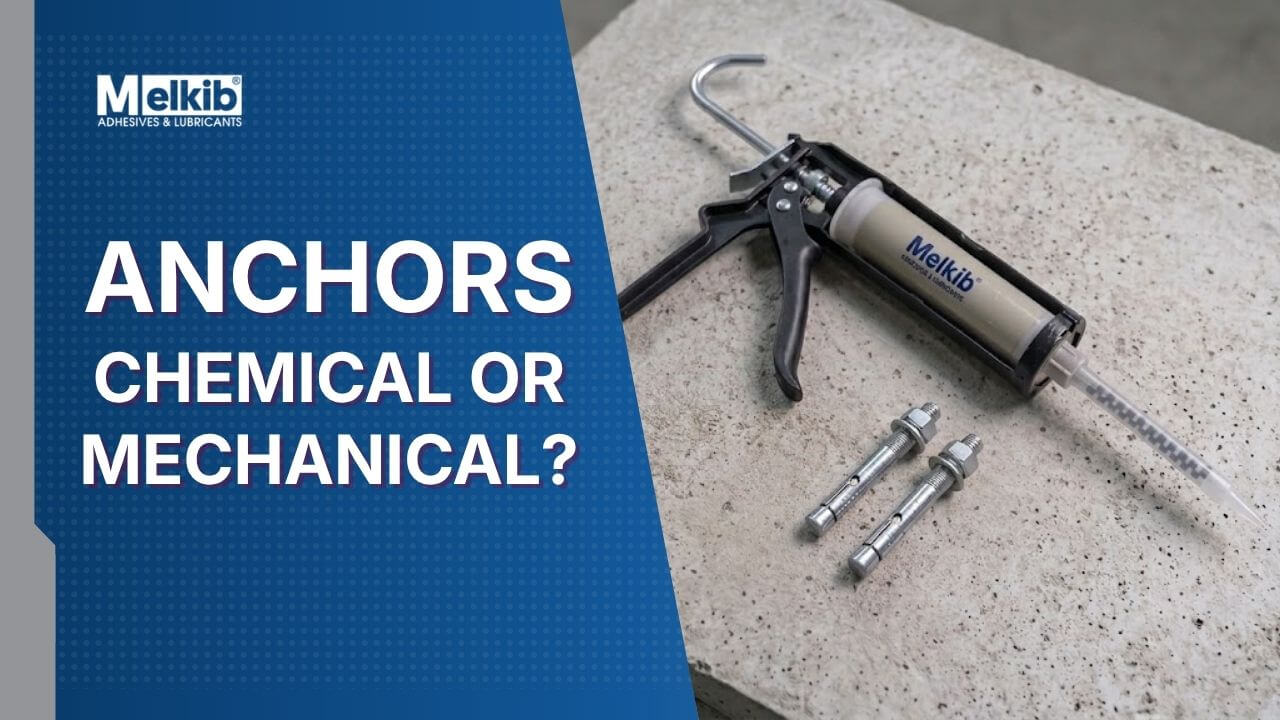
There is no universal rule saying that a chemical anchor is always stronger or that a mechanical anchor is always the faster and simpler option. The correct choice depends on the base material, its condition, the applied load, edge distances, anchor spacing, environmental conditions and the required installation speed.
In practice, mechanical anchors are often the most efficient solution for fast, repeatable installation in a suitable concrete substrate. Chemical anchoring systems offer greater flexibility where expansion forces need to be limited, edge distances are small, masonry is involved or the anchorage geometry is more demanding.
For structural and safety-critical fixings, the final selection must always be based on the documentation and approval of the specific anchoring system, together with the required design calculations.
Key points at a glance
- A chemical anchor is not inherently stronger than a mechanical anchor.
- Both technologies can provide high-performance fixings in concrete when correctly selected.
- Chemical systems often provide more design flexibility where edge distances or anchor spacing are limited because they do not rely on conventional expansion during setting.
- For hollow masonry, injection systems are frequently used together with an approved anchor sleeve.
- A mechanical anchor does not require a chemical curing period before the fixing can be used in accordance with its installation requirements.
- Chemical anchoring requires additional attention to temperature, working time, borehole preparation and dispensing equipment.
- For structural fixings, always verify the relevant ETA, manufacturer documentation and project-specific calculations.
What is the difference between a chemical anchor and a mechanical anchor?
The most useful question is not simply “Which anchor is stronger?” but rather “Which anchoring principle is better suited to this substrate, load case and installation geometry?”
If installation speed is a priority and the fixing is being made in suitable concrete with sufficient edge distances and spacing, a mechanical anchor can be the most practical choice. Where reduced expansion forces, masonry substrates, restricted geometry or greater flexibility of embedment are important, an injection system may offer a better engineering solution.
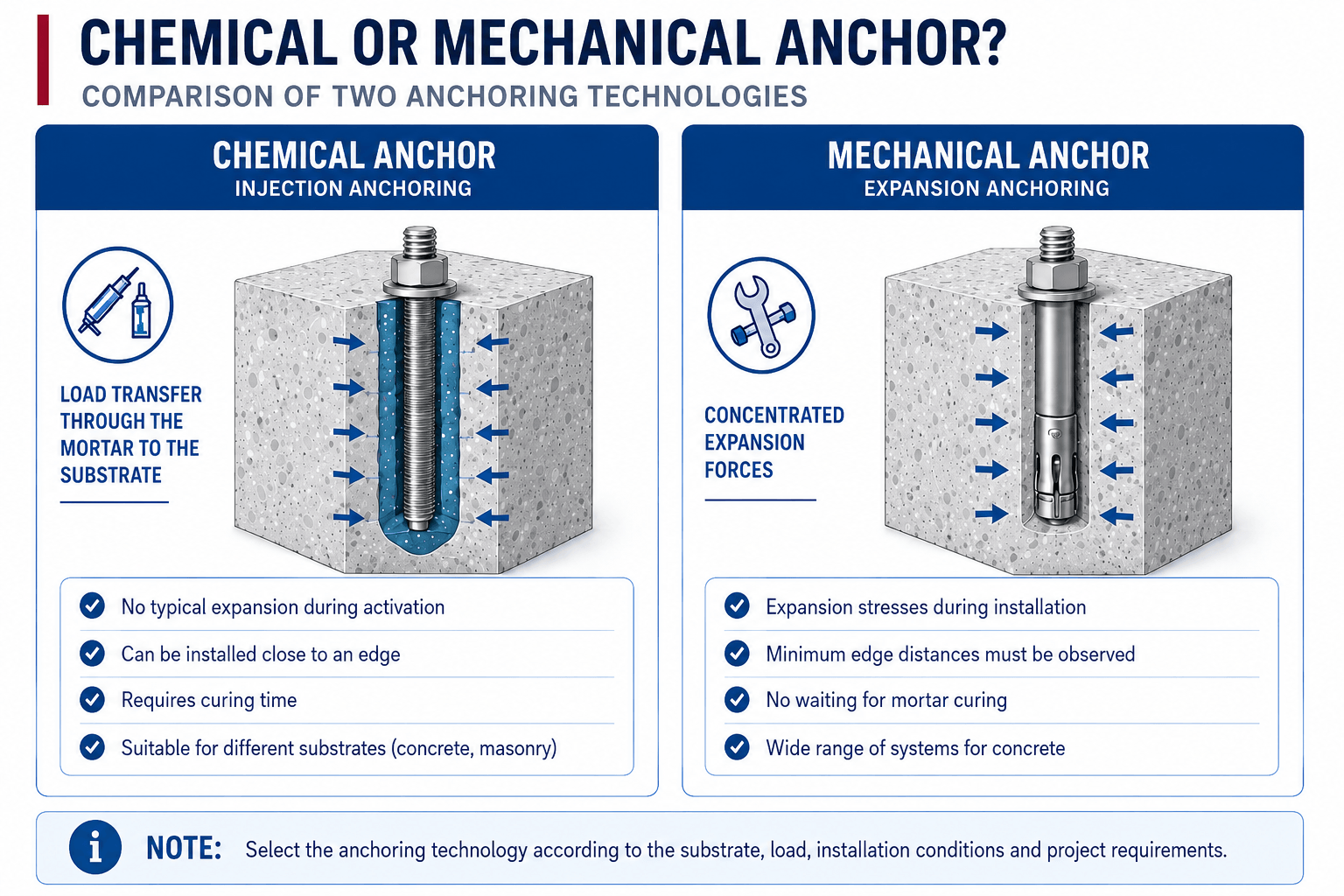
The fundamental difference lies in how the load is transferred into the base material and in the installation process required to create a reliable fixing.
How does a mechanical anchor work?
A mechanical anchor is installed in a drilled hole and transfers load through a mechanical fastening principle such as expansion, friction, interlocking or a combination of these mechanisms.
In a typical bolt anchor, tightening the nut draws a cone into an expansion clip. The clip is forced against the wall of the drilled hole, creating the mechanical action required to transfer the load into the concrete.
This group includes bolt anchors, sleeve anchors and other steel anchoring systems. One of their main practical advantages is installation speed. Once a suitable anchor has been correctly installed and activated, there is no resin curing period to wait for.
That does not mean that mechanical anchoring is insensitive to installation quality. The manufacturer's requirements for drill diameter, hole depth, embedment depth, anchor spacing, edge distance, substrate thickness and installation torque must still be followed.
The fischer range illustrates why individual mechanical anchors should never be treated as interchangeable. The FBN II family is designed for economical anchoring in non-cracked concrete, whereas products from the FAZ II range are designed for demanding applications that include cracked concrete within their relevant approvals.
Melkib offers selected FBN II bolt anchors for applications in non-cracked concrete.
...
You can explore a wider range in the mechanical fasteners category.
How does a chemical anchoring system work?
With an injection system, a suitable mortar is dispensed into a correctly prepared borehole and an approved anchoring element, such as a threaded anchor rod, is then inserted. After the mortar has cured, the fixing transfers load through the complete system consisting of the base material, injection mortar and anchoring element.
For this reason, the term “chemical anchor” should not be understood as referring only to a cartridge of resin. In technically demanding applications, it is a complete anchoring system that can include the injection mortar, anchor rod, internal threaded anchor, anchor sleeve, static mixer and other approved accessories.
Unlike conventional expansion anchors, bonded anchoring does not depend on expanding a mechanical sleeve against the borehole wall during activation. This can provide additional flexibility where anchor spacing and edge distances are restricted. The system still has defined minimum distances and installation requirements, so “non-expanding” must never be interpreted as “no design limits”.
A good example is the fischer FIS V Plus family. It is a styrene-free, two-component vinyl ester hybrid injection system with approved applications in concrete and masonry when used with the appropriate system components.
...
See the full Melkib range of chemical anchors.
Chemical vs mechanical anchors – key differences
| Criterion | Mechanical anchor | Chemical anchor |
|---|---|---|
| Load-transfer principle | Mechanical expansion, friction, interlocking or another mechanism defined by the anchor design | Load transfer through the bonded system consisting of the substrate, mortar and anchoring element |
| Installation speed | Often very fast | Requires mortar dispensing and insertion of the anchoring element |
| Time before loading | No resin curing period | Loading is permitted only after the specified curing time |
| Expansion forces during setting | Present in expansion-type systems | No conventional mechanical expansion during activation |
| Fixing close to an edge | Possible within the limits specified for the individual anchor | Often provides greater design flexibility, but minimum edge distances still apply |
| Concrete applications | Very wide range of systems available | Very wide range of systems available |
| Hollow masonry | Depends on the fixing type; conventional concrete anchors are not universal masonry fixings | Approved injection systems are available, often in combination with an anchor sleeve |
| Embedment depth | Defined by the anchor design and approval | Some systems provide a wider range of approved embedment configurations |
| Borehole cleaning | Requirements depend on the specific system | Particularly important and must follow the approved installation procedure |
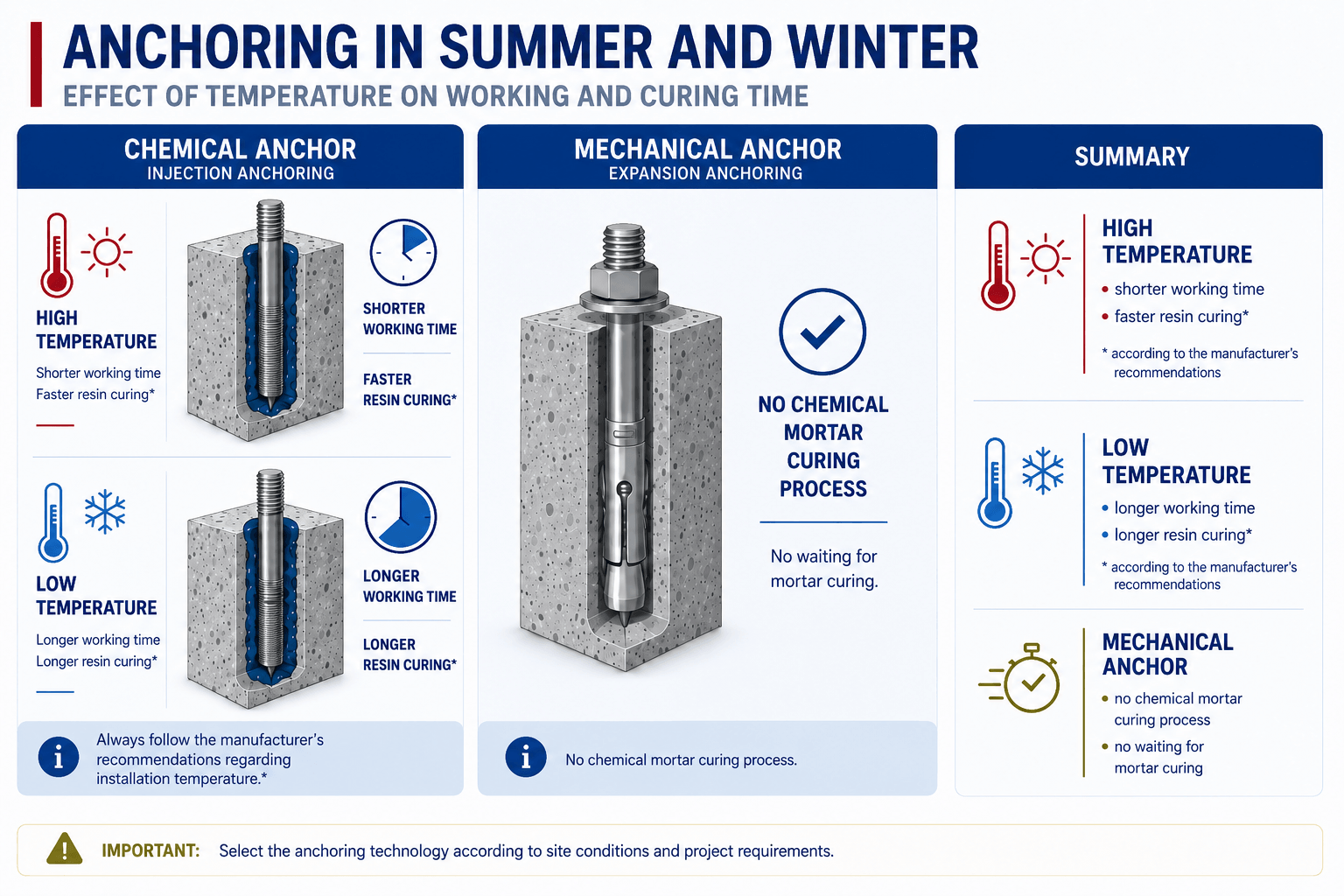
| Effect of installation temperature | No chemical mortar curing process | Temperature affects working and curing times |
| Storage | No resin shelf life, although corrosion and damage must still be prevented | Mortar has a defined shelf life and specified storage conditions |
| Cost per fixing | Often straightforward to calculate for repetitive installation | Also depends on mortar consumption, anchoring element and accessories |
| High loads | High-performance systems are available | High-performance systems are available |
Chemical or mechanical anchor? A practical selection guide
| Application | Typical starting point | What must be verified |
|---|---|---|
| Fast, repetitive installation in concrete | Often a mechanical anchor | Concrete condition, spacing, edge distances, activation method and ETA scope |
| Fixing close to an edge | Often a chemical anchoring system | The approved minimum edge distance still applies |
| Solid brick | Depends on the system; chemical anchoring is often considered | Masonry type and approved field of application |
| Hollow or perforated brick | Often an injection system with an appropriate sleeve | Brick type, anchor sleeve, mortar and anchoring element |
| High structural load | Either technology may be suitable | The complete anchoring system must be designed for the actual load case |
| Fixing must be available for loading without resin curing | Usually a mechanical anchor | The anchor still has to be suitable for the substrate and design load |
| Unusual anchorage geometry | Often a chemical system | The configuration must be covered by the relevant documentation |
| Large number of identical fixings | Often a mechanical anchor | Repeatable drilling and correct installation procedure |
| Old or unidentified masonry | Assess the substrate first | Site testing or pull-out testing may be required |
| Installation in hot conditions | Depends on the application and system | For injection mortars, working time becomes particularly important |
| Installation in cold conditions | A mechanical anchor may simplify site planning | For chemical systems, check permitted substrate temperature and curing time |
When is a mechanical anchor the better choice?
A mechanical anchor is often the logical starting point when the substrate is concrete with known properties, the required edge distances and spacing can be maintained, and installation speed is important.
Typical applications include repetitive fixing of steelwork, brackets, railings, service installations and certain types of machinery. Where dozens or hundreds of similar anchors have to be installed, avoiding a chemical curing stage can significantly simplify site logistics.
Example: fixing a steel structure to concrete
If the concrete, edge distances, anchor spacing and design loads fall within the approved range of a suitable mechanical anchor, the installation can be fast and highly repeatable.
A bonded system may still be preferable where the available geometry, required embedment depth, anchor spacing or other project constraints make an injection system more appropriate.
When should you consider a chemical anchor?
Chemical anchoring becomes particularly attractive where the geometry of the fixing makes a conventional expansion anchor difficult to use, or where the base material is not solid concrete.
Typical examples include small edge distances, limited anchor spacing, certain solid and hollow masonry substrates, deeper anchorage configurations and applications using threaded anchor rods or internal threaded elements.
Injection systems are also available for demanding structural loads. However, a random cartridge combined with an arbitrary threaded rod does not automatically constitute an approved structural anchoring system.
You need to establish which mortar, anchoring element, base material and installation procedure are assessed together as a system.
The fischer FIS V Plus family is one example of a system that can be configured for different applications in concrete and masonry. Melkib offers the fischer FIS V Plus 300 T injection mortar.
What do you need to install a chemical anchor?
This is one of the most important practical differences between the two technologies. A mechanical anchor is supplied as a fastening element ready for installation, whereas an injection system requires several components and tools to be prepared before work starts.
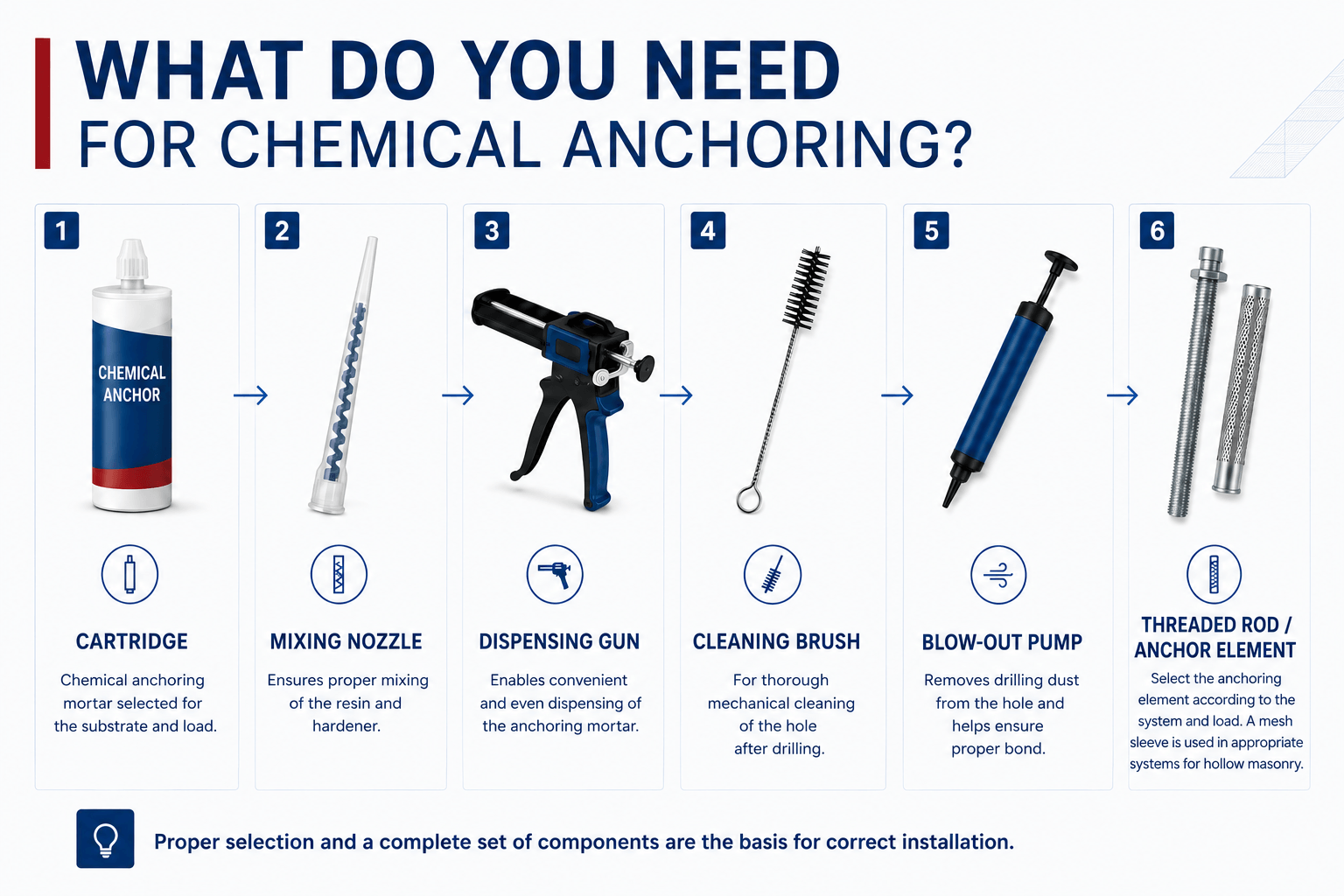
Depending on the mortar, cartridge and base material, the installation may require:
- a suitable injection mortar,
- an approved anchor rod or other anchoring element,
- a static mixer designed for the selected cartridge,
- a compatible dispensing gun,
- equipment for cleaning the drilled hole,
- an approved anchor sleeve where required for hollow or perforated masonry.
Do not assume that any dispenser or mixer will fit any chemical anchor cartridge. Cartridge design, mixing ratio and dispensing system must be compatible with the selected product.
If you are building a complete installation kit, see Melkib's range of chemical anchor guns. The individual dispenser still needs to be selected for the cartridge format and dispensing system being used.
Why should installers carry spare static mixers?
In a two-component injection mortar, the resin and hardener remain separated in the cartridge until they pass through the static mixer. The material inside the mixer then begins to react.
If work is interrupted for long enough, the mixed mortar can cure inside the nozzle. Before work is resumed, the mixer may need to be replaced in accordance with the manufacturer's instructions.
For larger jobs, carrying spare static mixers is therefore a practical part of site preparation, particularly when work is divided into stages or interruptions are likely.
Borehole cleaning is part of the anchoring system
Dust left inside a drilled hole can interfere with the intended bond between the mortar and the base material. However, there is no single cleaning procedure that can safely be applied to every injection mortar and every drilled hole.
The drilling method, brush type, blow-out equipment and number of cleaning cycles must follow the installation instructions for the specific system.
Chemical or mechanical anchor for concrete?
Non-cracked concrete
In non-cracked concrete, both mechanical and bonded anchoring systems may be suitable. The decision depends on the design load, concrete member thickness, edge distances, anchor spacing, environmental exposure and installation requirements.
The fischer FBN II is an example of a bolt anchor designed for economical fixings in non-cracked concrete. The product family also offers different embedment options, which illustrates why individual anchor variants must be checked against the project rather than selected only by diameter.
Cracked concrete
Anchoring in cracked concrete requires particular attention. Not every mechanical anchor and not every injection system is assessed for use in cracked concrete.
The relevant European Technical Assessment and manufacturer documentation need to be checked for the exact system being considered.
The fischer FAZ II family includes mechanical anchors designed for demanding fixings in cracked concrete. Chemical systems such as FIS V Plus and FIS EM Plus have their own assessed fields of application and system configurations.
That does not make these systems automatically interchangeable. The approved configuration, substrate, anchoring element and design conditions still have to match the project.
What should you use in solid brick and hollow masonry?
A mechanical anchor designed for solid concrete should not automatically be transferred to hollow brick or perforated masonry. The substrate geometry and the mechanism by which the load enters the building material are fundamentally different.
For many hollow masonry applications, an injection system with a suitable anchor sleeve and approved anchoring element is used.
The sleeve controls how the injection mortar is distributed within the hollow material. When the anchoring element is inserted, the mortar is pushed through the sleeve structure and forms the connection required by the system.
Example: anchoring in perforated brick
Simply filling an open cavity with resin and inserting an arbitrary threaded rod is not an appropriate design method.
The base material must first be identified. A system approved for that type of masonry can then be selected together with the specified mortar, anchor sleeve and anchoring element.
The fischer FIS H K, for example, is a system component designed for mortar-efficient installation of suitable threaded rods and internally threaded anchors in perforated brick masonry. The compatible mortars and anchoring elements are defined by the relevant system documentation.
The drilling method can also be critical. In hollow masonry, impact drilling may damage thin internal webs or alter the borehole geometry. Follow the installation method specified for the actual anchoring system.
What if the masonry is old or unknown?
A chemical anchor does not automatically compensate for weak or degraded masonry. The substrate itself may become the weakest component of the fixing.
Where the masonry type, condition or strength cannot be reliably established from the design documentation, trial fixings and on-site pull-out testing may be appropriate.
Anchoring close to an edge – why chemical systems can offer more flexibility
Many mechanical anchors work by expansion. During activation, the expansion element applies pressure to the wall of the drilled hole and introduces forces into the surrounding concrete.
As the anchor approaches an edge, the available concrete volume becomes increasingly important. The actual minimum edge distance must therefore be checked for the selected anchor and load case.
Bonded anchoring does not use the same conventional expansion mechanism during setting, which means that chemical systems can often offer more favourable solutions where the available edge distance or anchor spacing is restricted.
This does not mean that chemical anchors can be installed at any distance from an edge. Bonded systems also have defined minimum edge distances and spacing requirements.
Example: balustrade close to the edge of a concrete slab
Instead of assuming that “chemical is safer”, compare a specific mechanical anchor with a specific injection system for the real edge distance, slab thickness, concrete condition and applied load.
The relevant technical documentation and design calculations determine which option is appropriate.
Heavy loads – is a chemical anchor stronger?
A chemical anchor cannot generally be described as stronger than a mechanical anchor. Both technologies include systems intended for high structural loads.
The load-bearing capacity of an anchorage is determined by the complete system, including:
- the type and condition of the base material,
- anchor or rod diameter,
- effective embedment depth,
- anchor material and corrosion protection,
- anchor spacing,
- edge distance,
- load direction and load type,
- environmental exposure,
- installation quality.
Comparing two products only by threaded-rod diameter or by the label “chemical” versus “mechanical” therefore gives an incomplete picture.
Chemical anchoring in hot weather
Temperature has a direct effect on the reaction of an injection mortar. As installation temperature increases, the available working time can become considerably shorter. A procedure that works comfortably in moderate conditions may therefore become difficult to execute correctly on a hot summer site.
The key factor is not simply the weather forecast. The temperature limits and processing conditions stated for the specific mortar must be respected, including the relevant substrate and material temperatures.
The fischer FIS V Plus family includes variants designed for different installation conditions. FIS VS Plus Low Speed provides an extended processing time at higher application temperatures and is also useful for greater borehole depths. The FIS VW Plus High Speed variant has a shorter hardening time and is intended to support faster work at low temperatures.
Melkib offers the fischer FIS VS Plus Low Speed 300 T for applications where additional processing time is required in hot conditions.
For a more detailed explanation, see our dedicated guide: Anchoring in Heat: How to Avoid Summer Installation Mistakes. It explains how high temperatures affect working time, site organisation and installation accuracy.
Anchoring in cold weather – chemical or mechanical?
Low temperature is particularly important for bonded anchors because the curing reaction changes as conditions become colder. Depending on the mortar, the time required before the anchorage can be loaded may increase substantially.
A mechanical anchor does not require a chemical resin-curing process, which can simplify work planning in cold conditions. The anchor's own installation and substrate requirements still remain fully applicable.
This does not mean that chemical anchoring is unsuitable for winter work. Injection-mortar families can include formulations developed for faster curing at lower installation temperatures. The correct variant must be selected from the actual manufacturer documentation.
Storage and shelf life – an important practical difference
Storage is often overlooked when chemical and mechanical anchors are compared, yet it can make a real difference for installation teams and service vehicles.
A mechanical steel anchor does not have a resin shelf life. It still needs appropriate storage to prevent corrosion, contamination or physical damage.
Injection mortar, by contrast, is a chemical product with a specified shelf life and defined storage conditions. Material stored outside the manufacturer's specified range may no longer be suitable for use.
If cartridges have spent long periods in a service van, an uncontrolled warehouse or direct sunlight, their storage history should be checked against the manufacturer's requirements before the material is used.
For teams that perform anchoring work only occasionally, this can become an additional logistical advantage of mechanical anchoring – provided that a mechanical solution satisfies all of the technical requirements of the fixing.
Styrene-free mortars, odour and workplace safety
Modern injection systems can use styrene-free formulations. The fischer FIS V Plus is one example: the manufacturer describes it as a styrene-free vinyl ester hybrid mortar.
Removing styrene from the formulation avoids the characteristic styrene odour and can improve working comfort, particularly in enclosed areas. It does not mean that the product can be handled without normal chemical safety precautions.
Before use, consult the current Safety Data Sheet and product documentation, use the specified personal protective equipment and provide suitable working conditions.
What equipment is actually required?
| Item | Mechanical anchor | Chemical anchor |
|---|---|---|
| Anchoring element | Yes | Yes – compatible with the approved system |
| Drill and suitable drill bit | Yes | Yes |
| Tightening tool | Usually required | Depends on the anchoring configuration |
| Injection mortar | No | Yes |
| Dispenser | No | Depends on cartridge type |
| Static mixer | No | Yes for two-component cartridge systems |
| Borehole cleaning equipment | As required by the system | Particularly important and defined by the installation procedure |
| Anchor sleeve | Not applicable to conventional concrete bolt anchors | Used in selected systems for hollow or perforated masonry |
| Waiting period before loading | No resin curing period | Yes – according to the specified curing time |
Common mistakes when selecting and installing anchors
Selecting an anchor only by diameter
Two anchors with the same nominal diameter can use different load-transfer mechanisms, embedment depths, approvals and installation procedures. Diameter is only one part of the specification.
Assuming that chemical always means stronger
High-performance mechanical anchors can also carry demanding structural loads. The complete fixing system, rather than the general technology name, determines the result.
Failing to identify the base material
Non-cracked concrete, cracked concrete, solid brick, perforated brick and old masonry are not equivalent substrates. A fixing that is appropriate for one cannot automatically be transferred to another.
Ignoring edge distances and anchor spacing
It is not enough for the physical anchor to fit into the concrete member. Minimum edge distances and spacing are part of the technical design and depend on the specific anchoring system.
Incorrect borehole cleaning
With chemical anchors, residual drilling dust can reduce the quality of the bond. Follow the cleaning procedure specified for the actual system instead of applying one generic method to every mortar.
Using an arbitrary threaded rod
A cartridge of injection mortar and a threaded rod taken from general stock do not necessarily constitute an approved anchoring system. For structural applications, verify the anchoring element specified for the relevant system and ETA.
Ignoring installation temperature
Temperature affects the processing and curing of injection mortars. Hot conditions can shorten the available working time, while lower temperatures can extend the time required before loading.
Loading a bonded anchor too early
A rod inserted into fresh mortar is not yet a completed anchorage. The fixing should only be loaded after the required curing period for the actual product and installation conditions.
Checking only whether a product “has an ETA”
A European Technical Assessment describes assessed characteristics and applications for a specific product or system. The important question is not simply whether an ETA exists, but whether its scope covers the substrate, anchoring element, installation method and design conditions of the project.
fischer anchoring systems – how should you choose?
fischer offers both mechanical steel anchors and chemical fixing systems. Depending on the application, the range includes products such as FBN II and FAZ II bolt anchors, FH II high-performance anchors and FIS injection systems.
Do not begin the selection process with the product family name. First determine:
- the base material,
- whether the concrete is cracked or non-cracked where relevant,
- load direction and load characteristics,
- anchor layout,
- edge distances and spacing,
- environmental exposure,
- installation temperature,
- available installation tools and process.
Only after these conditions are known should the specific anchor and variant be selected.
FIS V Plus is an example of a flexible injection-mortar system for concrete and masonry. FIS EM Plus is an epoxy mortar intended for defined demanding applications, including post-installed rebar connections and anchoring in concrete.
This is why products commonly grouped under the term “chemical anchor” should not be assumed to offer identical properties or approvals.
Conclusion – chemical anchor or mechanical anchor?
There is no universal answer to the question chemical anchor or mechanical anchor?
If you are working in suitable concrete and need fast, repeatable installation without waiting for an injection mortar to cure, a correctly selected mechanical anchor may be the most efficient solution.
A chemical anchoring system can provide greater flexibility where the geometry is restrictive, edge distances are small, anchor spacing is limited or the substrate is suitable masonry. In hollow materials, approved systems can be used with dedicated anchor sleeves.
For high structural loads, do not assume that chemical anchoring automatically outperforms mechanical anchoring. Both technologies include systems for demanding applications.
The correct choice is ultimately determined by the specific anchoring system, base material, geometry, load case, environmental conditions and installation quality.
FAQ – chemical and mechanical anchors
Is a chemical anchor stronger than a mechanical anchor?
Not as a general rule. Both chemical and mechanical anchoring systems are available for high structural loads. Capacity depends on the substrate, effective embedment depth, edge distance, anchor spacing, load direction and installation quality.
Which is better for concrete: chemical or mechanical anchoring?
Both may be suitable. Mechanical anchors are often advantageous for fast, repetitive installation. Chemical anchors can offer additional flexibility where geometry, spacing or edge distances are restrictive. The condition of the concrete and the approval of the individual system must also be considered.
Can chemical anchors be used in hollow brick?
Yes, if the selected injection system is approved for the specific masonry substrate. Many systems use a dedicated anchor sleeve together with an approved mortar and anchoring element.
Are chemical anchors suitable close to a concrete edge?
They can often provide useful design options because they do not use conventional expansion during activation. However, every system still has minimum approved edge distances and anchor spacing.
How long must a chemical anchor cure before loading?
There is no universal curing time. It depends on the exact mortar, substrate temperature and installation conditions. Always use the curing-time table for the specific product.
Does the borehole have to be cleaned before chemical anchoring?
The hole must be prepared in accordance with the installation procedure for the selected anchoring system. Borehole cleaning can be critical to achieving the assessed performance.
Do chemical anchors require a special dispensing gun?
It depends on the cartridge design. The dispenser must be compatible with the cartridge format and dispensing system. A gun intended for one cartridge configuration cannot automatically be assumed to fit another.
Why does a static mixer sometimes need to be replaced?
Once the two components have been mixed, the mortar begins to react inside the nozzle. After a sufficiently long interruption, cured material can prevent further dispensing and the mixer may need to be replaced.
Can chemical anchors be installed in winter?
Yes, provided that the selected mortar is approved for the actual installation temperature. Lower temperature affects curing, so the permitted temperature range and the required waiting time before loading must be checked.
Which chemical anchor should be considered for hot-weather installation?
A system with an appropriately extended processing time can be advantageous. fischer FIS VS Plus Low Speed is designed to provide additional working time at higher processing temperatures. The product still has to match the substrate and anchoring configuration.
Can mechanical anchors be installed in cracked concrete?
Yes, if the specific mechanical anchor has the appropriate assessment for that application. Products from the fischer FAZ II family are examples of bolt anchors designed for use in cracked concrete, whereas the FBN II family is intended for non-cracked concrete within its relevant scope.
What does ETA mean for an anchor?
ETA stands for European Technical Assessment. For the designer or installer, the key point is not merely that an ETA exists, but whether its assessed application covers the actual base material, anchoring configuration and project conditions.
Need help selecting an anchoring system?
Send us the base material, expected load, available edge distance, environmental conditions and number of fixing points. With this information, it is much easier to narrow the choice to the appropriate anchoring technology and product family.
Technical sources
- fischer – Bolt anchor FBN II
- fischer – Bolt anchor FAZ II Classic
- fischer – Steel fixings and high-performance anchoring systems
- fischer – Injection mortar FIS V Plus
- fischer – Injection mortars including FIS EM Plus
- fischer – Injection anchor sleeve FIS H K
- EOTA – European Technical Assessment information