




What should you use to bond glass? The right adhesive depends primarily on the materials being joined and the type of bond you need: almost invisible, rigid and structural, or flexible. In practice, the main technologies include UV/VIS-curing adhesives, two-part epoxies, selected structural acrylic adhesives, neutral silicones, hybrid adhesives and MS polymers. Cyanoacrylate adhesives can be useful for small joints, but they are generally not the first choice for durable glass bonding.
Key information
- The durability of a glass bond depends to a large extent on surface cleanliness and condition, proper wetting and joint geometry.
- For a well-fitting glass-to-glass joint, a correctly selected transparent UV/VIS-curing adhesive will usually provide the least visible bond line.
- When bonding glass to a material with a different coefficient of thermal expansion, stresses caused by temperature changes must be considered. Such applications often require a bond that can accommodate at least some deformation.
- Not every acrylic or methacrylate adhesive is suitable for glass. Choose products for which the manufacturer explicitly confirms adhesion to glass and to the specific second substrate.
- Cyanoacrylates can quickly develop high initial adhesion to glass, but because of their rigidity and the possibility of reduced long-term durability, they are usually not preferred for large or safety-critical joints.
- Strength development may range from very fast light curing to 1K/2K chemical reactions or slower moisture curing. Always distinguish initial handling strength from full cure and final strength.
- Do not attempt an adhesive repair if the damaged glass performs a safety function and the repair is not permitted by the manufacturer or the applicable technical procedure.
Why is glass a demanding surface to bond?
Glass bonding requires particularly careful surface preparation because glass is smooth, non-porous and does not absorb adhesive in the way wood and other porous materials do. Joint durability therefore depends largely on adhesion at the glass–adhesive interface and on whether the adhesive has properly wetted the surface.
Even a very thin layer of grease, polishing compound, dust or moisture can reduce the actual contact between the adhesive and the glass. In glass-to-metal joints, differences in mechanical properties and thermal expansion introduce an additional source of stress. Research on glass–metal adhesive joints also shows that moisture and environmental ageing can significantly affect the durability of certain adhesive systems.[1][2]
Glass is also demanding from an aesthetic point of view. Air bubbles, an uneven adhesive layer, contamination or squeeze-out may remain visible through a transparent component. Adhesive selection should therefore consider not only strength, but also viscosity, bond-line thickness, positioning time and curing method.
Which types of adhesive are suitable for glass?
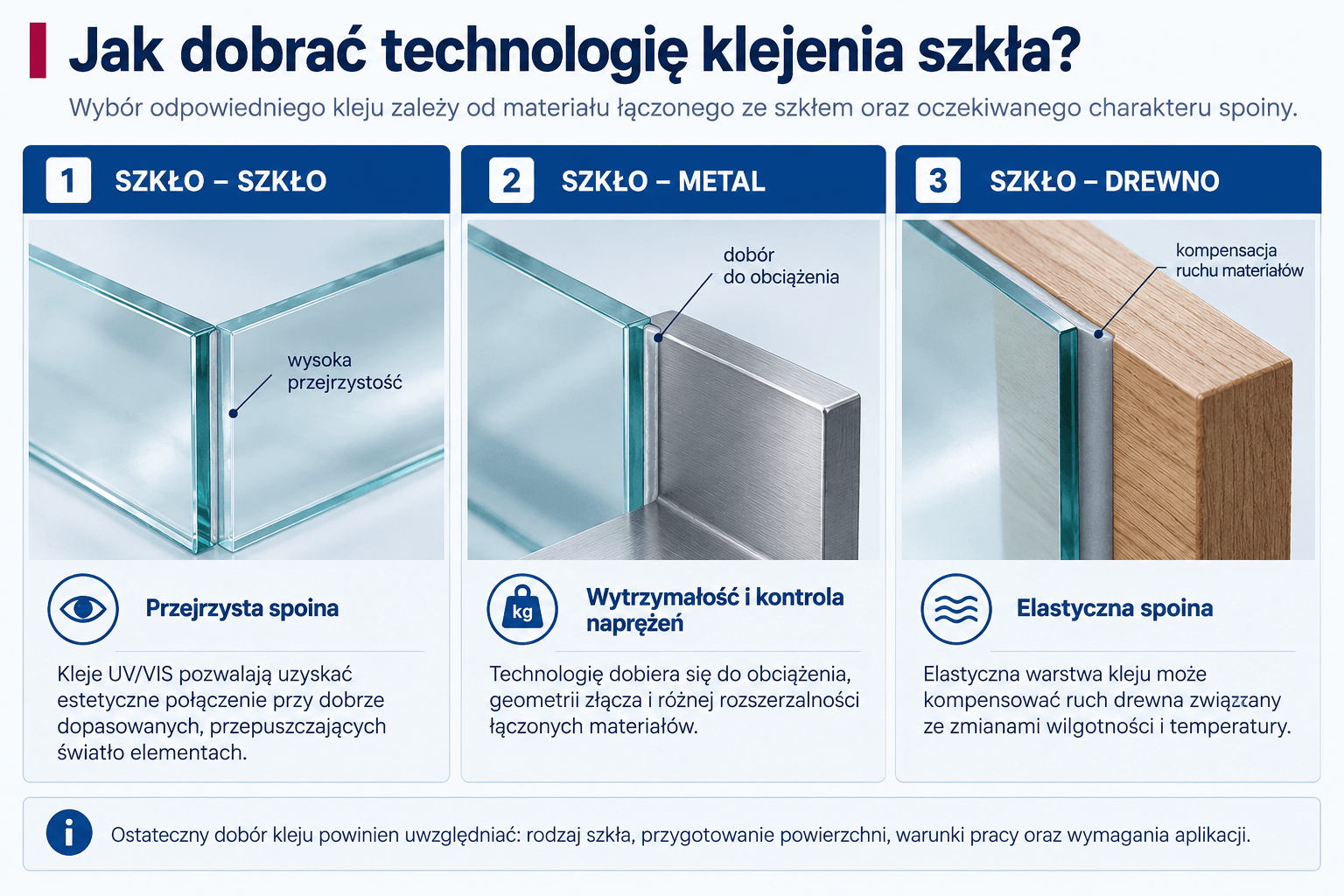
Which adhesive should you choose for glass? There is no single technology that is best for every joint. The decision depends on the second substrate, mechanical loads, required appearance, bond gap and service conditions. Within the Melkib range, a useful starting point is the glass adhesives category, followed by narrowing the choice to the appropriate technology.
- UV/VIS-curing adhesives – cure when exposed to light within the wavelength range specified in the product documentation. They can form very clear, thin bond lines and are particularly useful for aesthetic glass-to-glass and glass-to-metal joints where the required amount of light can reach the entire curing area.
- Two-part epoxy adhesives – cure after resin and hardener are mixed. They generally produce strong, relatively rigid bonds and can be suitable for structural joints or applications requiring controlled gap filling. With large glass joints involving materials with different thermal expansion, the rigidity of the cured adhesive must be taken into account.
- Structural acrylic and methacrylate adhesives – selected formulations can bond glass very effectively to metals, plastics and other substrates while providing high mechanical strength. However, this is not a property shared by every methacrylate adhesive. Many common MMA adhesives are primarily designed for metals, plastics and composites, so glass should only be bonded with a product whose manufacturer explicitly lists glass as a suitable substrate.[15][16]
- Cyanoacrylate adhesives – cure very rapidly on glass and can provide high initial strength in small, close-fitting joints. Because of their rapid cure, the relatively high rigidity of many formulations and the possibility of reduced long-term joint durability, they are generally not the preferred technology for large or safety-critical glass joints.[15]
- Neutral silicones – moisture-curing products that form flexible joints. They are used where the bond must accommodate movement. For mirrors, aquariums or structural glazing, use only products explicitly approved by the manufacturer for the intended application.
- Hybrid adhesives and MS polymers – usually cure with atmospheric moisture and form flexible joints that tolerate substrate movement well. They can be practical for mounting glass to metal, wood or construction substrates when the manufacturer confirms adhesion to the materials involved.
The term “universal adhesive” does not mean that a product will be optimal for glass. Final selection should be based on the technical documentation for the specific adhesive and, particularly for a critical joint, on testing with the actual production materials.
What should you use to bond glass to glass?
What should you use when bonding glass to glass if the bond line needs to be as inconspicuous as possible? With accurately fitting parts, a transparent UV/VIS adhesive designed for glass is usually one of the first technologies to consider, because it allows precise positioning before controlled curing begins.
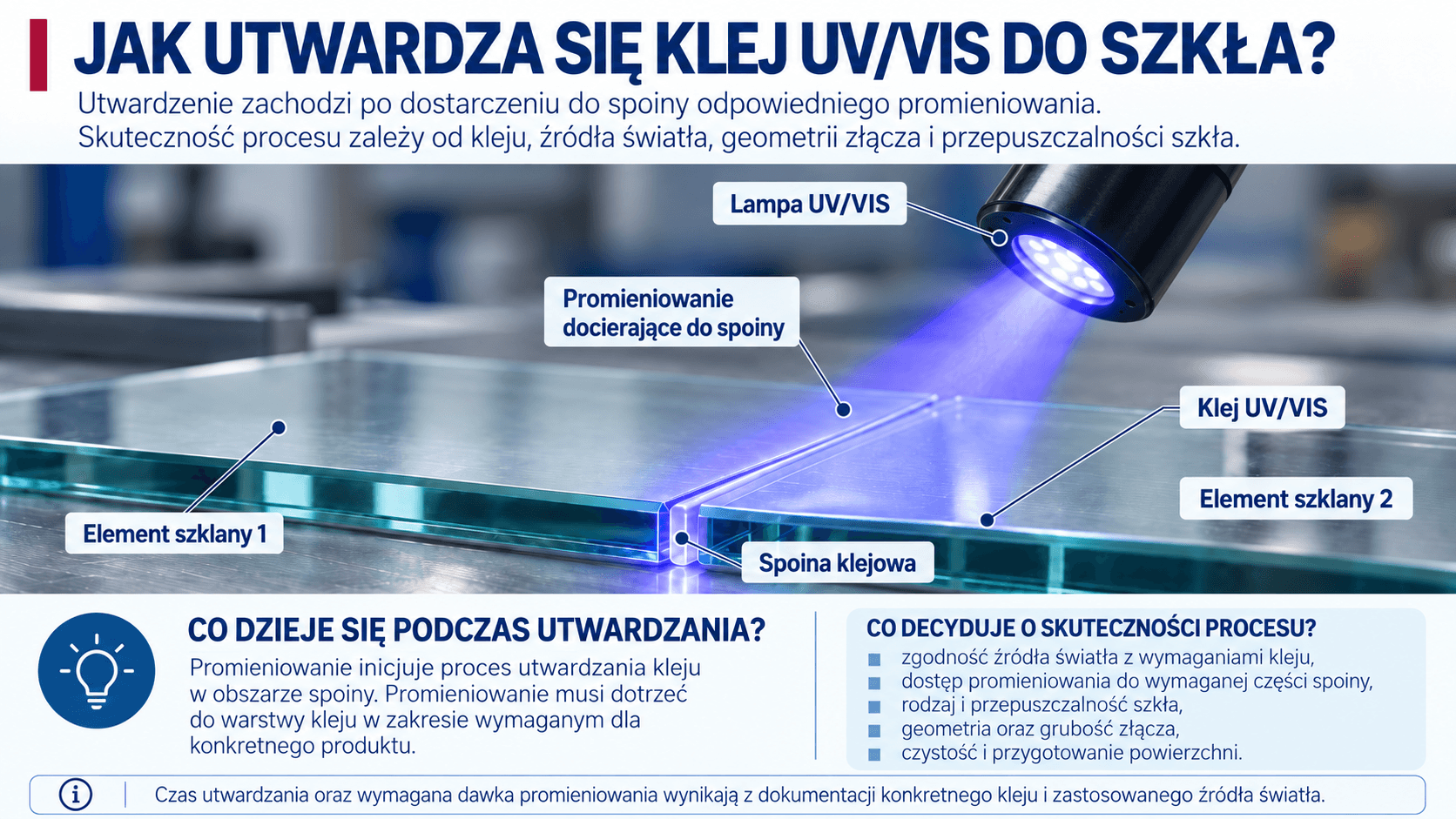
Bond clarity depends not only on the adhesive itself, but also on surface cleanliness, the absence of air bubbles, uniform bond-line thickness and correct curing. The light source must provide the wavelength range and intensity required by the adhesive. See light-curing adhesives and UV lamps for adhesive curing.
When repairing a crack, the edges should fit together as accurately as possible. If the gap varies along the crack, a piece of glass is missing or the damaged area requires filling, a thin-film UV adhesive may not be suitable. In that case, a system capable of handling the actual gap and required load must be selected.
If the joint is load-bearing, exposed to impact, large temperature changes or long-term moisture, appearance cannot be the only criterion. Research into glass bonding shows that factors such as the second substrate, adhesive-layer thickness and ageing can affect performance, and results obtained for one formulation should not automatically be applied to all UV adhesives.[3][4]
Adhesives and a curing lamp for precision glass bonding
What should you use to bond glass to metal?
Glass can be bonded to metal using an appropriate UV/VIS adhesive, epoxy, selected structural acrylic adhesive or flexible bonding system, depending on the load, size of the joint and the amount of movement the assembly must accommodate.
Do not assume that any MMA adhesive is suitable for glass simply because it is described as structural. Specialist structural acrylic adhesives for glass are available, including systems that are not MMA adhesives.[16]
Glass should be thoroughly cleaned and degreased. The metal may additionally require removal of corrosion, poorly bonded coatings, oxides or process contamination.
Depending on the adhesive, type of glass and required durability, the manufacturer may also specify a primer, adhesion promoter or particular surface treatment. Surface preparation can have an especially significant effect on joint durability in applications exposed to moisture.
Glass or metal should not automatically be abraded without considering the recommendations for the specific adhesive system. Mechanical preparation can improve adhesion for some systems, but in other cases it is unnecessary or may compromise the appearance of the joint.
A joint should be considered load-bearing when bond failure could result in loss of support, detachment of the component or uncontrolled transfer of load to other parts of the structure. In such cases, the adhesive must be treated as part of the structural system: the technology, joint geometry, surface preparation and inspection procedure must be selected accordingly, and the complete solution should then be validated by testing.
For less heavily loaded assembly joints, a flexible adhesive may be more suitable because it can better accommodate relative movement between glass and metal. The effects of moisture, environmental cycling and ageing on glass–metal joints are documented in the literature, although the degree of degradation depends on the specific adhesive chemistry and joint design.[1][2]
Adhesives for bonding glass to metal
What should you use to bond glass to wood?
For glass-to-wood joints, the adhesive generally needs to work well on both a non-porous and a porous surface while also tolerating the movement of wood caused by changes in moisture content. A flexible hybrid adhesive or MS polymer is a practical solution in many applications. A suitable two-part epoxy can also be used in certain cases.
Wood changes dimensions as its moisture content varies, whereas glass remains considerably more dimensionally stable. For this reason, a very rigid adhesive in a large joint can transfer substantial stresses to the glass edge or to the near-surface layer of the wood.
If the wood surface is uneven, large gaps should not simply be compensated for with an arbitrarily thick layer of adhesive unless the product is designed for this purpose. The bonding area should first be stabilised and prepared, dust removed, and the wood checked for loose fibres, oil, wax or poorly adhering coatings.
Where a more rigid system is appropriate, two-part epoxy adhesives may be considered, but only after confirming compatibility of the particular adhesive with both the glass and the type of wood involved.
How do you bond a mirror or glass panel to a wall?
For mirrors, use an adhesive specifically intended for mirror installation or a system whose manufacturer confirms compatibility with the reflective backing on the rear surface. For large panels, a flexible bond is often preferable because it can accommodate movement of the substrate and glass more effectively than a very rigid point bond.
Do not use an arbitrary silicone or general-purpose mounting adhesive. Some systems can affect the mirror's reflective coating or may not provide sufficient long-term adhesion. The safest selection criterion is an explicit statement from the manufacturer that the product is suitable for mirror installation.
The wall must be sound, clean, dry and free from dust, weak paint, chalking and grease. If the substrate is porous or friable, a primer specified by the adhesive manufacturer may be required. The glass must be supported against slipping until the adhesive reaches the necessary installation strength.
Adhesive alone is sufficient only when the fastening system, size and weight of the panel, substrate type and application method all fall within the limits specified by the manufacturer. For large or heavy panes, particularly those installed above pedestrian routes, additional mechanical retention should be considered.
For these applications, see also hybrid adhesives.
Flexible MS-polymer adhesives for glass and panel installation
How should glass be prepared before bonding?
Surface preparation is one of the most important requirements for durable glass bonding. The goal is to obtain a clean, dry surface free from grease, dust, polishing compounds and other intermediate layers that can reduce adhesion.
- Degrease the surface: use a cleaning agent compatible with the instructions for the specific adhesive. Many processes use fast-evaporating isopropyl alcohol for cleaning and degreasing. Avoid products that leave a film, polishing agents or arbitrary detergents unless their residues are thoroughly removed.
- Check surface readiness: the glass should be visibly clean, dry and free from streaks, dust and other contamination.
- Remove particles from the crack: loose fragments and dust should be removed without causing further chipping. If the cracked parts do not fit together in a stable manner, do not force them into alignment.
- Use mechanical preparation only when justified: abrasion may improve adhesion for selected systems, but it is not a universal recommendation and it changes the appearance of the glass. The effect of surface treatment depends on the specific adhesive and joint design.[3]
- Check primer requirements: if the manufacturer specifies a primer, adhesion promoter or other surface activation method, treat it as an integral part of the adhesive system.
- Consider temperature and moisture: do not begin bonding on a wet surface, on glass with condensation, or outside the application temperature range specified in the technical data sheet.
Isopropyl alcohol for cleaning and degreasing surfaces
How do you bond glass step by step?
- Prepare and clean the surfaces according to the requirements of the specific adhesive system.
- Apply the adhesive in the quantity and manner specified by the manufacturer so that assembly produces a continuous bonding area without unintended gaps or contamination.
- Bring the parts together without excessive sliding that could introduce air bubbles or squeeze out too much adhesive.
- Position and secure the joint in its working position using supports, fixtures or pressure appropriate to the technology.
- Cure the adhesive according to the technical data sheet: with UV/VIS light, a two-component chemical reaction, an activator or atmospheric moisture, depending on the technology.
- Remove excess adhesive only using a method approved by the manufacturer and at a stage of the process that will not damage the joint or glass surface.
- Inspect the result before applying load. Check bond-line continuity, component alignment, visible voids and the condition of the glass edges. Do not load the joint simply because the surface of the adhesive feels dry.
How long does glass adhesive take to cure?
The “drying time” of a glass adhesive depends on the technology and should not be confused with the time required to reach full bond strength. An adhesive may develop handling strength quickly but still require additional time or a complete curing cycle before it can safely be loaded.
With UV/VIS adhesives, curing speed depends on the product chemistry, wavelength and intensity of the light source, lamp distance, exposure time, light transmission through the glass and adhesive-layer thickness.
In two-part systems, important factors include formulation, mix ratio, quality of mixing and temperature. For silicones, one-part polyurethanes and MS polymers, humidity, temperature and the ability of moisture to diffuse into the bond line are important.
A thicker adhesive layer does not necessarily create a stronger joint. Each technology has an intended bond-line thickness range, and exceeding that range can alter both mechanical properties and curing time. Research on glass joints shows that adhesive-layer thickness can significantly affect mechanical behaviour, although the effect depends on the adhesive type.[3]
Supports or fixtures should only be removed once the adhesive has reached the condition specified by the manufacturer for the particular installation. Full use should begin only after the entire bond line has completed the required cure.
When should glass not be repaired with adhesive?
Not every damaged glass component should be repaired with adhesive. If the damaged item performs a safety function, forms part of a sealed glazing unit, is exposed to high temperatures or has direct food contact, the repair requires specific assessment or replacement of the component.
- Broken tempered glass: once its integrity has been lost, it should not be restored to its original function with adhesive. Replace the component with new glass of the required specification.
- Insulating glass unit: damage to the pane or the unit's seal affects airtightness and performance. Instead of carrying out a local adhesive repair, have the unit assessed by the manufacturer or replace it.
- Load-bearing or safety component: if failure could cause the glass to fall, result in injury or compromise a protective function, do not carry out an improvised repair. Use a solution engineered and validated for the relevant load.
- Vehicle glazing: installation and replacement of automotive glass require an adhesive system and procedure specifically designed for that application. See automotive glass adhesives and follow the system documentation.
- Glassware exposed to high temperature: cracked glass used with hot liquids, heating or substantial temperature changes should be replaced because an adhesive repair may not restore the original thermal and mechanical resistance.
- Direct food contact: do not use an arbitrary adhesive to repair a food-contact surface. The particular adhesive must have documentation confirming suitability for the intended contact conditions. In practice, replacing damaged drinking or food-use glassware is the safest option.[10]
Comparison of glass bonding technologies
The table below compares typical characteristics of the main technologies. The properties of a specific product must always be confirmed in its current technical documentation.
| Criterion | UV/VIS adhesives | Epoxy adhesives | Structural acrylic / methacrylate adhesives | Cyanoacrylate adhesives | Silicones and hybrid/MS adhesives |
|---|---|---|---|---|---|
| Bond-line transparency | Very high with transparent products and a thin, correctly cured bond line | From transparent to coloured, depending on the product | From transparent to coloured, depending on the specific formulation | Usually high in a very small bond line, although appearance depends on joint geometry and product | From transparent to opaque; flexibility is usually more important than invisibility |
| Mechanical strength | Can be high in a correctly designed joint | Often high; structural systems are available | Can be very high in systems specifically designed for glass | Good initially in small, close-fitting joints; long-term durability on glass may be limited | From assembly-grade to high depending on the system; the cured bond is generally more flexible |
| Bond flexibility | Low to moderate, depending on formulation | From rigid to modified, more flexible systems | Depends on formulation; systems with improved tolerance to impact and substrate movement are available | Usually low | High or very high in products designed for flexible bonding |
| Curing mechanism | UV/VIS light according to product requirements | Chemical reaction after mixing two components | Depends on the system: component reaction, activator or another curing mechanism | Very rapid polymerisation initiated by conditions at the substrate surface | Usually atmospheric moisture; two-part systems are also available |
| Time to full strength | Usually short after correct exposure, but dependent on light dose and formulation | From short to extended depending on the two-part system | Usually short to medium, depending on formulation | Very rapid fixture in a small gap, but long-term durability must be assessed separately | Usually longer for moisture-curing one-part systems; two-part systems may cure faster through the full bond thickness |
| Water resistance | Depends on product and quality of cure | Depends on formulation and surface preparation | Depends on product, surface preparation and ageing conditions | Variable; requires particular verification for long-term glass joints | Often good in products intended for exterior use, but must be confirmed for the specific system |
| Temperature resistance | Depends on the specific formulation | Depends on the specific system | Depends on the specific system | Depends on the product; differences in thermal expansion can place additional stress on a rigid bond | Depends on the product; flexibility helps accommodate thermal movement in the joint |
| Additional equipment required | Suitable curing lamp and eye/skin protection according to the procedure | Mixing and dispensing equipment appropriate to the package | Depending on the system: mixer, applicator or activator | Usually minimal application equipment | Gun/applicator; some systems may also require primer and temporary supports |
| Typical glass application | Aesthetic glass-to-glass and glass-to-metal bonding | Joints requiring strength, gap filling or curing without a lamp | Selected structural glass-to-metal or glass-to-other-substrate joints after compatibility of the specific product has been confirmed | Small, lightly loaded components where very fast fixture is the main requirement | Mirrors, panels, glass-to-metal, glass-to-wood and other joints requiring flexibility |
In most cases, the choice of technology is determined first by joint geometry and load, the second substrate and the required appearance of the bond. Process speed, ease of application and curing equipment should then be compared between technologies that meet those fundamental requirements.
Which glass adhesive should you choose for a specific application?
| Application | Recommendation |
|---|---|
| Repairing a glass ornament where the bond should remain almost invisible | A transparent UV/VIS adhesive for glass can provide a thin, unobtrusive bond line if the parts fit well and sufficient light reaches the entire curing area. |
| Bonding a glass tabletop to a metal base | A UV/VIS adhesive, suitable structural system designed for glass, or flexible assembly adhesive. The choice depends on geometry, load, component size and differences in thermal expansion. |
| Mounting a mirror or glass panel on a wall | A dedicated mirror adhesive or suitable MS/hybrid adhesive. The product should be compatible with the reflective backing and form a joint capable of accommodating substrate movement. |
| Bonding a glass component to a wooden base | Usually a flexible MS/hybrid adhesive; in selected applications, an appropriate two-part epoxy. The choice depends on joint size, wood movement and the need to accommodate surface irregularities. |
| Repairing an item that will be washed regularly | An adhesive with explicitly confirmed resistance to water and the cleaning agents used. A general claim such as “waterproof” is not sufficient for demanding service conditions. |
| An outdoor component exposed to moisture and freezing temperatures | A system with confirmed weather resistance and suitable mechanical properties. Durability should be assessed with ageing, moisture and temperature cycling in mind. |
| No access to a UV lamp | A two-part epoxy, selected structural acrylic adhesive intended for glass, or hybrid/MS adhesive depending on the substrates, load and gap. The absence of a UV lamp does not automatically mean that an MMA adhesive should be used. |
FAQ – glass bonding
Is glass adhesive safe for drinking vessels and food-contact items?
Only if the documentation for the specific product confirms that it is suitable for the intended type of food contact under the actual service conditions. The fact that an adhesive becomes hard after curing or is described as “non-toxic” is not sufficient evidence. The safest option for cracked drinking or food-use glassware is generally replacement.[10]
Can bonded glass withstand outdoor conditions?
It can, provided that the adhesive is intended for exterior exposure and the joint is correctly designed. Water, UV radiation, temperature cycling, freezing conditions and differential movement between the bonded materials all need to be considered. Research shows that ageing can affect adhesive joints to different degrees depending on the adhesive system.[2][3]
How can cured adhesive be removed from glass?
The removal method must be matched to the adhesive chemistry and type of glass. Some adhesives can be removed mechanically with a suitable glass scraper, while others require a dedicated remover. Always check the resistance of coatings, printed areas and decorative layers first.
Can glass adhesive be used to seal an aquarium?
Only use a product whose manufacturer explicitly approves it for aquarium construction or repair. A general-purpose silicone or “glass adhesive” is not automatically suitable for permanent immersion, hydrostatic loads and contact with the aquatic environment.
Will glass adhesive work on frosted or tinted glass?
It may, but the frosting, tinting or coating process can affect adhesion or prevent correct light curing. With frosted, coated, laminated or tinted glass, carry out a trial and check the adhesive documentation, particularly when the curing process requires UV/VIS radiation to pass through the component.
Is cyanoacrylate “super glue” suitable for glass?
It can create a strong initial bond very quickly, but it is generally not the preferred technology for long-term glass bonding. Cyanoacrylates cure exceptionally quickly on glass, and in combination with the relatively high rigidity of many formulations and differences in thermal expansion, this can create joint stresses and reduce durability.[15]
Cyanoacrylate is most appropriate for small, accurately fitting and lightly loaded components. For larger, critical or long-service-life joints, use a bonding technology specifically intended for the application and the glass involved.
Not sure which adhesive to choose for your glass application?
Adhesive selection depends not only on the materials, but also on bond size and thickness, load, temperature, moisture, operating conditions and surface preparation. If the joint is unusual or must carry significant loads, it is worth discussing the application before purchasing and, for a critical joint, carrying out a trial using the actual components.
Sources
Scientific publications
- Katsivalis I., Feih S., Prediction of moisture diffusion and failure in glass/steel adhesive joints, Glass Structures & Engineering 7, 381–397 (2022), DOI 10.1007/s40940-022-00194-w.
- Durability of adhesive glass-metal connections for structural applications, Engineering Structures 126 (2016), 237–251, ScienceDirect.
- Machalická K., Eliášová M., Adhesive joints in glass structures: effects of various materials in the connection, thickness of the adhesive layer, and ageing, International Journal of Adhesion and Adhesives 72 (2017), 10–22, ScienceDirect.
- Salehi M. et al., Preparation and characterization of UV-curable composite containing nano silica for glass-to-glass bonding, Progress in Organic Coatings 196 (2024), 108751, ScienceDirect.
Technical documentation and resources
- UV light-curing adhesives – Melkib category.
- 3M DP-190 – Melkib product page.
- Melkib MS Polymer White 600 ml – product page.
- IPA isopropanol – Melkib product page.
- Automotive glass adhesives – Melkib category.
- MELKIB UV 100GM MB-0042 – Melkib product page.
- UV LED linear lamp 30 cm 5 W – Melkib product page.
- Pulsar MS-40 POLIMER – Melkib product page.
- WEICON Green Tube Flex 310 M Crystal – Melkib product page.
- Permabond – Glass Adhesives. Technical information on UV, epoxy, structural acrylic and cyanoacrylate adhesives for glass.
- Henkel LOCTITE AA 319 – structural acrylic adhesive for glass and metal. Classified as a non-MMA structural acrylic adhesive.
Regulatory sources
- U.S. Food & Drug Administration, Food Packaging & Other Substances that Come in Contact with Food – an example of a regulatory source showing that adhesives may be considered food-contact materials and must be assessed for the specific intended application.