




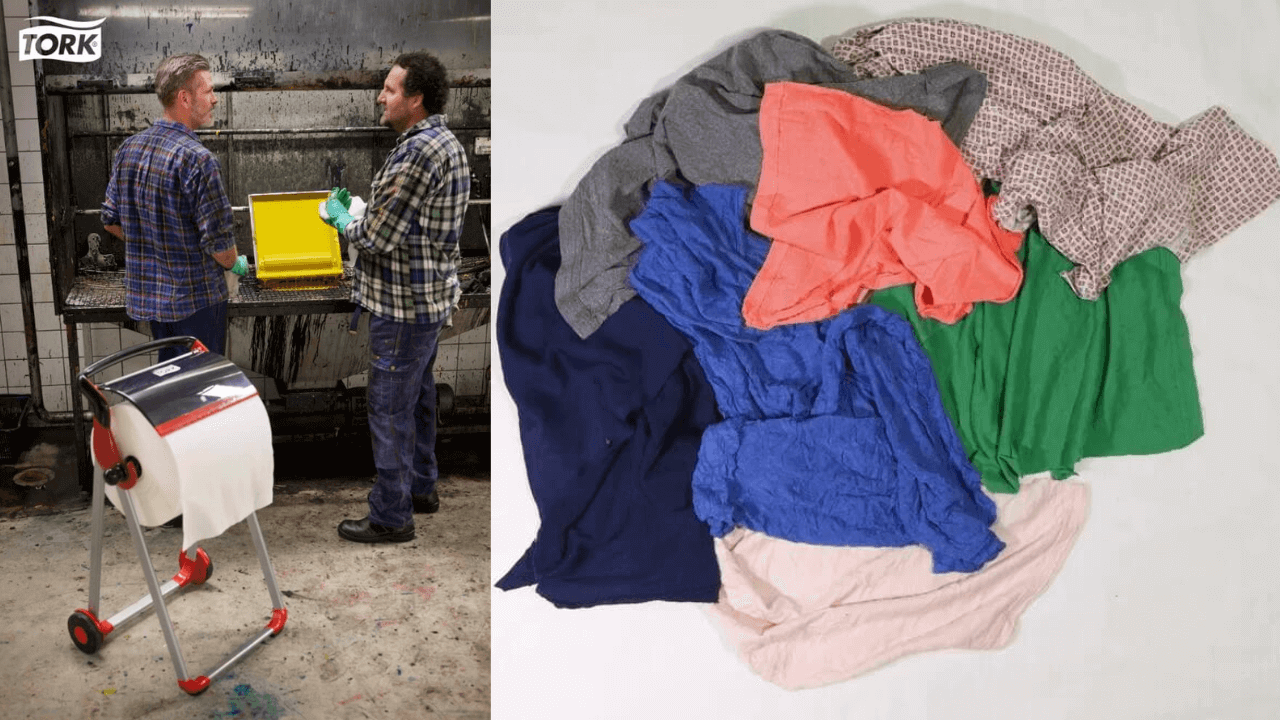
Cut cotton rags are still widely used in workshops, maintenance departments and production plants because their purchase price can look attractive. But the cheapest material per kilogram is not always the cheapest way to clean a workstation.
A more useful comparison is total cost of ownership (TCO): how much material is actually consumed, how long the cleaning task takes, how much chemical is used, how consistent the result is, what quality risks appear and how much contaminated waste must finally be handled.
Key takeaways
- Cut rags can be inexpensive to buy, but their size, thickness, composition and absorbency may vary from piece to piece.
- Selected nonwoven industrial wipes can provide more repeatable performance, better wet strength and lower linting than mixed textile rags.
- Paper wipes are often a good choice for fast spill absorption and lighter cleaning tasks, but they are usually less resistant to repeated scrubbing.
- The most cost-effective option depends on the contamination, surface, cleaning chemical, workstation and disposal route.
- Compare cost per cleaning task, not only the price of a bag, roll or box.
Video: paper vs nonwoven wipes vs cotton rags
The comparison below shows the differences in practical use, consumption and typical applications. It is a useful starting point when deciding whether a workstation should use paper, nonwoven industrial wipes or traditional cotton rags.
What should be included in the real cleaning cost?
Purchase price is only one part of the calculation. A wipe that costs more per sheet can still be cheaper in use if fewer sheets are needed, cleaning takes less time or the process uses less solvent.
| Cost area | What should be measured? |
|---|---|
| Material consumption | Pieces, sheets, rolls or kilograms used per workstation and per shift. |
| Labour time | Minutes required to clean the part, replace the wipe and collect waste. |
| Cleaning chemicals | Actual solvent, degreaser or detergent consumption for the same task. |
| Quality risk | Lint, streaks, scratches, foreign objects and rework caused by inconsistent cleaning. |
| Waste | Mass and volume of used material plus the applicable waste-handling route. |
| Dispensing and organisation | Whether the system controls consumption and keeps clean wipes protected and accessible. |
Cut cotton rags – when do they make sense?
Cut rags are usually made from old garments or textile-production offcuts. They can be absorbent, strong and convenient for general workshop cleaning.
The main limitation is lack of repeatability. A bag can contain pieces with different:
- dimensions,
- thickness,
- fibre composition,
- absorbency,
- seams, prints or other textile features.
Foreign elements such as buttons, fasteners or hard seams can also create a quality risk when delicate or finished surfaces are being cleaned.
When can rags still be a reasonable choice?
They can work well for low-risk tasks where surface finish, linting and precise consumption are not critical — for example general maintenance, coarse cleaning or absorbing heavy workshop contamination.
When can they become expensive?
The apparent saving can disappear when workers need several pieces for one task, when large amounts of contaminated textile waste are generated or when inconsistent pieces slow down cleaning and make consumption difficult to control.
Nonwoven industrial wipes – when are they worth choosing?
Nonwoven wipes are designed to provide more consistent dimensions and performance than mixed textile rags. Depending on the specific product, they can offer high wet strength, good absorption, compatibility with common cleaning chemicals and low-lint variants for more demanding surfaces.
They are often selected when a plant wants to:
- standardise cleaning at multiple workstations,
- reduce variation between individual pieces of wiping material,
- work effectively with oils, grease and wet contamination,
- reduce lint or marks on surfaces where a suitable low-lint grade is used,
- control consumption through rolls, boxes or one-at-a-time dispensing systems.
The current Melkib English range is available in Industrial cleaning cloths.
Industrial nonwoven wiping solutions
Paper wipes – where do they work best?
Paper wiping materials are often well suited to fast absorption of spills and light or medium cleaning tasks. They are easy to dispense and can be very practical where a fresh sheet is preferred for each operation.
Compared with stronger nonwoven wipes, paper is generally less suited to prolonged scrubbing, sharp edges or repeated use when wet. The exact performance depends on the number of plies, fibre quality and product design.
Paper or nonwoven?
- Choose paper for quick spill removal, routine wiping and tasks where disposable sheets are convenient.
- Choose nonwoven for heavier oils and grease, wet scrubbing, repeated wiping or applications where greater mechanical strength is useful.
Paper wiping solution for industrial cleaning
Rags, nonwoven or paper – practical comparison
| Criterion | Cut cotton rags | Nonwoven wipes | Paper wipes |
|---|---|---|---|
| Consistency | Often variable | High for a defined product | High for a defined product |
| Wet strength | Usually good | Often very good | Product-dependent, usually lower |
| Heavy oils and grease | Useful | Often very suitable | Suitable for lighter or quick removal depending on grade |
| Sensitive surfaces | Requires caution because composition and hard elements can vary | Suitable when a compatible low-lint or soft grade is selected | Suitable when the selected paper does not scratch or leave unacceptable lint |
| Consumption control | Difficult when taken from bulk bags | Good with controlled dispensing | Good with controlled dispensing |
| Reuse during one task | Often possible | Often possible for durable grades | Usually limited |
Mini checklist: calculate TCO in your own facility
- Measure real consumption. Record pieces, rolls or kilograms per workstation for at least a representative period.
- Measure cleaning time. Compare how long the same task takes with each material.
- Measure chemical consumption. Include solvent, degreaser or detergent used with the wipe.
- Weigh the waste. Do not compare only the number of discarded pieces.
- Record quality problems. Include lint, streaks, scratches and re-cleaning.
- Include dispensing. Check whether controlled issue reduces unnecessary consumption.
- Compare cost per completed task. Only then compare the purchase price.
FAQ – industrial wipes and cotton rags
Are industrial wipes always cheaper than cotton rags?
No. The answer depends on the task. Industrial wipes can become more cost-effective when they reduce consumption, cleaning time, chemical use, rework or waste, but this should be measured in the actual process.
Are nonwoven wipes always safe for delicate surfaces?
No universal wiping material is safe for every surface. Select a low-lint, soft and chemically compatible grade where the surface is sensitive, and validate it on the real part.
When is paper the better choice?
Paper is often convenient for fast spill absorption, routine wiping and tasks where a fresh disposable sheet is preferred. For heavy scrubbing or repeated wet use, a stronger nonwoven may be more suitable.
Why can cotton rags create more waste?
They are relatively heavy and often supplied in inconsistent sizes, so waste by mass can become significant. The actual difference should be measured at the workstation rather than assumed.
What is the best way to compare costs?
Run the same cleaning task with each material and measure wipe consumption, cleaning time, chemical use, waste and any quality issues. This gives a much more useful figure than comparing purchase price alone.
Want to compare wiping systems at your workstations?
Describe the contamination, surface, cleaning chemical and expected consumption. This makes it easier to compare paper, nonwoven and textile options based on the real task rather than on price per package.