



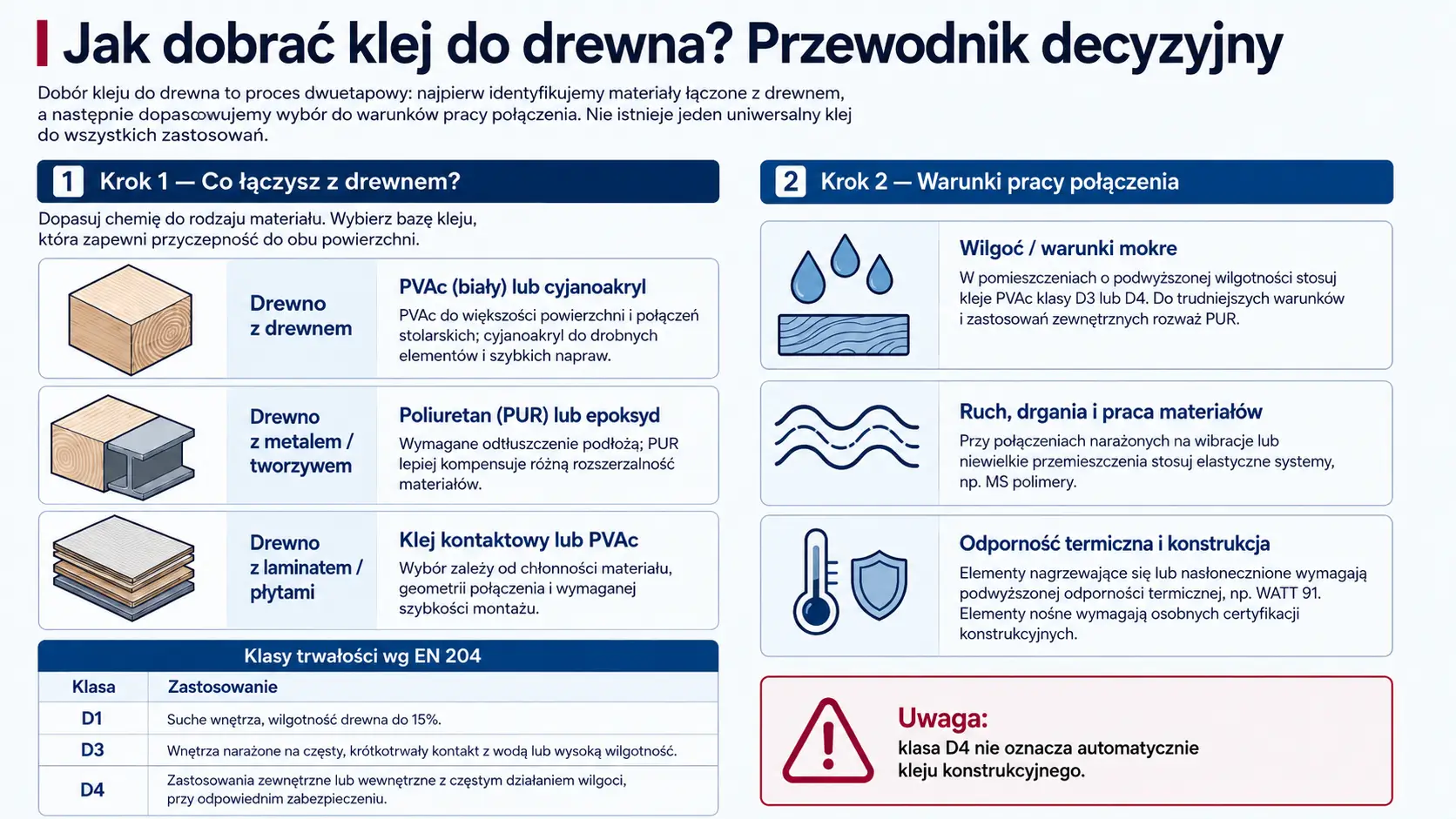
There is no single best adhesive for every type of wood. The choice depends on whether you are bonding solid wood, MDF, plywood, particleboard or veneer, what the second material in the joint is, and whether the bond will be exposed to moisture, temperature, vibration or constant load.
PVAc adhesives are often used for well-fitting wood-to-wood joints. When bonding wood to metal, PVC, laminate or another material, a polyurethane, epoxy or flexible adhesive may be a better starting point. The final choice should also take into account the gap size, required open time, clamping method and curing conditions.
Research and technical studies on wood bonding confirm that the result depends simultaneously on the properties of the adhesive, the moisture content and structure of the wood, surface quality, joint design and the environment in which the bond will operate.
Key takeaways
- The adhesive should be selected for both materials being bonded , not just for the general category of “wood”.
- Well-fitting wood-to-wood joints usually require a different technology than wood bonded to aluminium, steel, PVC or a composite.
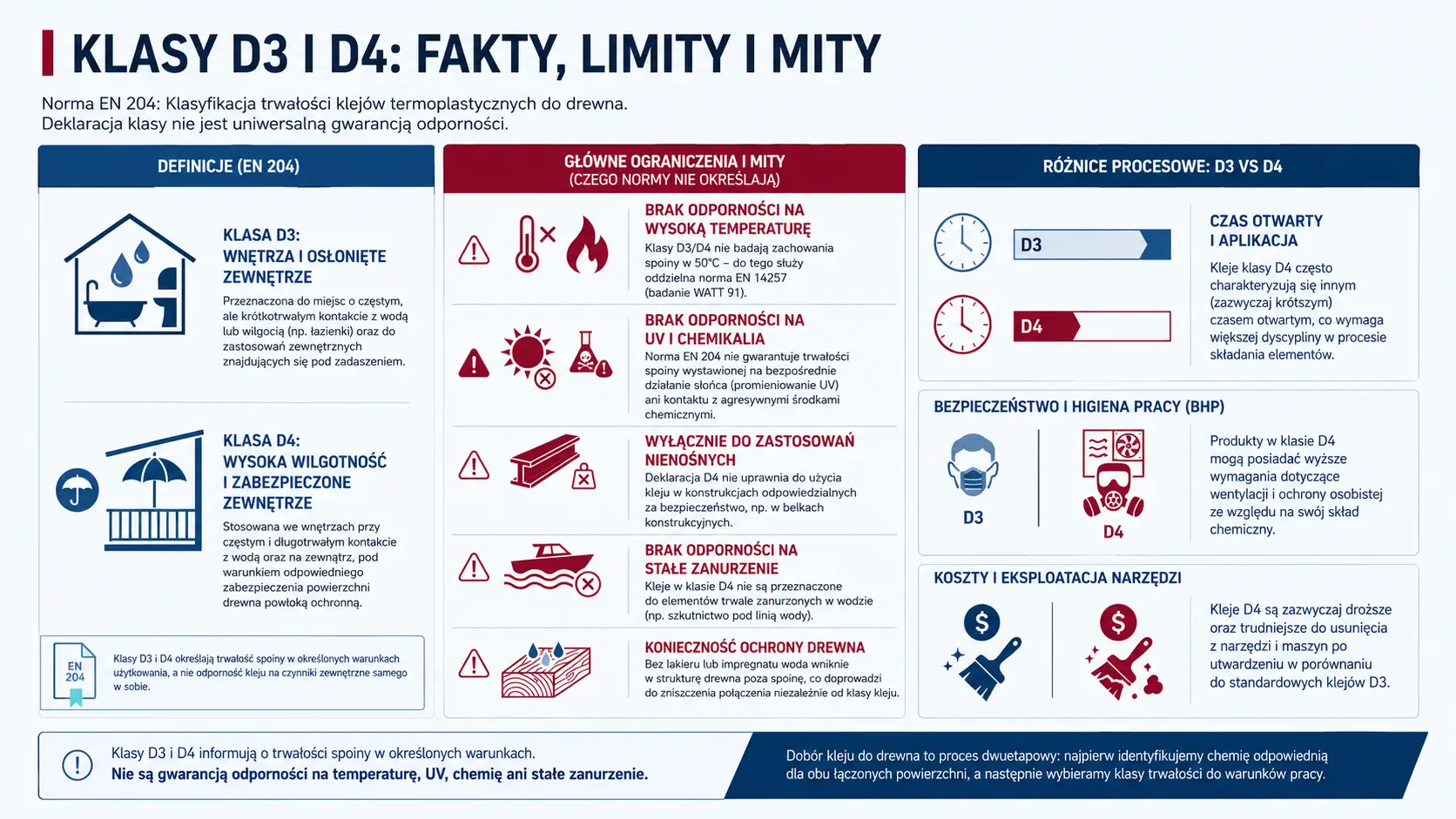
- Class D3 or D4 does not describe resistance to temperature, UV radiation, chemicals or permanent immersion in water.
- PVAc adhesives require good surface fit, the correct amount of adhesive and even clamping pressure.
- Foaming of a PUR adhesive does not automatically mean that the resulting foam is a load-bearing filler for a large gap.
- Wood moisture content, temperature and open time affect both curing and the strength of the joint.
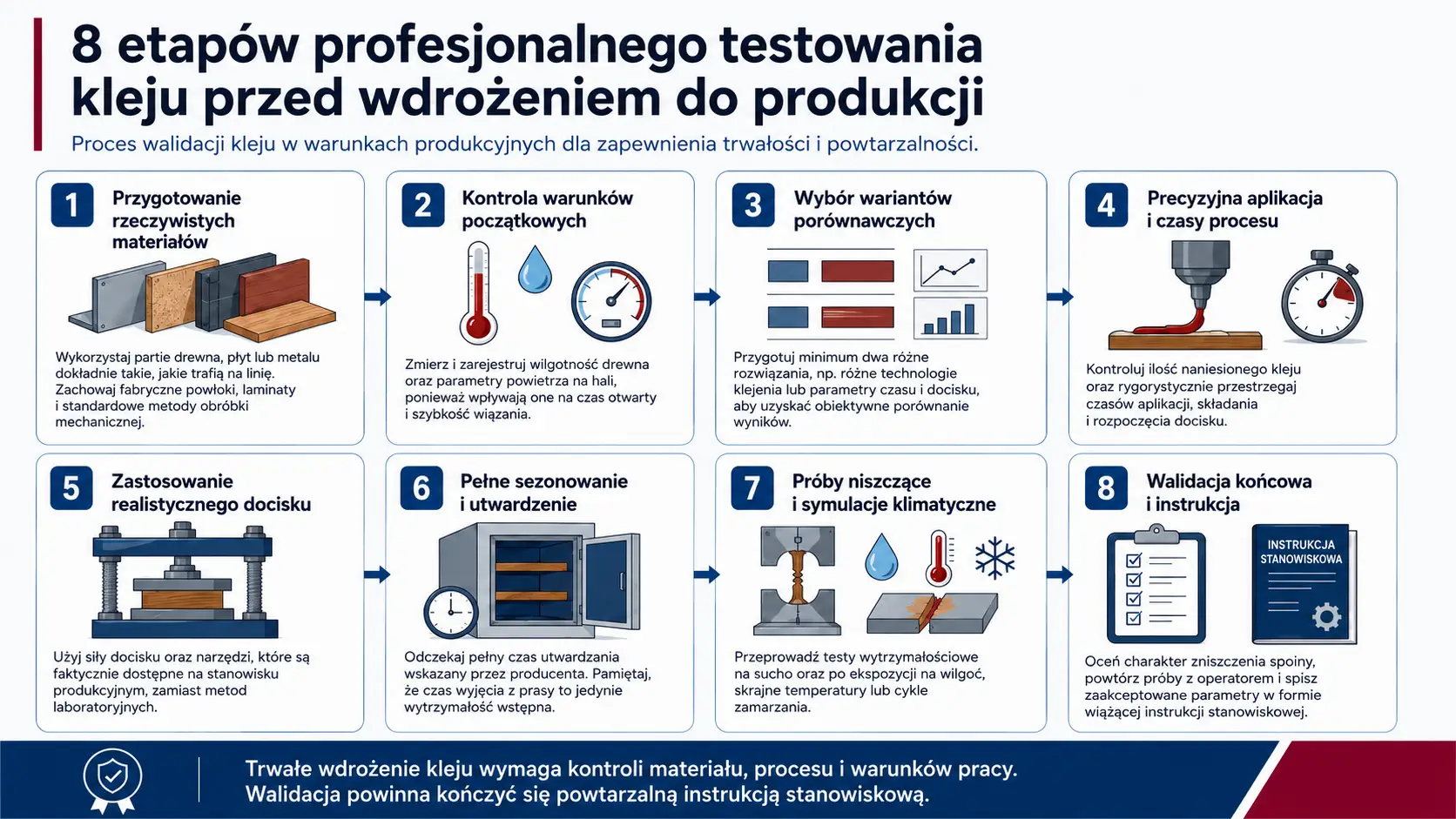
- Selection for serial production should be confirmed by a trial carried out on the actual materials and with the actual process time.
What is a wood adhesive?
A wood adhesive is a specialised chemical product designed to permanently join wooden elements and wood-based materials through adhesion and penetration into the cellular structure of the substrate. After curing, it forms a bond capable of carrying mechanical loads and resisting changing environmental conditions.
Which wood adhesive should you choose? Quick answer
| Application | Recommended direction and what to check |
|---|---|
| Well-fitting wood-to-wood joint indoors | PVAc. Check wood moisture content, open time, adhesive amount and uniformity of clamping pressure. |
| Wood periodically exposed to moisture | PVAc of the appropriate durability class or PUR. Verify the type of exposure and surface protection. |
| Wood with metal or aluminium | PUR, epoxy or a flexible adhesive. Assess metal preparation, vibration and the different thermal expansion of the materials. |
| Wood with PVC, ABS or another plastic | PUR, a flexible adhesive or a system intended for the specific plastic. First identify the type of plastic and any coating. |
| MDF, plywood or particleboard | PVAc, PUR or an industrial technology selected for the process. Take edge absorbency and pressing time into account. |
| Veneer or laminate | PVAc, a contact adhesive or a hot-melt system. Check the type of facing, temperature and whether repositioning is possible. |
| Uneven parts or a controlled larger gap | An epoxy system or PUR approved for that bond-line thickness. Verify the load-bearing capability of the filled gap. |
| Small parts requiring rapid fixing | Cyanoacrylate adhesive. Assess porosity, gap size, bond brittleness and bonding area. |
| Joint exposed to movement and vibration | PUR, MS polymer or another flexible adhesive. Define the range of movement, bond-line geometry and full curing time. |
If the only information available is “wood”, with no details about the second material, moisture, load or service conditions, it is safer to start by checking the wood adhesives category rather than choosing a specific product solely on the basis of a high-strength claim.
What determines the durability of a wood bond?
Type of wood and wood-based material
Solid wood, MDF, plywood, particleboard and veneer do not behave in the same way during bonding. They differ in absorbency, porosity, surface structure and the way they transfer stresses.
In solid wood, important factors include species, density, grain direction and the presence of resins, tannins and natural oils. MDF has a relatively uniform surface, but its machined edges can absorb adhesive very intensively. With plywood, the layer arrangement and the quality of the outer veneer must be taken into account. Particleboard may fail within its own structure before a correctly made adhesive bond fails.
The surface may also be varnished, laminated, impregnated, oiled or coated with a release agent. In such a case, the adhesive does not bond to the wood itself but to the layer on its surface. Adhesion to that layer can become the weakest point of the joint.
Wood moisture content and material conditioning
There is no single moisture-content value suitable for all adhesives and applications. The wood should be conditioned to conditions close to those of its later service, and the permissible moisture range should be checked in the technical data sheet of the specific adhesive.
Wood that is too wet can hinder surface wetting, change the curing rate and cause later shrinkage. Very dry wood, in turn, can quickly draw water out of a dispersion adhesive, shortening the time available for correct assembly. With PUR adhesives, moisture takes part in the curing reaction, but excess moisture does not automatically mean a stronger bond.
Studies of wood joints indicate that moisture content during bonding affects the micromechanics and strength of the bond line. Separate experiments with PUR adhesives have also shown a relationship between wood moisture content, open time and shear-test results. However, the result of one study should not be directly applied to every adhesive, wood species and production process.
Quality of surface preparation
The surface should be sound, clean and free of loose dust and foreign layers. Degreasing alone will not repair a surface that has been scorched during machining, covered with an old coating or mechanically damaged.
Fresh machining immediately before bonding is particularly important for wood rich in extractives and natural oils. A USDA Forest Products Laboratory publication indicates that remachining the surface can remove some extractives, improve wettability and even out the parts. The best machining method, however, must be selected for the particular wood species and adhesive.
The rule “the rougher the surface, the better” does not always apply. Overly aggressive sanding can leave loose fibres and dust, while an overly fine finish can impair wetting. What matters is a flat, fresh surface without a weak boundary layer.
Part fit and gap size
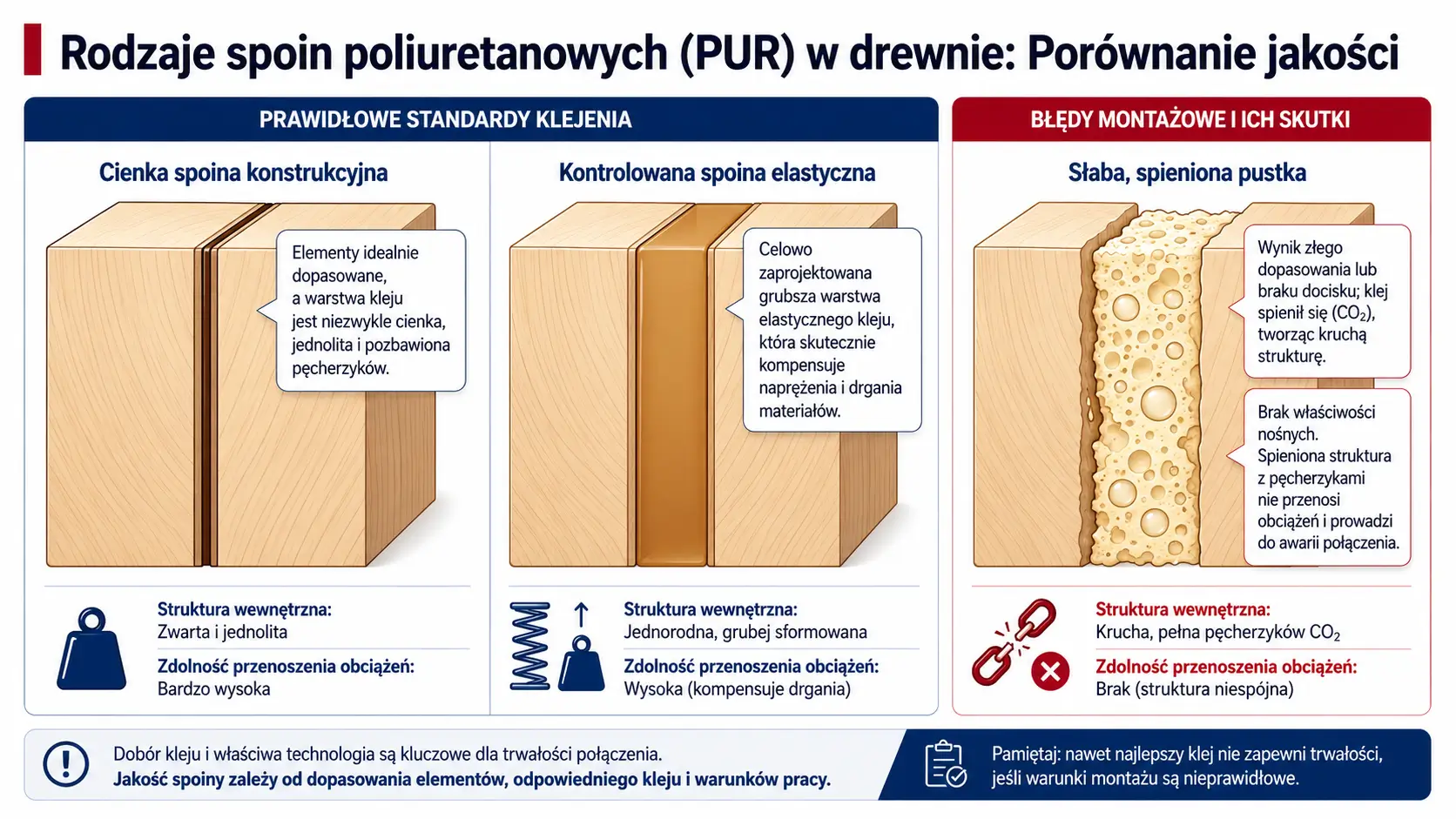
Well-fitting surfaces make it possible to form a uniform bond line. If the gap is too small, some adhesive may be squeezed out. If it is too large, the adhesive may not have sufficient internal strength or may not cure correctly throughout its full volume.
It is useful to distinguish three situations:
- a thin structural bond line , in which the parts fit well,
- a controlled flexible bond line , whose thickness is needed to compensate for movement,
- an accidental void , resulting from warped parts or incorrect machining.
An adhesive intended for a thin bond line should not be used as a universal filler for defects. The ability to remain in a gap is not the same as the ability to carry load.
Type of load
An adhesive bond generally performs best under shear load distributed over as large an area as possible. Peel, cleavage and loads acting only at the edge of the joint are much more demanding.
During design, check:
- whether the load is static, cyclic or impact,
- whether vibration is present,
- whether the wood can swell and shrink due to moisture,
- whether the second material has a different coefficient of thermal expansion,
- whether the joint will be loaded before the adhesive is fully cured.
A very rigid adhesive can be a good solution in a stable, well-fitting joint. In a joint between wood and a long metal element, the same rigidity may cause stress concentrations at the ends of the bond line.
Service environment
The term “outdoors” is too general. An element under a roof has different requirements from a window exposed to periodic condensation, and still different requirements from a joint that remains in contact with water or heats up in the sun.
Determine:
- the frequency and duration of contact with water,
- the minimum and maximum temperature,
- the number of freeze-thaw cycles,
- exposure to UV radiation,
- contact with oils, cleaning agents or other chemicals,
- whether the bond line can be protected with a coating.
Production process
An adhesive that is suitable for the materials may be impractical for the process. If the open time is too short, the last parts may be assembled after curing has already started. If pressing time is too long, the workstation is blocked and throughput falls. Difficult cleaning can increase downtime and waste.
Before choosing a technology, determine:
- the time needed to apply the adhesive and assemble the parts,
- the time from application to the start of clamping,
- the available type of press or clamps,
- the time after which the part must leave the workstation,
- the time before further processing and full loading,
- how the adhesive will be metered and its amount controlled,
- the method for cleaning the equipment,
- the repeatability of temperature and humidity in the production hall.
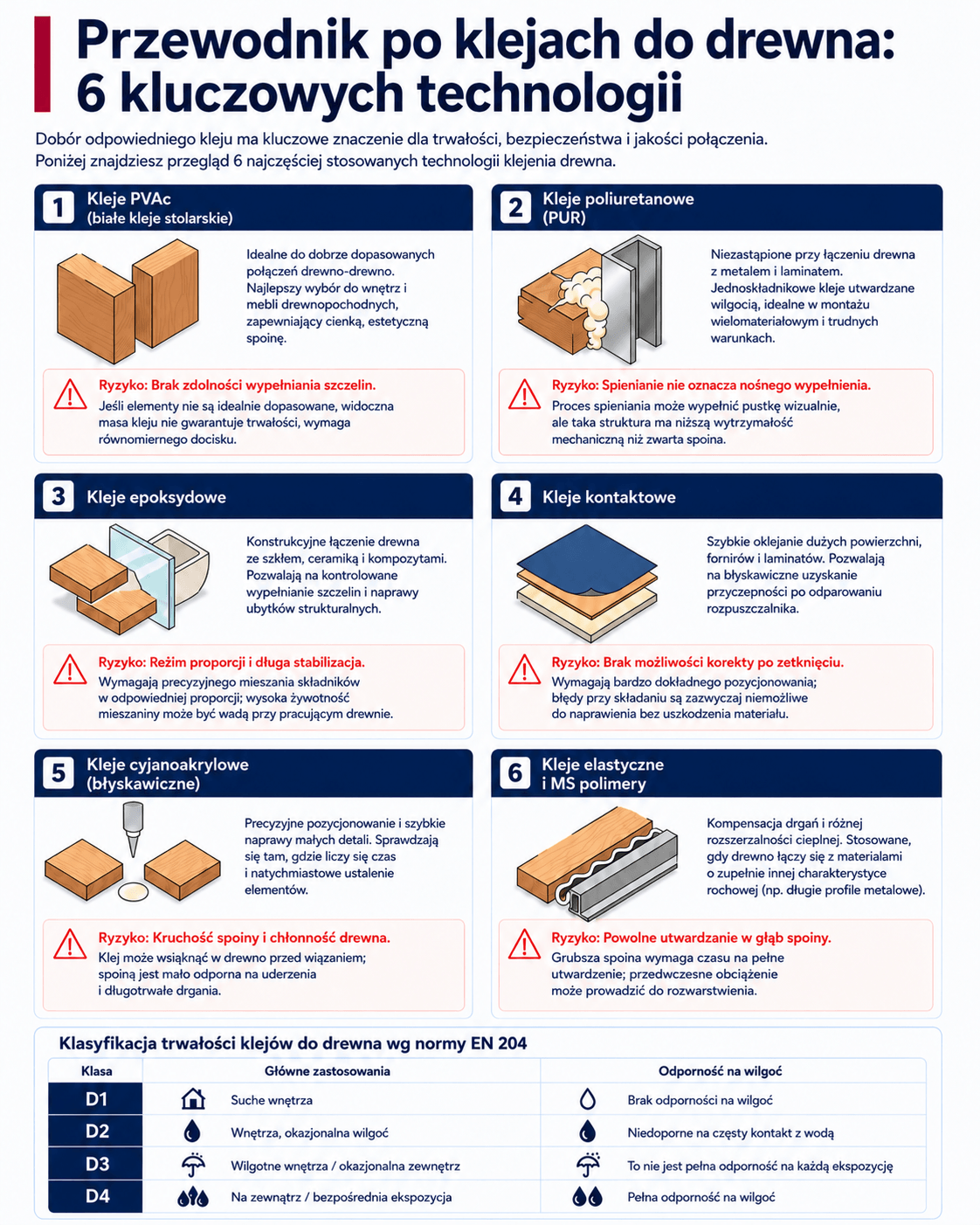
Types of wood adhesives – applications and limitations
PVAc adhesives
PVAc adhesives, often called white woodworking glues, are a good starting point for well-fitting wood-to-wood joints and for many wood-based materials.
Their advantages include easy application, good wetting of wood and the ability to form a thin bond line. In the process, however, open time, surface absorbency, adhesive amount and uniform clamping pressure must be controlled.
PVAc is not a good choice for accidentally filling large gaps. If the parts do not fit, a visible mass of adhesive between them does not mean that a durable joint has been created.
In applications involving moisture, check the declared durability class of the specific product. It should not be assumed that every PVAc adhesive is D3 or D4.
PUR polyurethane adhesives
PUR adhesives are often selected for bonding wood to metals, laminates, selected plastics and mineral materials. One-component moisture-curing products can be useful in multi-material assembly and where more flexibility is needed than in a typical rigid woodworking bond.
Polyurethane adhesives differ in viscosity, open time, degree of foaming, required moisture and permissible bond-line thickness. They should not all be treated as interchangeable.
When selecting a product, it is worth checking the polyurethane adhesives category and then narrowing the choice based on the materials, process time and bond-line requirements.
Epoxy adhesives
Epoxy adhesives are worth considering for bonding wood to metal, glass, ceramics and composites, as well as for repairs and controlled gap filling. Gap-filling capability, however, depends on the specific formulation.
The main limitations include the need to maintain the correct mixing ratio, limited working time after mixing, longer curing time and often high bond-line rigidity.
Not every epoxy has the same resistance to water, temperature and UV radiation. The statement “epoxy adhesive is completely waterproof” is too broad without data for the specific product and exposure conditions.
Contact adhesives
Contact adhesives are used, among other things, for laminates, facings and large surfaces where rapid adhesion is required after the solvent or water has flashed off.
Once the two prepared surfaces are brought together, there is usually little possibility of correcting their position. Even adhesive application, correct flash-off time and accurate positioning are therefore important.
Contact technology is not automatically suitable for every veneer. Thin natural veneers may require a different system, controlled pressure or a pressing process.
Cyanoacrylate adhesives
Cyanoacrylate adhesives work well for small parts, quick repairs, positioning and joints with a small gap. They can fix parts rapidly and reduce assembly time.
Their limitations include low tolerance for large gaps and often lower resistance to peel loads, impact or long-term movement of the joint. On absorbent wood, the adhesive may penetrate the material before it forms a proper bond line.
Flexible adhesives and MS polymers
Flexible adhesives are used when wood is bonded to a material with different expansion characteristics or when the joint is exposed to vibration, deformation and movement.
In this case, a thicker bond line can be part of a correct design. It must, however, be made in a controlled way. Slower through-cure, the required geometry and the time before loading must be taken into account.
What is the difference between classes D1, D2, D3 and D4?
Classes D1–D4 are defined by EN 204, which classifies thermoplastic wood adhesives intended for non-structural applications. The classification is based on bond-strength test results after specified conditioning cycles under dry and wet conditions.
| Class | Application and key limitation |
|---|---|
| D1 | Dry interiors without significant exposure to moisture. Not intended for periodic wetting of the bond line. |
| D2 | Interiors with occasional, short-term increases in humidity. Does not mean resistance to frequent contact with water. |
| D3 | Interiors with frequent short-term contact with water or high humidity, and selected sheltered outdoor applications. Does not mean full resistance to every type of outdoor exposure. |
| D4 | Interiors with frequent and prolonged contact with water, and outdoor applications with appropriate surface protection. Does not mean resistance to permanent immersion, UV radiation or every temperature. |
EN 204 applies to thermoplastic adhesives. For thermosetting wood adhesives intended for non-structural applications, EN 12765 uses classes C1–C4. In commercial descriptions, the D4 designation is sometimes used more broadly, so before making a decision, check which standard, test method and product variant the declaration refers to.
D3 or D4 – which should you choose?
A higher class does not always mean a better process choice. A D4 adhesive may have a different open time, curing mechanism, occupational health and safety requirements, price and cleaning method than a D3 solution.
The choice should be based on the actual exposure:
- whether contact with water will be occasional or regular,
- whether water will run off, condense or remain on the surface,
- whether the element will be protected with varnish or another coating,
- whether changes in humidity will cause the wood to swell and shrink,
- whether the customer’s requirements specify a particular standard and test method.
What is WATT 91?
WATT 91, described in EN 14257, is a method for testing the strength of lap joints bonded with a wood adhesive at elevated temperature. The current standard describes testing at 80°C.
A WATT 91 result does not replace a D1–D4 class. The D class primarily relates to durability after specified water-related conditioning, while WATT 91 evaluates the behaviour of the joint at elevated temperature.
When is EN 204 not enough?
EN 204 applies to non-structural applications. If the bonded joint is a structural element on which the safety of a building or machine depends, the appropriate standards, approvals and documentation for the specific application are required.
A D4 declaration on the packaging is not a sufficient basis for using an adhesive in a load-bearing beam, building element, transport structure or any other safety-critical joint.
Which adhesive should you choose for a specific material?
Which adhesive for MDF?
For bonding flat MDF surfaces, PVAc can often be considered. Machined edges, however, are much more absorbent and may require a different amount of adhesive, an additional coat or a change of technology.
The most common problem is a dry bond line: the adhesive is absorbed by the material before the parts are assembled correctly. A second risk is failure within the MDF structure itself. In that case, increasing adhesive strength does not necessarily improve the load-bearing capacity of the entire joint.
Which adhesive for plywood?
With plywood, check the species of the outer veneer, the type of existing interlayer bonding and the presence of any coating. With correctly prepared surfaces, PVAc, PUR, epoxy or a flexible adhesive can be considered depending on the second material and service conditions.
If the joint is subjected to peel loading, the outer layer of the plywood may fail. This is not a failure of the adhesive itself but of the material beneath the bond line.
Which adhesive for particleboard?
With particleboard, distinguish between the flat surface and the porous edge. A laminated surface requires an adhesive that bonds to the decorative layer, not to the wood particles underneath it.
For loaded joints, it is worth increasing the bonding area and avoiding concentration of force on a small area of the board.
Which adhesive for exotic and oily wood?
Exotic wood may contain natural oils and extractives that make wetting more difficult. Their effect depends on the species, drying method, time since machining and the adhesive used.
Studies on hardwoods show that extractives and wood anatomy can affect wettability and joint behaviour. For this reason, results obtained on beech or pine should not automatically be transferred to teak, iroko, merbau or wenge.
A safe procedure includes freshly machining the surface, removing dust and testing several preparation variants. Do not use a random solvent without checking its compatibility with the wood and adhesive. An unsuitable product may spread oils over the surface or leave a layer that reduces adhesion.
Which adhesive for veneer and laminate?
With veneer, uniform adhesive spread, open time and the possibility of applying flat pressure are important. Excess adhesive can bleed through a thin facing, while uneven pressure can leave bubbles or local areas of delamination.
With laminate, identify the material of the backing layer. An absorbent veneer behaves differently from HPL, and differently again from a plastic containing release additives.
Which adhesive for wood and metal?
For wood and metal, PUR, epoxy or a flexible adhesive can be considered. The choice depends on joint length, differences in material expansion, vibration and the type of load.
The metal should be free of oil, loose oxides, rust and weak coatings. If anodised aluminium, galvanised steel or a painted surface is being bonded, adhesion to the specific layer must be checked.
In a long wood-to-aluminium joint, a rigid bond line can concentrate stresses at the ends. An adhesive with controlled flexibility may compensate for movement better, but it requires the correct bond-line thickness.
Which adhesive for wood and plastic?
The term “plastic” is not sufficient for adhesive selection. PVC, ABS, polycarbonate, polyamide, polypropylene, polyethylene and POM have different surface properties.
Before selecting an adhesive, determine:
- the exact type of plastic,
- the presence of plasticisers, fibres, slip agents or other additives,
- the type of coating or surface texture,
- whether sanding, activation or a primer can be used,
- the temperature and loads on the joint,
- the risk of stress and cracking in the plastic.
Icema adhesives can be considered for selected plastics, wood and metals, but their suitability must be confirmed on exactly the materials that will be used in production.
Icema adhesives for wood and multi-material joints
Icema is a line of H.B. Fuller industrial polyurethane adhesives intended, among other things, for assembly work and for bonding wood-based materials to selected metals, plastics and mineral materials.
For wood bonding, Icema R 145/88 and Icema R 145/31 are particularly worth comparing. They are not simply two package sizes of the same adhesive. They differ primarily in consistency and open time and therefore suit different processes.
| Product | Characteristics, application and risk |
|---|---|
| Icema R 145/88, 310 ml cartridge | One-component PUR paste with limited sag and a short open time. Worth considering for fast assembly, bead application and vertical surfaces. Main risk: little time to assemble and clamp the parts. |
| Icema R 145/31 LEE LQ, 1 kg pack | One-component, more fluid PUR with a longer open time. Worth considering for larger surfaces and processes that require unhurried positioning. Main risk: the need to control application, sagging and curing conditions. |
...
Icema R 145/88 – when is a short open time an advantage?
Icema R 145/88 is a one-component moisture-curing PUR adhesive. The manufacturer specifies applications including wood and wood-based materials, HPL, rigid PVC, ABS, selected metals, concrete and tiles. The product has a paste-like consistency and a low degree of foaming.
According to the available technical data sheet, the approximate open time at 20°C and 50% relative humidity is about 5 minutes without additional water spraying and about 2 minutes after spraying. The manufacturer notes that higher humidity and temperature accelerate the reaction, so these values should be treated as guidance rather than as a guaranteed process time.
R 145/88 is worth considering when you need:
- fast assembly of parts,
- cartridge application,
- limited sag on vertical surfaces,
- bonding wood to a selected plastic or metal,
- a short cycle time at the assembly station.
It is not a good choice if the operator needs several or more minutes to spread the adhesive, position a large panel and apply many clamps.
Icema R 145/31 – when is a longer working time needed?
Icema R 145/31 is a more fluid, one-component PUR adhesive intended, among other things, for wood-based materials, prepared metals, aluminium, selected plastics and cement-bonded materials.
According to the available technical data sheet, the approximate open time at 20°C and 50% relative humidity is about 45 minutes without additional moisture and about 15 minutes after spraying with water. These values change with temperature, humidity and adhesive amount.
R 145/31 is worth considering for:
- bonding larger surfaces,
- production of panels and layered elements,
- processes requiring unhurried positioning of parts,
- spreading the adhesive with a notched trowel or another surface-application system,
- bonding wood to prepared metal or a selected plastic.
On large surfaces, the conditions required for the adhesive to cure must be provided. If both sides are completely non-absorbent, moisture access to the interior of the bond line may be limited. Such a configuration must be confirmed by testing.
How do you choose between R 145/88 and R 145/31?
Choose R 145/88 as the variant for trials when the application needs to be fast, the adhesive must stay in place, the parts can be assembled quickly and the process uses a 310 ml cartridge.
Choose R 145/31 as the variant for trials when a larger area is being bonded, more time is needed for spreading and positioning, and the process can be organised around a lower-viscosity adhesive.
In both cases, before implementation, verify the current technical data sheet and safety data sheet, the surface-preparation method, the amount of moisture, clamping time and the behaviour of the joint after full cure.
Which wood adhesive for outdoor use?
An adhesive for outdoor use must be selected not only for water exposure but for the entire environmental cycle: wetting, drying, swelling, shrinking, heating and cooling.
D4 class alone does not guarantee durability of the entire element. The standard allows outdoor applications with appropriate surface protection. If the wood remains unprotected, water can penetrate beyond the bond line, cause dimensional changes and damage the material.
Before choosing, check:
- whether the bond line will be directly exposed to rain,
- whether the joint can retain water,
- whether the wood will be protected with a coating,
- whether the adhesive is resistant to the temperature required in the application,
- whether UV radiation will reach the bond line directly,
- whether the joint allows water to drain and the material to dry.
The most durable solution usually combines a correctly selected adhesive, appropriate joint design and effective wood protection.
Does PUR adhesive fill gaps?
PUR adhesive can increase in volume and foam during curing, but that does not mean every void it fills will have high load-bearing capacity.
Carbon dioxide can be generated in the reaction of moisture-curing polyurethane. The degree of foaming depends, among other things, on the amount of adhesive, moisture, temperature, joint geometry and clamping pressure. The Icema R 145/88 technical data sheet explicitly states that foaming may be beneficial in some applications and undesirable in others.
The foamed portion of the adhesive usually has a different structure from a dense bond line. It may visually fill a space but does not necessarily carry the same loads.
If the parts are warped or the gap exceeds the range permitted by the manufacturer:
- improve the fit of the parts,
- change the joint design,
- choose an adhesive intended for a greater bond-line thickness,
- use a controlled spacer,
- perform a destructive test after full cure.
What is the strongest wood adhesive?
The strongest adhesive is the one correctly selected for the materials, gap, type of load and service conditions. The strength value given in a technical data sheet alone is not enough to predict the durability of the finished joint.
Four different factors determine the result:
- adhesion , meaning the adhesive’s ability to bond to the surface,
- cohesion , meaning the internal strength of the cured adhesive,
- the strength of the wood or surface layer ,
- joint geometry and the way stresses are distributed.
After a correctly performed test, partial wood failure is often expected, but it is not the only evaluation criterion. In wood-based materials, a high proportion of substrate failure may also mean that the board itself is the weakest element in the system.
Most common mistakes when bonding wood
| Problem | Possible cause and what to check |
|---|---|
| The adhesive peels cleanly from the surface | Possible cause: dust, oil, coating, extractives or poor wetting. Check the type of surface, freshness of machining and cleaning procedure. |
| The bond line cracks at the edge | Possible cause: peel loading, an adhesive that is too rigid or poor geometry. Check the direction of force, overlap length and joint design. |
| The joint delaminates after exposure to moisture | Possible cause: incorrect durability class, lack of wood protection or material movement. Verify the actual exposure and product documentation. |
| A dry bond line is visible | Possible cause: too little adhesive, high absorbency or exceeded open time. Check dispensing, edge absorbency and assembly time. |
| The adhesive does not cure in the middle of a large surface | Possible cause: limited access to moisture or another component needed for the reaction. Check the curing mechanism, absorbency of the materials and bond-line thickness. |
| PUR foams heavily | Possible cause: excess moisture, too much adhesive or insufficient clamping pressure. Check dispensing, the amount of water and fixture stability. |
| The bond line on oak darkens | Possible cause: reactions of tannins with iron, water or process components. Check tool cleanliness, water and preparation products. |
| Exotic wood delaminates over time | Possible cause: natural oils, extractives or incorrect cleaning. Perform fresh machining and compare several preparation variants. |
| The bond weakens under constant load | Possible cause: adhesive creep, elevated temperature or incorrect geometry. Assess the nature of the load and the product’s behaviour over time. |
| Production results are inconsistent | Possible cause: lack of control over moisture content, adhesive amount, open time or clamping pressure. Define the process parameters and how they will be recorded. |
How to bond wood correctly step by step
- Identify both materials. Record the wood species, type of board, plastic, metal, laminate and all coatings.
- Define the service conditions. Include moisture, temperature, UV radiation, vibration, chemicals and the type of load.
- Check the condition of the materials. Assess moisture content, conditioning, flatness and the presence of oils, dust or old coatings.
- Prepare the surfaces. Remove weak layers and dust. Match the cleaning method to the material and adhesive.
- Assess the gap. Determine whether the surfaces fit well and whether the adhesive is approved for the required bond-line thickness.
- Select the technology. Compare at least two solutions that match the materials and the process.
- Read the technical data sheet. Check the application temperature, open time, required clamping pressure and curing time.
- Control the amount of adhesive. Do not assess it only visually. During a trial, it is useful to weigh the adhesive consumption for a defined area.
- Assemble the parts within the required time. Do not apply adhesive to a larger batch than can be assembled before the end of the open time.