




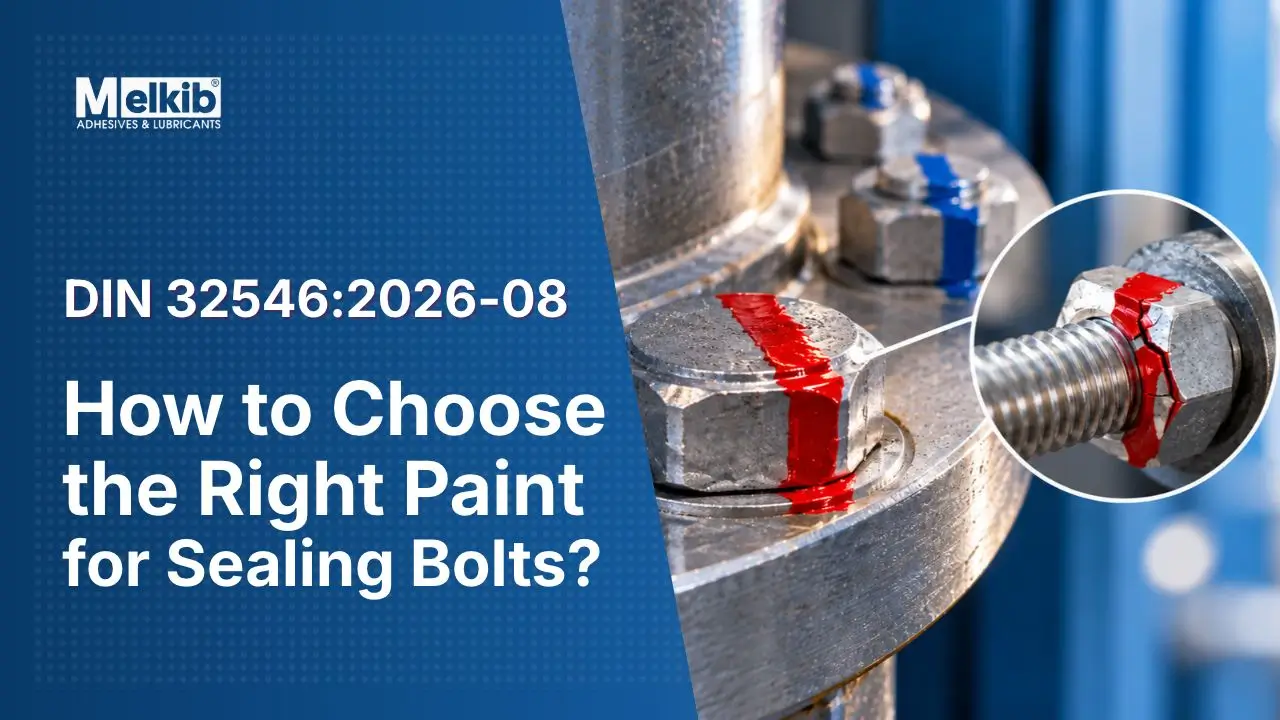
A coloured mark on a bolt can indicate that an assembly check has been completed. However, if you need to detect subsequent rotation of a bolt or nut, you need a suitable torque seal applied in the correct position. A mark on the bolt head alone does not provide this function.
DIN 32546:2026-08 covers torque seal used for the visual inspection of threaded joints. In practice, selection starts with three questions: what movement do you need to detect, what conditions will the joint encounter, and will the cured coating leave a clearly visible indication of disturbance?
Key points
- A mark indicating a completed check and a seal that reveals joint movement serve different purposes.
- Application geometry is just as important as choosing the right lacquer.
- Compare Standard, Zero and Fast Dry against your process requirements, rather than colour or price alone.
- A product conformity declaration does not replace checking its performance on the actual joint.
What does DIN 32546 cover, and does it require you to stop using markers?
DIN 32546:2026-08 “Siegellack”, with the English title “Torque seal”, was published in August 2026. The official description states that it specifies the characteristics and application requirements for torque seal on bolts and other threaded fasteners. The coating serves as a visual inspection mark and a loosening indicator; it can also reveal interference with a joint. [1]
This does not establish a blanket legal ban on using pens for every type of marking. DIN explains that standards are generally voluntary and can become mandatory when referenced in contracts or legislation. A plant therefore also needs to check its customer's requirements and process documentation. [2]
The practical question is: do you need to mark a completed operation, or create a seal that will help you identify subsequent movement? Establishing the intended function comes before selecting the material and application method.
Marker, torque seal or threadlocker: which function do you need?
| Requirement | Selection approach | Limitation |
|---|---|---|
| Marking a completed check or operation | The mark specified in the assembly procedure | Do not automatically treat it as a seal that detects movement. |
| Visually detecting rotation or interference | Torque seal bridging the appropriate components | Performance depends on adhesion, geometry and the behaviour of the cured coating. |
| Preventing a joint from loosening unintentionally | A locking method selected for the joint design, such as a suitable threadlocking adhesive | An inspection lacquer does not replace this protection. |
Separating these functions helps prevent an unsuitable choice. If joints repeatedly loosen, adding torque seal provides an indication of possible movement but does not address the cause. The joint design and assembly process need to be assessed. DIN Media explicitly states that torque seal does not replace technical threadlocking. [1]
Why can a line on a bolt head be insufficient?
Bäder describes torque seal as a physical bridge between a threaded fastener and an adjoining component, designed to break visibly when the joint moves. A mark confined to one component does not perform the same function. [3]
Consider a bolt securing a bracket. A dot on its head moves with the bolt. A seal applied across the boundary between the head and the bracket can reveal their relative movement, provided that adhesion and breaking behaviour have been checked on this joint. Where a nut or washer is involved, first establish which components can move relative to each other.
How do you select torque seal for the actual joint?
Describe the application and operating conditions before choosing a product. The following checklist is a practical selection aid, rather than a conformity test procedure:
- Surfaces: metal, zinc plating, paint or another substrate. Check adhesion to the actual surface finish.
- Geometry: space for the bridge, applicator access and the components whose relative movement needs to be revealed.
- Operating conditions: temperature and exposure to oil, fuel, cleaning agents or other substances. Check resistance to the specific substance and exposure conditions.
- Process timing: when the assembly will be handled, packed or inspected. Distinguish touch-dry time from full cure.
- Inspection: visibility at the inspection point, contrast against the substrate and the ability to identify a break.
- Documentation: the correct product variant, current technical and safety data sheets, and the scope of declared conformity.
We recommend starting with a joint that represents production conditions. Approval on a clean metal test piece does not establish how the lacquer will perform on the intended coating and in the actual process.
Which Bäder range should you choose: Standard, Zero or Fast Dry?
For general industrial applications, Standard can be a starting point for trials. The manufacturer describes it as a lacquer with Flow behaviour. Consider it when there is no specific requirement for a water-based system or a shorter touch-dry time. [4]
Compare Zero with Standard when the process requires a water-based system without organic solvents. Bäder specifies Anti-Flow behaviour for this range. Substrate suitability, drying and the operating environment still need to be assessed; a water-based formulation is not automatically suitable for every application. [5]
Fast Dry is a selection option when drying time before the next operation and material running are process concerns. The manufacturer describes rapid drying and Anti-Flow behaviour. A shorter drying stage does not mean immediate full cure. [6]
Bäder's combined technical data sheet gives approximate touch-dry times of 5 minutes for Standard, 10 minutes for Zero and 1 minute for Fast Dry. Full cure is stated as approximately 24, 12 and 24 hours respectively. These are indicative values that depend on the coating thickness and conditions; verify the time required in your own process. [7]
For specific operating conditions, Bäder also offers Heat, developed for high temperatures, and Resist, developed for chemical resistance. Selection should be based on current documentation for the specific variant and its intended exposure. [8] [9]
| Range | Declared class | Selection focus |
|---|---|---|
| Standard | SL-2.1.GHS 02 | General applications |
| Zero | SL-1.2 | A process requiring a water-based system |
| Fast Dry | SL-2.2.GHS 02 | Short touch-dry time |
| Heat | SL-3.2 | Elevated temperatures |
| Resist | SL-1.2 | Demanding chemical exposure |
The classes above are based on information from Bäder. They are not a quality ranking or proof of suitability for every joint. Check the scope of the manufacturer's declaration for the variant you intend to order. [3]
Melkib products to compare in an application trial
Once your requirements are established, you can compare three lacquers in 20 ml tubes: Bäder Standard 20 ml, Bäder Zero 20 ml and Bäder Fast Dry 20 ml. Choose a colour that contrasts with the substrate and check the currently available variant.
For a broader comparison of seal types, see our guide to security seal classification and selection, available in Polish.
How do you introduce torque seal without creating a false sense of control?
We recommend treating implementation as the development of a repeatable process, rather than simply replacing a pen with a tube of lacquer:
- Define the inspection objective. Record what movement or interference you need to detect, and who will inspect the seal and when.
- Establish the operation sequence. Apply the seal after assembly and the required checks are complete. A mark must not replace checking the joint.
- Prepare the surfaces. Bäder's technical data sheet requires the removal of grease, oil, moisture and rust, together with material compatibility checks. Select a cleaning method appropriate for the substrate. [7]
- Check the application. On trial joints, assess adhesion, bridge geometry, cure and the visibility of damage after a controlled disturbance. Do not carry out a trial by loosening a joint on operating machinery.
- Set acceptance criteria and a response. Prepare a reference showing a correctly applied seal and a procedure for broken, detached or unreadable seals. Record the product, surface preparation and process timing.
If you need to demonstrate conformity with DIN 32546, use the full text of the applicable edition and the manufacturer's documentation. The steps above are implementation guidance, not a complete test method under the standard.
The seal has broken or detached: what should you check?
Do not paint over damage before establishing its cause. Within the plant's procedure, distinguish between possible joint movement, loss of adhesion to the substrate and accidental damage to the seal. Each calls for a different assessment.
First, retain a record of the location and appearance of the damage. Then have the joint and application method assessed by the person responsible for inspection. Apply a new seal only after the required actions have been completed. Remarking should not conceal an unresolved nonconformity.
This is a process recommendation: inspection frequency, acceptance criteria and the response to damage should be established for the specific equipment and the significance of the joint.
FAQ: questions when selecting torque seal
Is lacquer supplied in a marker-style applicator unsuitable by definition?
Do not assess a product solely by the shape of its packaging. Bäder also offers Brush Marker and High Precision Marker lacquer applicators. Check the declaration's scope for the specific variant and whether it can form the required seal; do not treat these applicators as equivalent to ordinary marking pens. [5]
Does seal colour indicate the conformity class or required tightening torque?
Neither should be inferred from colour. Bäder states classes for its product ranges. If a plant uses colour to identify an inspection stage, that meaning should be defined in its own procedure and understood by the people reading the mark. [3]
Can Zero be used in food contact applications without further checks?
The manufacturer's “food safe” statement does not define every condition of a specific application. Before use in this area, obtain documentation setting out the scope and conditions of the declaration for the relevant product. A water-based formulation alone does not establish suitability. [5]
Where should selection begin?
If you need to visually detect bolt movement, start with the seal geometry and operating conditions. Then choose a range that suits the process and check it on the intended joint. If loosening itself is the problem, lacquer selection should accompany an assessment of the locking method rather than replace it.
Select torque seal for your joint and inspection process
Send Melkib a photograph of the joint and details of the substrate, temperature, exposure to substances and time available before the next operation. Also describe what the seal needs to reveal. We can help narrow down the product selection and identify the requirements worth checking in an application trial.
Technical sources
- DIN Media — DIN 32546:2026-08 “Siegellack”: public description of the standard's scope, not the full text.
- DIN — Standards and the law: general principles of voluntary and mandatory use of standards.
- Lackfabrik Bäder — DIN 32546 for Torque Sealants: declared classes and explanation of the seal's function.
- Bäder — Standard Range.
- Bäder — Zero Range.
- Bäder — Fast Dry Range.
- Bäder — Technical Data Sheet: Torque Sealant: comparison table p. 4, surface preparation pp. 12 and 20, disclaimer p. 31.
- Bäder — Heat Range.
- Bäder — Resist Range.
- Bäder — Safety Data Sheet: Fast Dry Range, version 3, revised 13 August 2024, sections 2, 7 and 8.
Sources checked on 7 October 2026. Selecting a specific variant requires current product documentation and consideration of the application conditions.