





Industrial oil analysis is one of the most useful tools in condition-based maintenance. A properly taken sample can provide information not only about the lubricant itself but also about contamination, wear processes and changes occurring inside the machine.
Shell LubeAnalyst is an oil and equipment condition-monitoring service that combines laboratory testing, digital reporting and technical interpretation. Its greatest value comes from regular sampling and trend analysis rather than from treating one isolated result as a complete diagnosis.
Key takeaways
- Oil analysis can help detect abnormal wear, contamination and lubricant degradation before they develop into more expensive problems.
- A single sample is useful, but repeatable sampling and trend analysis provide much stronger diagnostic value.
- Shell LubeAnalyst combines laboratory testing with equipment-based diagnosis, reports and a digital platform for monitoring results.
- Oil analysis can support condition-based maintenance and help optimise oil-drain intervals where this is permitted by the machine manufacturer and the maintenance strategy.
- The test package must match the equipment and lubricant. A hydraulic system, gearbox, turbine and engine do not require exactly the same diagnostic parameters.
- The quality of the result starts with the sample: sampling point, machine condition, bottle cleanliness and correct labelling all matter.
What is Shell LubeAnalyst?
Shell describes LubeAnalyst as an oil and equipment health-check service. Laboratory results are combined with lubricant and equipment information to help identify developing problems, support preventive maintenance decisions and monitor lubricant performance over time.
Current Shell materials highlight three main elements:
- equipment-based diagnosis and insights,
- technical support and preventive-maintenance recommendations,
- a digital platform and mobile tools for sample management and access to results.
Shell also states that its oil-condition monitoring portfolio provides access to more than 100 different tests across its service offering. The exact tests selected for a sample depend on the equipment type, lubricant and chosen analysis package.
What can industrial oil analysis tell you?
Oil analysis does not “see inside the machine” directly. Instead, it measures physical, chemical and contamination-related properties of the lubricant and interprets them in the context of the equipment.
| Diagnostic area | What may be assessed | What a change can indicate |
|---|---|---|
| Lubricant condition | Viscosity, oxidation or other chemistry-specific degradation indicators. | Oil ageing, overheating, contamination, mixing with another fluid or unsuitable service conditions. |
| Contamination | Water, particles, dust, process contamination or other foreign material depending on the test package. | Seal problems, poor storage or transfer practices, ingress from the environment or process contamination. |
| Wear debris | Wear metals and other elemental information. | Developing wear in components, provided the result is interpreted together with the machine design and previous samples. |
| Cleanliness | Particle contamination or cleanliness class where applicable. | Filtration problems, contamination during filling or maintenance, or abnormal generation of particles inside the system. |
| Trend behaviour | Comparison with previous results from the same machine and sampling point. | Whether a parameter is stable, gradually deteriorating or changing suddenly. |
Why trend analysis is more valuable than a single sample
A single oil sample provides a snapshot. A sequence of comparable samples provides a history.
This makes it possible to distinguish between:
- a parameter that has always been stable at a particular level,
- a gradual deterioration over several sampling intervals,
- a sudden abnormal change after maintenance or a process event,
- normal variation caused by operating conditions.
Shell’s current LubeAnalyst materials emphasise an up-to-date overview of lubricant performance and a trends-based profile of equipment. This is why historical results should be treated as part of the machine’s maintenance record rather than as isolated laboratory reports.
How does Shell LubeAnalyst work?
The general workflow is straightforward:
- Register the equipment and lubricant. Correct machine and oil information gives the laboratory context for interpretation.
- Take a representative sample. Use a repeatable sampling point and procedure.
- Register and send the sample. Correct labelling prevents results from being assigned to the wrong asset or lubricant.
- The laboratory performs the selected tests. The test package depends on the application.
- Results are interpreted and reported. The user receives condition information and maintenance-related recommendations.
- Compare results with previous samples. Trend analysis supports condition-based decisions.
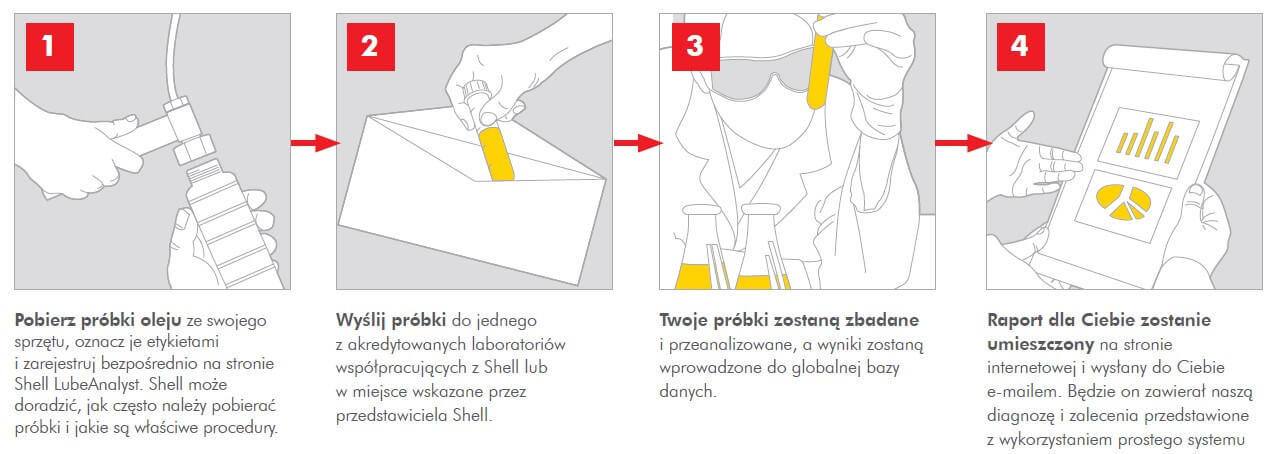
Sampling quality determines analysis quality
An advanced laboratory cannot compensate for a sample that does not represent the oil actually working in the machine. For repeatable condition monitoring, establish a standard sampling procedure.
Use the same sampling point
Take successive samples from a defined location that represents the active oil in the system. Avoid comparing samples taken from different points unless the diagnostic purpose specifically requires it.
Sample under comparable operating conditions
Where safe and consistent with the equipment procedure, sample after the oil has circulated and the machine has reached a representative operating condition. Sampling cold, stagnant oil from the bottom of a reservoir can produce a very different result from sampling circulating oil.
Avoid introducing contamination
Use clean sampling equipment and bottles. Do not touch the inside of the bottle or cap. Where a sampling valve is used, follow the defined flushing procedure before filling the bottle.
Record what happened to the machine
A good sample record should include information relevant to interpretation, for example:
- machine and component identification,
- oil brand, product and viscosity grade,
- oil operating hours where known,
- machine operating hours,
- recent top-ups or oil changes,
- filter changes,
- repairs or unusual operating events.
Which machines and lubricants can be monitored?
The current Melkib and Shell materials show a broad range of industrial and mobile applications, including:
- engines,
- gearboxes and final drives,
- axles and transmission systems,
- hydraulic systems,
- industrial gear units,
- stationary gas engines,
- air and gas compressors,
- refrigeration compressors,
- circulating-oil systems and bearings,
- turbines,
- heat-transfer systems,
- transformer and electrical insulating oils,
- marine and selected aviation applications.
Not every application uses the same laboratory package. For example, the diagnostic priorities for a hydraulic oil can differ significantly from those for a gas-engine or turbine oil.
Oil analysis and condition-based maintenance
A fixed oil-change interval is easy to administer, but it does not always reflect the actual condition of the lubricant. In suitable applications, regular oil analysis can support a shift toward condition-based maintenance.
Possible benefits include:
- detecting deterioration before a critical failure develops,
- planning maintenance instead of reacting to an unexpected stop,
- avoiding unnecessarily early oil changes,
- confirming whether an extended drain interval is technically justified,
- checking the effect of filtration, contamination-control or maintenance improvements.
How to read an oil-analysis report
The correct interpretation depends on the report format and test package, but a useful review sequence is:
- Check the sample identity. Confirm that the machine, lubricant and sampling date are correct.
- Read the overall condition or diagnostic status.
- Review abnormal parameters. Do not focus only on one number without checking related results.
- Compare the result with previous samples.
- Check recent maintenance events. A top-up, oil change or repair can explain a sudden change in the trend.
- Translate the diagnosis into an action. The action may be resampling, filtration, checking for water ingress, inspecting a component or planning an oil change.
- Confirm the result after corrective action. A follow-up sample helps verify whether the intervention worked.
Common mistakes in oil-condition monitoring
- taking samples from different points each time,
- sampling immediately after a large top-up without recording it,
- using dirty sampling equipment,
- sending a sample with incomplete machine or lubricant information,
- changing the lubricant but continuing the old trend without documenting the change,
- reacting to a single abnormal value without checking the rest of the data,
- waiting for visible oil deterioration before performing the first analysis,
- using analysis only after a failure instead of building a baseline while the machine is healthy.
Where can you order oil analysis from Melkib?
The current English Melkib range of Shell LubeAnalyst services is available in the Oil research category. The Polish range includes multiple Standard, Plus and Premium test packages selected for different equipment groups and diagnostic requirements.
Planning an oil-condition monitoring programme?
Prepare the machine type, lubricant currently in use, sump or system volume, operating hours, current oil-change interval and any recurring problems. This information helps determine which analysis package and sampling frequency are appropriate.
FAQ – industrial oil analysis
Why analyse oil if the machine is still running normally?
Because many contamination, wear and lubricant-degradation processes develop gradually. Establishing a baseline while equipment is operating correctly makes later abnormal trends easier to recognise.
Can oil analysis predict every machine failure?
No. It can provide early warning of many lubricant-, contamination- and wear-related conditions, but it cannot detect every mechanical or electrical failure. It should be combined with inspections and other condition-monitoring methods.
Can oil analysis help extend oil-change intervals?
Yes, where the maintenance strategy and OEM requirements allow it. Trend data can help determine whether the lubricant remains fit for service, but the decision should consider the complete machine and operating context.
How often should oil be sampled?
There is no universal interval. Sampling frequency depends on equipment criticality, oil volume, operating severity, historical results and the speed at which a developing fault could become critical.
Why is sampling from the same point important?
Because trend analysis depends on comparing like with like. Changing the sampling location can change particle concentration, water content and other measured properties even when the machine itself has not changed.
Is one laboratory result enough to diagnose the machine?
Usually not. The strongest interpretation combines the current result, historical trend, machine design, operating conditions and maintenance history.