




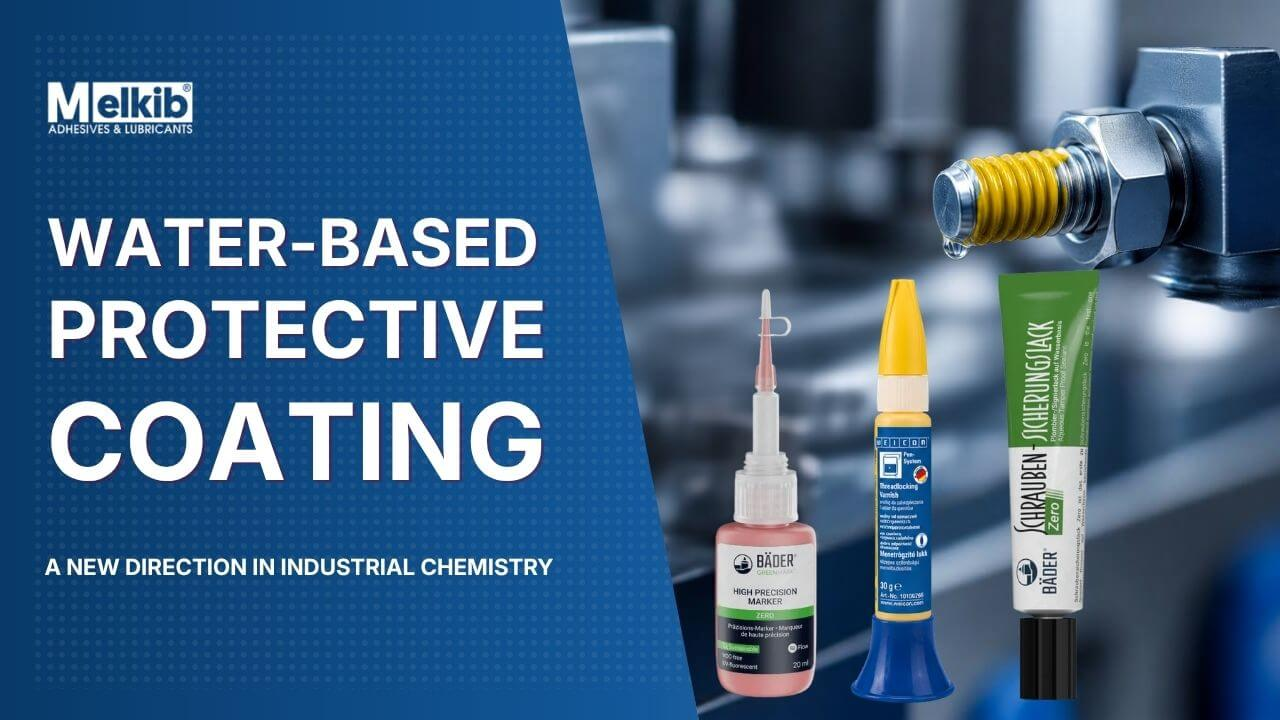
If the thread inspection lacquer used so far was doing its job, why would a manufacturer change the formulation? In a modern production environment, a clearly visible inspection mark is no longer the only consideration. Operator working conditions, the chemical classification of the product, emissions of volatile substances and the possibility of reducing the use of conventional solvent-based systems are becoming increasingly important.
WEICON Threadlocking Varnish is a good example: the product is moving to a water-based formulation. This is not an isolated development. Lackfabrik Bäder has been developing its water-based Zero range and the broader Greenmark® concept for years, while Metron Optics positions its water-based Torque Seal formulation as a more modern alternative to conventional products of this type. Together, these examples point to a wider shift in the chemistry used for visual inspection of bolted connections.
Key takeaways
- The move towards less hazardous substances and technologies is a broader direction in industrial chemistry, not simply a change affecting one product.
- WEICON is switching Threadlocking Varnish to a water-based formulation while retaining its core functions: marking, sealing and visual inspection of connections.
- According to the safety data sheet for the new water-based WEICON formulation, the finished mixture is not classified as hazardous under CLP.
- Bäder has made water-based systems a deliberate strategic direction within Greenmark®, with the Zero range being its most direct solution in the torque-seal and inspection-lacquer category.
- Metron Optics also offers water-based products for visual inspection of connections, so the trend is not limited to two European manufacturers.
- An inspection lacquer reveals relative movement or tampering, but it should not be confused with an anaerobic adhesive used to mechanically lock a thread.
- A water-based formulation is not automatically the best solution for every application. Process time, temperature, media exposure, surface condition and application method still need to be checked.
Why are manufacturers changing industrial chemical formulations?
Formulation changes are not simply driven by a trend towards products marketed as “eco-friendly”. In industrial applications, what matters far more is reducing a specific risk while maintaining the technical function required by the process.
The European Chemicals Agency points out that companies in the European Union are increasingly replacing hazardous chemicals and manufacturing processes with safer substances, technologies or redesigned products. Reasons may include regulatory requirements, worker and consumer safety, customer expectations, environmental objectives and improvements to the manufacturing process itself.
This does not mean that the issue can be reduced to a simple equation of “solvent-based = bad, water-based = good”. ECHA also stresses that substitution should take into account not only chemical hazards, but also exposure, technical performance, process economics, energy and resource consumption and the full life cycle of the solution.
This is particularly relevant for inspection lacquers. These products are often applied manually, many times during a single shift and directly at the assembly workstation. From the plant's perspective, the durability of the inspection mark therefore matters alongside the type of chemistry the operator is regularly exposed to.
What is WEICON changing in Threadlocking Varnish?
WEICON has decided to change Threadlocking Varnish from its previous formulation to a water-based system. One of the main reasons given by the manufacturer is the protection of people who work with chemical products.
The fundamental function of the product remains unchanged. Threadlocking Varnish is intended for visual inspection of connections, marking, sealing and tamper detection. Once applied, it creates a visible bridge of lacquer between two components. If a screw, nut or adjustable component changes position, the mark breaks or shows visible damage.
This allows an operator, quality inspector or service technician to see without additional tools whether a connection has been adjusted, loosened or subjected to relative movement.
| Property | New version |
|---|---|
| Formulation type | Water-based |
| Mixture classification | According to the SDS for the new water-based formulation, the product is not classified as hazardous under CLP |
| Primary function | Visual inspection, marking, sealing and tamper detection |
| Electrical conductivity | Non-conductive coating |
| UV and weathering resistance | At least 4 years according to DIN EN ISO 2810 |
| Full cure | Approximately 12 hours |
| Colours | Red, yellow and green |
The new Threadlocking Varnish is therefore intended to meet the same technical need as before: quick visual inspection of a connection and a clear indication of possible tampering. The main change is the chemical formulation.
At Melkib, the new version is already available as the 30 g yellow variant:
...
What does a water-based formulation mean for the user?
A different chemical profile
The main change is not how the inspection mark is applied. The operator still places a small amount of product across the connection. What changes is the formulation they work with.
For WEICON's new water-based version, the current SDS is particularly important: the finished Threadlocking Varnish mixture is not classified as hazardous under the CLP Regulation. It should not be confused with the previous solvent-based formulation, which had a different classification. This specific technical information is more meaningful than general labels such as “green”, “eco” or “environmentally friendly”.
A more favourable classification does not eliminate workplace safety requirements
A product that is not classified as a hazardous mixture is still a chemical preparation. The current safety data sheet, workplace hygiene requirements and the procedures applicable at the facility must still be followed.
Instead of asking whether a water-based lacquer is “completely safe”, a better question is whether using it can reduce a specific risk at the workstation without compromising the process.
A more favourable hazard profile must not come at the expense of technical performance
A formulation change only makes sense if the product still adheres properly, creates a clearly visible mark, breaks in the expected way when disturbed and provides the resistance required in the intended environment.
The new formulation should therefore be tested on the actual component, especially where surfaces are painted, zinc-coated or contaminated with process oil, or where the mark may come into contact with fuel, cleaning agents or other media.
Inspection lacquer and threadlocker – they are not the same thing
This is one of the most important distinctions when selecting a product for threaded fasteners. A product such as Threadlocking Varnish or Torque Seal is primarily a visual indicator. It shows whether marked components have moved relative to one another or whether the connection has been disturbed.
An anaerobic threadlocking adhesive works inside the metal threaded connection. It cures between mating metal surfaces under restricted oxygen exposure and is used, among other purposes, to mechanically reduce self-loosening caused by vibration.
The two technologies can complement one another. A screw can first be secured with an anaerobic threadlocker and, after correct tightening, additionally marked with an inspection lacquer. The first product stabilises the connection; the second provides an immediate visual reference during inspection.
If you want to compare different types of inspection seals, markers and thread-securing solutions, see the Melkib guide to selecting tamper-evident seals and markers.
Bäder Zero and Greenmark® – a strategy built around water-based systems
WEICON's change becomes particularly interesting when compared with the direction previously taken by Lackfabrik Bäder. Rather than developing a single water-based product, the manufacturer built the Greenmark® brand around the concept.
Bäder describes Greenmark® as a family of marking and coating systems developed without substances classified as hazardous, with a strong focus on water-based technologies. The manufacturer explicitly describes a strategic decision to place greater emphasis on high-performance water-based systems in new developments and thereby improve the environmental profile of its portfolio.
The first such solution was the Zero range for marking and visual inspection of bolted connections. Bäder states that Zero is formulated on a 100% water basis, contains no organic solvents and has a VOC content of 0 g/l.
Zero is available in a wide range of colours and packaging formats, allowing the system to be adapted both to manual service work and to more repetitive manufacturing processes.
Zero in a tube – a conventional inspection seal
The standard Bäder Zero works in a similar way to conventional inspection lacquers: once applied, it creates a visible mark between components. If that mark is broken, a change in position or tampering can be detected.
High Precision Marker – when a very small mark is required
For electronics, small screws and adjustment components, a standard tube nozzle may be too large. High Precision Marker Zero uses the same water-based technology but gives the operator more precise control over where the material is placed and how much is applied. The manufacturer specifically designed it for small components and inspection marks.
Brush Marker Zero – when a brush is more convenient
Brush Marker Zero features an integrated brush and is intended, among other applications, for securing knobs, potentiometers, screws, nuts and other adjustable components. It illustrates that the development of water-based systems is not limited to chemistry alone – manufacturers are also refining the way these products are applied.
...
More variants are available in the tamper-evident seals and markers category.
Are other manufacturers moving in the same direction?
Yes. It is important, however, to distinguish products that perform essentially the same function from other water-based technologies used with threaded connections.
Metron Optics – a water-based Torque Seal instead of a conventional formulation
Metron Optics communicates a very similar approach. The manufacturer offers Metron Marker Torque Seal, a water-based, non-conductive system for making inspection marks on nuts, screws, connectors and other components.
Metron explicitly describes the product as a redesign of the traditional torque-seal concept. The manufacturer highlights the water-based formulation and the reduction of issues associated with the typical fumes and solvents found in older technologies.
This is particularly relevant because the product serves practically the same purpose as WEICON Threadlocking Varnish and Bäder Zero: the visible mark is intended to reveal relative component movement, rotation of a screw or nut, or tampering with the connection.
Henkel LOCTITE – water-based technology in other threaded applications
Henkel's portfolio provides an even broader perspective. Products from the LOCTITE DRI family, including DRI 503HV and DRI 517, are water-based, pre-applied thread sealants.
They are not equivalents of WEICON inspection lacquer and should not be used interchangeably. Their function is different: the material is applied to the thread in advance and, after drying, forms a sealing layer that is activated during subsequent assembly.
It is nevertheless another example showing that water-based formulations are no longer limited to simple paints or consumer products. They are also being developed for specialised industrial chemical processes involving threaded connections.
WEICON, Bäder and Metron – what do they have in common?
| Manufacturer / system | Base | Primary function | Safety approach | Available from Melkib |
|---|---|---|---|---|
| WEICON Threadlocking Varnish | Water-based | Marking, sealing and tamper detection | The SDS for the new water-based formulation does not classify the finished mixture as hazardous under CLP | Yes – the new formulation is currently available as the 30 g yellow variant |
| Bäder Zero | 100% water-based according to the manufacturer | Connection inspection, marking and tamper indication | The manufacturer states that it contains no organic solvents, has a VOC content of 0 g/l and is part of the Greenmark® concept | Yes – including High Precision Marker and Brush Marker |
| Metron Marker Torque Seal | Water-based | Torque marking, detection of relative movement and tampering | The manufacturer positions the formulation as non-toxic and free from the typical compromises associated with conventional solvent-based systems | No |
The most interesting point is therefore not one particular specification of any of these products, but their common direction: manufacturers are trying to retain a simple and highly useful visual inspection function while changing the chemistry behind the coating.
Is a water-based system always the better choice?
No. This is precisely why a technology change should not be based solely on the phrase “water-based”.
Bäder's own portfolio provides a useful example. The manufacturer offers both the water-based Zero range and the solvent-based Fast Dry range. Zero has a manufacturer-declared VOC content of 0 g/l and becomes dust-dry after approximately 10 minutes. Fast Dry contains organic solvents and approximately 520 g/l VOC, but becomes dust-dry after only around one minute.
| Criterion | Bäder Zero | Bäder Fast Dry |
|---|---|---|
| Technology | Water-based | Solvent-based |
| VOC according to the manufacturer | 0 g/l | 520 g/l ±20 g/l |
| Dust-dry time | Approx. 10 min | Approx. 1 min |
| Application temperature | 2°C to 40°C | -20°C to 40°C |
| Temperature resistance | -80°C to +120°C | -80°C to +160°C |
If a plant's main objective is to reduce the use of conventional solvents, a water-based system may be a natural candidate for testing. If, however, the production line requires the inspection mark to dry almost immediately or operates outside the temperature range of the water-based system, another technology may be more suitable.
This is exactly the conclusion reflected in ECHA materials on substitution: an alternative should be assessed not only in terms of hazard, but also in terms of technical function and the actual conditions of the process.
How is the WEICON change being introduced at Melkib?
The transition to the new formulation is therefore gradual. This is particularly important for plants that specifically want to introduce the water-based version because of their own occupational safety requirements, purchasing procedures or an approved production process.
The current product page for the yellow variant is available here: WEICON Threadlocking Varnish yellow 30 g – water-based version.
For the red and green versions, the Threadlocking Varnish name alone should not be taken as confirmation that the item currently in stock already uses the new formulation. If the formulation type is a critical requirement, the current batch should be confirmed before purchase.
How can you safely switch to the new formulation?
- Define the actual function of the lacquer. Is it used to confirm a tightening operation, detect later movement or tampering, mark a quality-control check, or simply identify a component?
- Compare the current documentation. When changing formulation, use the latest TDS and SDS for the exact variant that is to be introduced.
- Check the actual surface. Carry out a trial on the real metal, paint coating, zinc coating, plastic or other substrate present at the workstation.
- Check the process time. The mark must reach the required stability before transport, packaging or the next production operation.
- Consider media and temperature. Oils, fuels, cleaning agents, IPA, coolants and elevated temperatures may affect coating performance.
- Select the application method. A tube may be sufficient for a large screw, whereas electronics may be easier to mark with a precision marker or brush.
- Verify the result over time. Assess not only the fresh mark but also its adhesion and readability after the actual operating cycle of the equipment.
This approach treats a formulation change as a controlled technology implementation rather than a simple substitution of one package for another.
FAQ – water-based inspection lacquers for bolted connections
Does a water-based inspection lacquer mechanically lock the thread?
It should not be assumed to replace an anaerobic threadlocker. The primary function of this type of lacquer is to leave a visible mark that makes relative movement or tampering detectable. If mechanical protection against self-loosening is required, an appropriate threadlocking product must be selected.
Is a water-based product automatically safe?
No. The presence of water as the base does not by itself determine the safety profile. The complete formulation and the current classification of the specific mixture in the SDS must be checked. For the new water-based WEICON formulation, the current SDS does not classify the finished mixture as hazardous under CLP. The previous formulation had a different classification.
Why replace a solvent-based lacquer if it works well?
A change may be worthwhile if the new formulation retains the technical properties required by the process while reducing a specific risk or exposure associated with the chemistry being used. The decision should nevertheless be confirmed by testing under real process conditions.
Is WEICON the only company developing water-based inspection lacquers?
No. Bäder develops its water-based Zero range within the broader Greenmark® strategy, while Metron Optics offers a water-based Torque Seal for detecting relative movement and tampering on connections. This shows that water-based solutions are being developed by several manufacturers within this product category.
Are all WEICON colours available from Melkib already water-based?
No. As of 3 September 2026, the new formulation is used for the 30 g yellow variant. Current stocks of the red and green variants still use the previous formulation.
When might a solvent-based lacquer still be the better option?
When its specific properties are required by the process. For example, Bäder Fast Dry reaches a dust-dry condition much faster than the water-based Zero system and has a wider declared temperature range. If these parameters are critical, a switch to a water-based system should first be evaluated and tested.
Can a water-based inspection lacquer simply be introduced without validation?
This is not recommended in production processes. At minimum, it is worth checking adhesion to the actual substrate, behaviour after exposure to relevant media, the time required before the component can be handled further and the readability of the mark after operation at the target temperature.
WEICON's change reflects a wider direction in industrial chemistry
WEICON's move to a water-based formulation for Threadlocking Varnish is interesting not because another “green” product has entered the market. What matters more is that the manufacturer is trying to retain the existing technical function while changing the type of chemistry that operators work with every day.
Bäder demonstrates a similar direction in a more developed form, with the water-based Zero range becoming part of the broader Greenmark® concept. Metron follows a comparable approach with Torque Seal, while water-based technologies are also appearing in other product categories associated with threaded connections, as demonstrated by LOCTITE DRI solutions.
This does not mean the end of solvent-based chemistry, nor does it mean that every water-based formulation is automatically superior. Ultimately, a plant needs a product that is technically appropriate, can be used consistently and fits the safety requirements of the process.
Want to check whether a water-based inspection lacquer will work in your process?
Tell us the material, type of connection, operating temperature, media present in the application and the required process time. We can help you compare the available solutions and select suitable variants for testing.
Technical sources
- WEICON GmbH & Co. KG, Threadlocking Varnish – Technical Data Sheet, edition dated 21.08.2026.
- WEICON GmbH & Co. KG, Threadlocking Varnish – Safety Data Sheet, version 5, 20.08.2026.
- WEICON – Threadlocking Varnish, official product page.
- Lackfabrik Bäder – Greenmark®.
- Lackfabrik Bäder – Zero Range Torque Sealant.
- Lackfabrik Bäder – comparison of Torque Sealant product families.
- Metron Optics – Metron Marker Torque Seal.
- Henkel – LOCTITE DRI 517, water-based pre-applied thread sealant.
- European Chemicals Agency – substitution to safer chemicals.