





A successful first bonding trial does not mean that the technology is ready for production. The joint should be checked under conditions that reflect its real service: mechanical load, temperature, humidity, chemicals and time.
For this reason, adhesive-bond validation should not be reduced to one strength value from a testing machine. The failure mode, repeatability of results and behaviour after ageing are equally important.
This guide explains how to select a test method according to the real risk of the application and how to build a practical qualification plan before serial production.
Key takeaways
- The test should reflect the actual load mode of the joint.
- A result in N/mm² alone is not enough; the location and type of failure must also be assessed.
- Qualification specimens should reproduce the production materials and surface preparation as closely as possible.
- Comparing results before and after ageing provides much more information than testing a fresh joint only.
- Standardised specimens are useful for comparing technologies, but they do not replace testing on the real component when geometry is critical.
What are we actually validating?
A technical data sheet describes how an adhesive performed under the manufacturer’s specified test conditions. In the real product, however, additional variables appear: the actual metal alloy, coating, plastic or composite, surface preparation, bond-line thickness, joint geometry, temperature and load mode.
Therefore, qualification does not assess only the adhesive product. In practice, it assesses the complete system:
material → surface preparation → adhesive → geometry → application process → cure → service conditions
This is important in production engineering. A change of sheet supplier, coating, laminate, cleaning agent or curing condition can affect the joint even when the adhesive product number remains unchanged.
How should the test method be selected?
There is no single test that answers every question. First determine what the real joint is most likely to experience: shear, peel, sustained static load, moisture-related adhesion loss, thread loosening or another failure mode.
| What do we want to assess? | Example method | Reference |
|---|---|---|
| Lap-joint shear | Tensile loading of a single-lap bonded specimen | ISO 4587 / EN 1465 |
| Peel resistance | Floating roller peel, T-peel or 180° peel | EN 1464, ISO 11339, ISO 8510-2 |
| Elastic adhesive or sealant | Bead peel test | ISO 21194 |
| Cylindrical retaining joints | Pin-and-collar test | ISO 10123 |
| Threadlocking | Torque-strength test of bonded threaded fasteners | ISO 10964 |
| Adhesive shear behaviour | Thick-adherend tensile test | ISO 11003-2 |
| Long-term static load | Time-to-failure under sustained load | EN 15336 |
Other specialist methods also exist, including torsional shear tests, wedge tests and bending/peel procedures. They should be used when they correspond to the real technical question, not simply because a standard exists.
Lap-shear testing: a useful reference, but not the whole picture
The single-lap joint is one of the most common methods for comparing adhesives, substrates and surface-preparation variants.
ISO 4587 specifies a method for determining tensile lap-shear strength of rigid-to-rigid bonded assemblies. A commonly used geometry associated with EN 1465 uses specimens approximately 100 mm long, 25 mm wide and 1.6 mm thick with a 12.5 mm overlap.
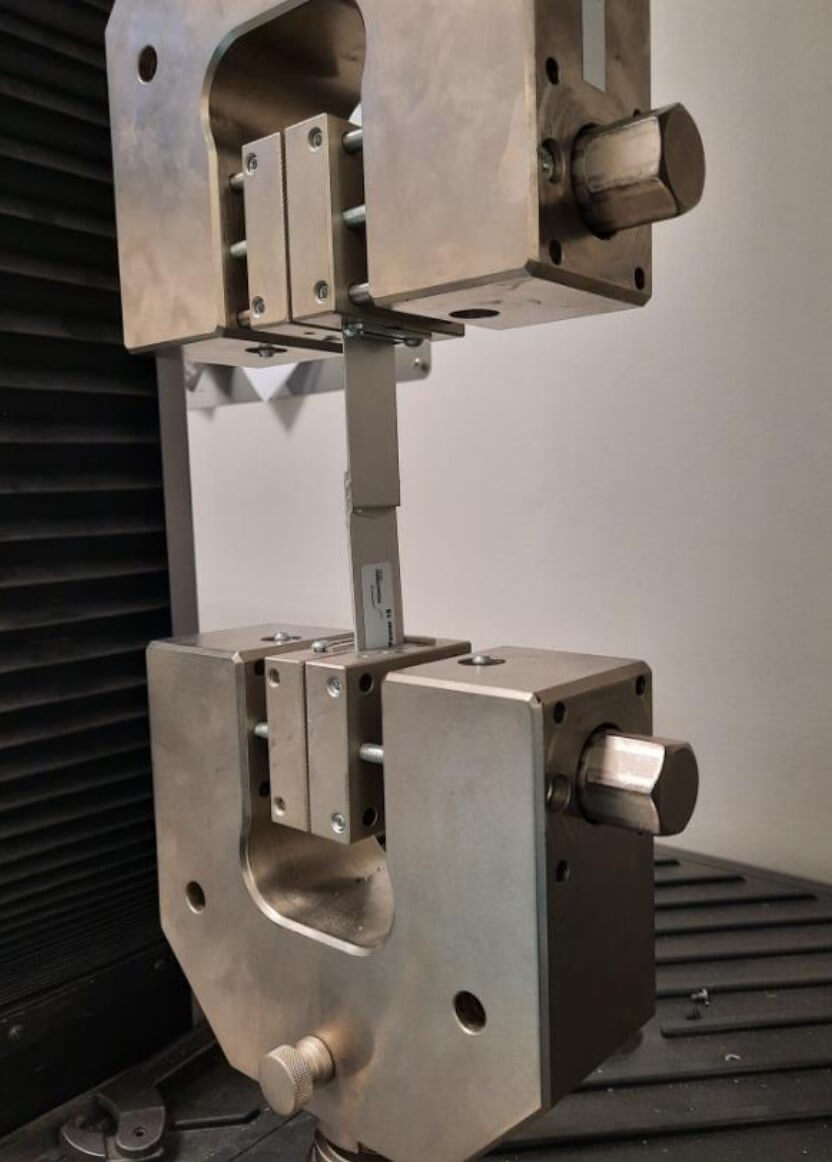
During the test, the bonded specimen is loaded in tension until failure. The result is useful for comparing technology variants, but it is not automatically a design value for every real joint.
Geometry, adherend stiffness and bond-line thickness influence the stress distribution. For this reason, comparative specimens should be prepared consistently and according to the selected standard.
For a more detailed discussion of this method, see Testing of adhesive joints – ISO 4587.
Failure mode: often as important as the strength value
After testing, examine the fracture surfaces. ISO 10365:2022 provides standard designations for the principal failure patterns of bonded assemblies.
| Failure mode | Typical observation | What should be checked? |
|---|---|---|
| Adhesive failure | The adhesive separates mainly from one substrate. | Surface preparation, contamination, wetting, primer, coating quality and adhesive compatibility. |
| Cohesive failure | The adhesive layer breaks internally and adhesive remains on both substrates. | Adhesive strength, cure, bond-line thickness and applied load. |
| Substrate failure | The base material breaks outside or close to the joint. | Whether this failure mode is acceptable for the product and whether the substrate has become the limiting element. |
| Mixed failure | More than one failure mechanism is visible. | Repeatability of preparation, local stress concentrations and variation of the bonding surface. |
A particularly useful warning sign appears after ageing. If a fresh specimen fails cohesively but the aged specimen begins to debond cleanly from the substrate, this can indicate deterioration of the adhesive interface even if the average strength has not yet fallen dramatically.
Peel testing: when the joint is loaded from an edge
A lap-shear test is not suitable for every construction. Where one adherend is flexible or where the joint can be loaded from an edge, peel resistance may be more relevant.
EN 1464 describes a floating roller peel method for a flexible-to-rigid bonded assembly. A typical geometry uses a 25 mm wide specimen with a bonded length of approximately 200 mm.
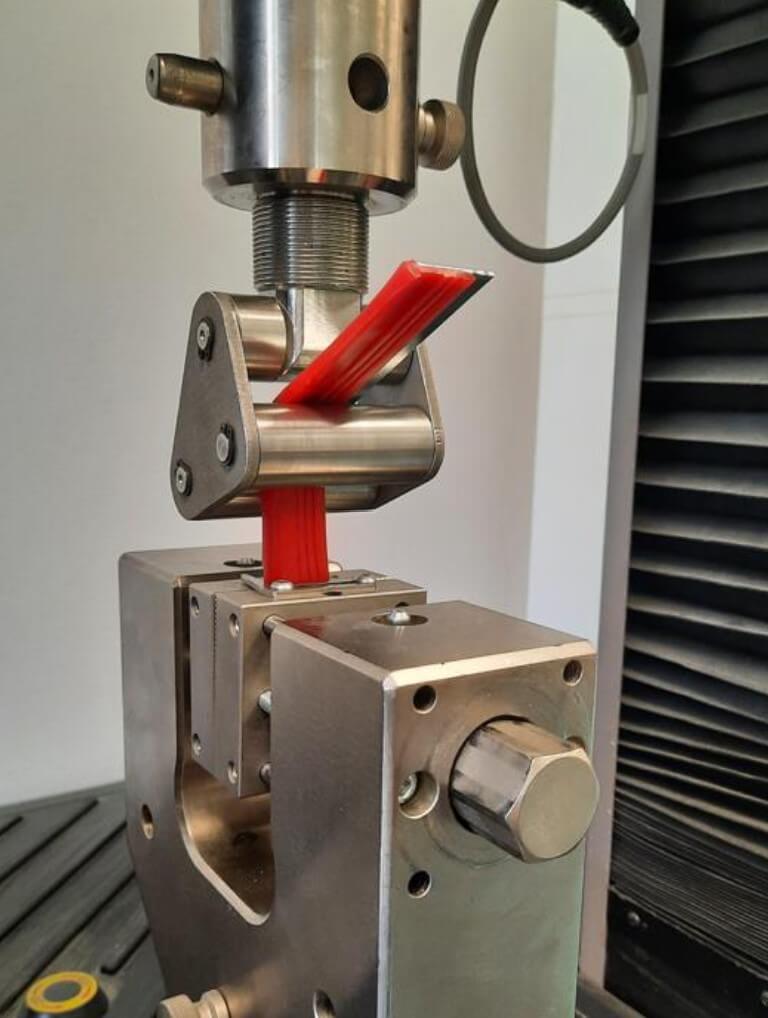
In shear, the load is distributed over a much larger bonded area. During peel, the load is concentrated near the moving separation front. This is why a joint that performs very well in lap shear can perform much worse when loaded from an edge.
The practical design conclusion is simple: wherever possible, adhesive joints should be designed to reduce peel and cleavage and transfer more of the load through shear.
How are elastic adhesives and sealants evaluated?
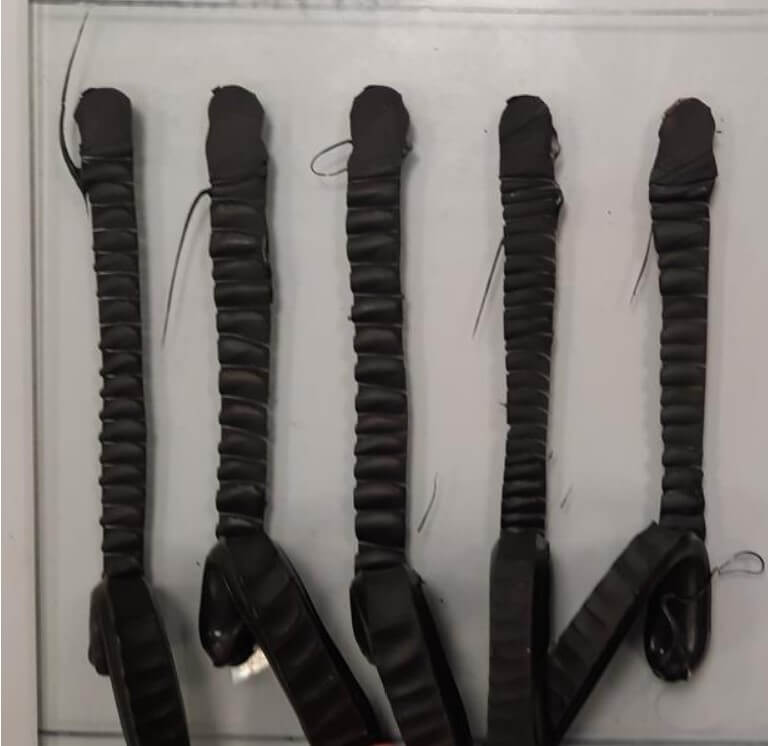
A conventional lap-shear specimen does not always describe the behaviour of a flexible adhesive or sealant well. ISO 21194:2019 defines a bead peel test for evaluating the adhesion of elastic adhesives and sealants to different substrates.
The method can be used to compare surface pretreatments and to assess how substrate, preparation and ageing affect long-term adhesion.
Ageing tests: a fresh specimen is only the beginning
A joint that performs very well after full cure may behave differently after long exposure to water, heat, chemicals or cyclic conditions. ISO 9142 provides guidance for selecting laboratory ageing conditions for bonded joints.
The ageing programme should correspond to the actual service risk. Laboratory ageing does not automatically predict exact service life; ISO explicitly notes that there is no direct universal relationship between accelerated laboratory exposure and real-life lifetime.
The most useful arrangement: test before and after ageing
| Stage | What do we do? |
|---|---|
| 1. Reference | Test correctly cured specimens and record strength and failure mode. |
| 2. Exposure | Expose other specimens to temperature, humidity, liquid media or a cycle relevant to the application. |
| 3. Repeat test | Perform the same mechanical test after exposure. |
| 4. Compare | Assess the change in average strength, scatter and failure mode. |
This approach can reveal cases where average strength changes only slightly but the failure mechanism changes significantly. For long-term joint durability, such a change may be more important than a small percentage difference in the numerical result.
What should an ageing programme include?
The answer depends on the product. Typical exposures may include:
- constant temperature and humidity,
- cyclic temperature or climate conditions,
- immersion in water or process chemicals,
- salt-containing environments where corrosion is relevant,
- UV exposure for applications where radiation reaches the bond or substrate,
- sustained mechanical loading or creep where the joint carries long-term static load.
Do not copy a severe automotive or aerospace ageing cycle into another application without understanding what failure mechanism it is intended to reproduce.
When can a bonding technology be considered validated?
There is no universal strength value that makes every adhesive joint “good”. The acceptance criteria depend on the product, design requirements, customer specification and consequences of failure.
| What do we assess? | Example question |
|---|---|
| Strength | Does the joint carry the required load with the defined safety margin? |
| Repeatability | Do successive specimens produce comparable results? |
| Failure mode | Is the failure mechanism acceptable and stable? |
| Ageing | How much performance is retained after the required exposure? |
| Product function | Does the joint still provide sealing, geometry, stiffness or another required function? |
The highest average result does not always represent the best production process. A technology with slightly lower average strength but low scatter and stable behaviour after ageing can be much safer for serial production.
How does practical qualification work before production launch?
- Define the real materials. Include coatings, finishes and actual production grades.
- Define surface preparation. Use the same cleaner, abrasion, primer or activation process intended for production.
- Define service conditions. Include load, temperature, humidity, chemicals and expected life.
- Prepare comparable specimens. Control bond-line thickness, adhesive quantity and curing conditions.
- Test a reference group. Record strength and failure mode.
- Age the required specimen groups. Use exposure relevant to the application.
- Repeat the same test. Compare average value, scatter and failure mode.
- Test the real component. Standard specimens are excellent for comparing variants, but they do not reproduce every edge, stiffness difference or stress concentration in the actual product.
- Translate the result into a production process. Define surface preparation, adhesive quantity, application time, fixture method, cure and release criteria.
Adhesive joint testing and technology qualification with Melkib
A qualification plan can include comparison of adhesives, surface-preparation variants, mechanical tests, failure-mode analysis and before/after ageing comparisons.
The most useful information at the beginning of a project is:
- substrates and coatings,
- joint geometry,
- expected loads,
- temperature and environmental exposure,
- chemicals or process media,
- required service life and acceptance criteria.
FAQ – adhesive bond testing
Is one lap-shear test enough to approve an adhesive?
Usually not. Lap shear is an excellent comparison method, but the qualification programme should reflect the real load mode, environment and consequences of failure.
Why should the fracture surfaces be inspected?
Because the failure mode can reveal whether the limiting factor is adhesion to the substrate, cohesive strength of the adhesive, the substrate itself or local process variation.
Does bond-line thickness affect shear results?
Yes. Changing bond-line thickness changes the stress distribution in the specimen. Comparative tests should therefore use consistent specimen geometry and preparation.
Why test before and after ageing?
The comparison shows how environmental exposure changes both strength and failure mode. A fresh joint can perform well even when the long-term interface is not durable.
Can accelerated ageing predict exact service life?
Not automatically. ISO 9142 states that laboratory ageing results are not directly equivalent to real service life unless a correlation has been established for the specific application.
Which standard describes failure modes?
ISO 10365:2022 defines the principal failure-pattern designations used when assessing bonded assemblies after mechanical testing.
Want to verify a joint before production launch?
Send information about the materials, joint geometry, surface preparation, loads and service environment. On this basis, a test plan can be selected to answer the real technical question rather than simply generate a laboratory number.
Standards and technical sources
- Melkib – current Polish counterpart: adhesive-joint validation before production.
- Melkib – previous English version of this article.
- ISO 4587:2003 – tensile lap-shear strength of rigid-to-rigid bonded assemblies.
- ISO 10365:2022 – designation of main failure patterns.
- ISO 11339:2022 – T-peel test for flexible-to-flexible bonded assemblies.
- ISO 21194:2019 – bead peel test for elastic adhesives.
- ISO 10123:2013 – shear strength of anaerobic adhesives using pin-and-collar specimens.
- ISO 10964:1993 – torque strength of anaerobic adhesives on threaded fasteners.
- ISO 11003-2:2019 – tensile test method using thick adherends.
- ISO 9142:2003 – selection of laboratory ageing conditions for bonded joints.
- EN 1465 – tensile lap-shear testing of rigid-to-rigid bonded assemblies.
- EN 1464 – floating roller peel testing.
- EN 15336 – determination of time to failure under static load.