




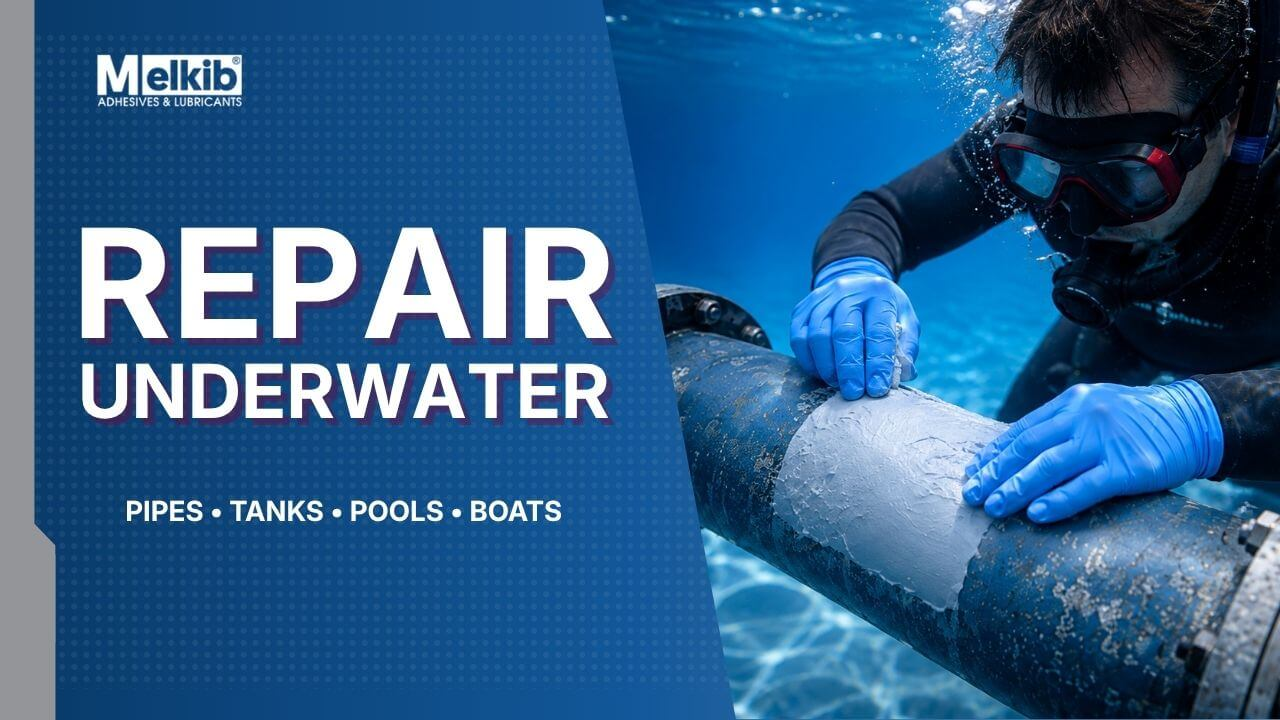
Not every leak can be repaired after the component has been drained, dismantled and thoroughly dried. In maintenance and service work, the problem may involve a wet pipe, tank, pump, marine component or a surface that remains completely submerged.
Repairs in these conditions are possible, but only when the application requirements are clearly understood. Water resistance after curing does not automatically mean that an adhesive or repair compound can be applied to a wet surface or underwater. The substrate, size of the damage, movement of the component, pressure and actual cause of the failure also need to be considered.
This guide explains how to assess the damage and how small local repairs, larger surface rebuilding, emergency pipe repairs and repairs to tiles or mosaics in swimming pools require different approaches.
Key takeaways
- “Water-resistant” and “suitable for underwater application” are not the same technical claim.
- Before repairing a leak, identify the substrate, size of the damage, operating conditions and whether pressure is present.
- WEICON Repair Stick Aqua is designed for quick, local repairs on damp and wet surfaces and for underwater applications.
- WEICON UW is intended for more extensive repair and maintenance work on wet surfaces and also provides very good adhesion when bonding underwater.
- Pipe Repair Kit is a dedicated emergency pipe repair system that uses a water-activated, fibreglass-reinforced repair tape.
- Pool Repair-Kit is designed for repairs to tiles, mosaic tiles and similar rigid surfaces, including repairs carried out underwater.
- An emergency repair does not replace an assessment of the underlying cause of corrosion, cracking or structural damage.
Can a leak really be repaired underwater?
Yes. Specialist epoxy repair systems are available for application on damp and wet surfaces, and some are specifically designed for use on fully submerged components.
This property must not be assumed for every epoxy adhesive. A cured epoxy may resist water very well and still require a dry substrate during application.
In practice, three different situations need to be distinguished:
- water exposure after curing – the repair is completed under the required application conditions and is exposed to water only after curing,
- application to a damp or wet surface – the substrate cannot be completely dried before the repair,
- application underwater – the repair compound is applied while the component remains submerged.
What should you check before selecting a repair system?
The selection process should not start with the question “Which adhesive is strongest?”. The first step is to describe the failure correctly.
What exactly is damaged?
A small crack in a housing, a perforated pipe, material loss on a tank and a detached pool tile are different repair problems and may require different application methods.
What is the component made of?
Identify the actual substrate and any surface layer present. Painted metal, corroded steel, ceramics, concrete, composites and plastics cannot be treated as the same substrate simply because all of them are exposed to water.
Is the component rigid or flexible?
Epoxy repair compounds are a natural choice for filling defects in rigid or relatively rigid components. They should not automatically be used instead of a flexible patch on a thin membrane that bends, stretches or folds during service.
Is there active flow or pressure?
A product suitable for underwater application is not automatically capable of stopping any flowing medium at any pressure. Where the installation allows it, reduce the flow and depressurise the damaged section before beginning the repair.
Is the repair temporary, emergency or intended as a final repair?
Sealing a local perforation may stop a leak, but it will not restore wall thickness across a severely corroded area. Similarly, filling a crack does not replace a structural assessment of a fatigued or delaminated component.
Wet-surface application vs underwater application
This is one of the most important distinctions when choosing a repair system.
WEICON UW is described by the manufacturer as a mineral-filled epoxy resin system that adheres to wet and moist surfaces and provides very good adhesion even when bonding underwater.
Repair Stick Aqua is intended for quick repairs on damp and wet surfaces and for underwater applications.
Pool Repair-Kit has been developed for repair work on wet surfaces, including quick repairs carried out underwater.
Pipe Repair Kit works differently. Its repair tape is impregnated with resin that is activated by contact with water. This does not mean that the kit should automatically be treated as a universal system for every repair performed while fully submerged.
Which repair system should you choose?
| Situation | Suggested direction | Why? | Key limitation |
|---|---|---|---|
| Small local crack, hole or defect | WEICON Repair Stick Aqua | The kneadable putty format makes it easy to prepare a small quantity and press it directly into the defect. | The cured compound is rigid, so substrate movement must be considered. |
| Larger surface repair on a wet or submerged component | WEICON UW | The mineral-filled two-component epoxy paste is intended for repair and rebuilding work on wet surfaces. | The components must be mixed thoroughly and the substrate should be prepared as effectively as conditions allow. |
| Damaged pipe that can be wrapped | WEICON Pipe Repair Kit | The kit combines a repair putty with a fibreglass-reinforced repair tape. | Pressure, pipe geometry and the ability to wrap the repair area correctly must be assessed. |
| Damaged tile or mosaic in a swimming pool | WEICON Pool Repair-Kit | The manufacturer specifically positions the kit for fast repairs to tiles and mosaic surfaces, including underwater work. | This should not be transferred automatically to flexible pool liners. |
| Thin, flexible liner or membrane | A repair system confirmed for the specific membrane material | The repair needs to accommodate movement of the flexible substrate. | A rigid epoxy compound is not a universal substitute for a flexible patch. |
...
What does an underwater repair look like in practice?
The difference between a technical declaration and real-world application becomes particularly clear when working on a submerged component. The following demonstration shows a pipe repair carried out directly underwater.
The process includes preparing Repair Stick Aqua, fixing a reinforcing mesh, mixing the WEICON UW resin and hardener, applying the epoxy system to the mesh and securing the repaired area.
WEICON UW – for larger repairs
WEICON UW is a two-component, mineral-filled epoxy resin system with a pasty consistency.
The manufacturer recommends it particularly for repair and maintenance work on pipes, pumps, tanks and containers. Its formulation is designed to adhere to wet and moist surfaces and provides very good adhesion even when bonding underwater.
Compared with a repair stick, UW is better suited to situations where a larger area needs to be covered, a surface needs to be rebuilt or the repair requires reinforcement over a wider zone.
Wet-surface capability does not eliminate the need for surface preparation. If the epoxy is applied over loose corrosion, poorly bonded paint, deposits or other weak layers, the repair may adhere to that layer rather than to the sound substrate beneath it.
Repair Stick Aqua – for quick local repairs
WEICON Repair Stick Aqua is a ceramic-filled epoxy repair putty designed for quick repairs on damp and wet surfaces, including applications underwater.
The manufacturer lists applications such as sealing cracks, holes and leaks in water and fuel tanks, radiators, sanitary equipment and swimming pools, as well as use in sanitary and heating systems, electrical equipment and the marine sector.
The practical advantage of the stick format is that a small amount of material can be prepared and pressed directly into a local defect. For a larger repair area, a pasty system such as WEICON UW may be easier to apply.
Pipe Repair Kit – when the problem is a pipe
WEICON Pipe Repair Kit 5/15 is designed specifically for the emergency repair of defective and damaged pipes and pipelines.
The kit contains WEICON Repair Stick Multi-Purpose, a special fibreglass-reinforced repair tape, assembly instructions and protective gloves. The tape is impregnated with a special resin and is activated by contact with water.
The manufacturer lists stainless steel, aluminium, copper, PVC, many plastics, fibreglass, concrete, ceramics and rubber among suitable surfaces. Material compatibility should still be checked for the actual substrate, particularly for plastics with difficult-to-bond surfaces.
For the 5/15 variant, the repair tape reaches full cure and becomes load-bearing after approximately 30 minutes. This variant is also supplied with drinking-water approval.
Pool Repair-Kit – for tiles and mosaics
WEICON Pool Repair-Kit is intended for fast repairs on wet surfaces, including underwater applications.
The manufacturer highlights repairs to tiles, mosaic tiles and similar rigid surfaces. This makes the system particularly relevant where draining a swimming pool solely to carry out a small surface repair would be difficult or expensive.
This is a different problem from a puncture in a thin, flexible above-ground pool liner. A system intended for tiles and mosaics should not automatically be transferred to a flexible PVC or other membrane without confirmation of material compatibility and sufficient flexibility.
Why does the substrate matter?
Metal
When repairing a metal pipe, pump or tank, assess not only the metal itself but also corrosion and the condition of any existing coating.
If the visible hole is only one perforation within a much larger corroded area, locally sealing the leak may stop the immediate loss of fluid but will not restore the original wall thickness in the surrounding material.
Ceramics, tiles and mineral substrates
With pool tiles, the condition of the layer beneath the tile is as important as the ceramic itself. A loose tile, a failed substrate and a small local defect are not the same repair problem.
Plastics
“Plastic” is not a sufficiently precise substrate description. Different polymers have very different surface properties, and the same epoxy system will not provide the same level of adhesion to all of them.
For a critical repair, identify the actual polymer and confirm compatibility rather than selecting a repair material simply because the component operates in water.
Composites and laminates
A repair compound may be worth considering for a small local defect in a rigid composite component. Structural delamination of a hull laminate, however, is a different type of failure and requires assessment of the damaged area and an appropriate composite repair procedure.
Flexible liners and membranes
If the substrate repeatedly bends, stretches or folds during service, the repair needs to accommodate that movement. A rigid cured epoxy compound is not automatically appropriate for a thin flexible liner merely because the epoxy itself can operate in contact with water.
Can an active pressurised leak be sealed?
That depends on the damage, installation design, medium, pressure and repair system. It cannot be determined from the phrase “suitable for underwater application” alone.
An active flow may displace fresh material from the repair area, while system pressure can begin loading the repair before the material has achieved the required strength.
Where operating conditions allow:
- reduce or stop the flow,
- depressurise the damaged section,
- determine the true extent of the damage,
- prepare the substrate,
- apply the selected system according to its instructions,
- restore service conditions only after the required cure has been achieved.
For high-pressure process installations or systems carrying hazardous media, the repair method should be based on an appropriate engineering assessment of the installation rather than on the adhesive properties alone.
Boat repairs and marine applications
Marine environments are an obvious example of situations where the ability to work on damp, wet or submerged surfaces can be valuable. WEICON lists UW for use in marine and inland navigation, while Repair Stick Aqua is also intended for marine applications.
These products may be useful for local repairs to rigid components, pipes, tanks, housings and other equipment, provided that the substrate and service loads are compatible with the selected repair system.
How to prepare and carry out a wet or underwater repair
The detailed procedure always depends on the selected product. The following sequence helps prevent mistakes during diagnosis and preparation.
- Locate the damage. Inspect not only the visible leak but also the surrounding material.
- Identify the substrate. Determine the material and any coating to which the repair system will actually need to bond.
- Assess the extent of the failure. A small defect, widespread corrosion, a damaged pipe and a loose tile require different approaches.
- Reduce flow and pressure where possible. Secure the installation against accidental start-up.
- Remove weak layers. Loose corrosion, deposits, poorly bonded coatings and contamination can compromise the repair.
- Prepare the surface according to the product instructions. Do not use random solvents or preparation methods without checking compatibility with the substrate.
- Prepare only the amount of material you can use correctly. For two-component products, maintain the required proportions and mix thoroughly.
- Apply the product within its specified working time. Ensure good contact with the substrate and complete filling of the damaged zone.
- Add reinforcement if the repair procedure requires it. Depending on the system, this may be mesh or repair tape.
- Do not load the repair too early. Observe the curing requirements in the current technical documentation.
- Check the result. Verify tightness and inspect the surrounding material, especially where corrosion is present.
Common mistakes in wet and underwater repairs
| Mistake | What can go wrong? | Better approach |
|---|---|---|
| Choosing a product only because it is described as water-resistant | It may not bond correctly when applied to a wet or submerged substrate. | Check the manufacturer's declared application conditions. |
| Applying over loose corrosion or deposits | The repair may detach together with the weak surface layer. | Reach a sound substrate as far as the repair procedure allows. |
| Ignoring active pressure | Fresh repair material may be displaced or overloaded. | Depressurise the installation whenever possible. |
| Using rigid epoxy on a highly flexible membrane | The substrate and the repair may deform differently. | Select a system compatible with the movement of the substrate. |
| Failing to identify the plastic | Adhesion may be inadequate. | Identify the polymer and confirm compatibility. |
| Sealing the hole without investigating the cause | Corrosion, fatigue or delamination may continue to develop. | After controlling the leak, assess the condition of the entire component. |
Underwater application does not mean suitability for every water environment
The ability to apply a product underwater describes its application conditions. It does not automatically confirm suitability for drinking water, food-contact systems, aquariums or environmentally sensitive water bodies.
Before selecting a repair compound, check separately whether the application requires:
- drinking-water approval,
- food-contact approval,
- suitability for aquariums or systems containing aquatic organisms,
- resistance to a particular chemical medium,
- specific industry approvals or acceptance procedures,
- special requirements for safety-critical components.
Always consult the current technical data sheet and safety data sheet for the exact product and variant being used.
FAQ – wet and underwater repairs
Can every epoxy adhesive be applied underwater?
No. Water resistance after curing does not automatically mean that an epoxy can be applied to a wet or submerged surface. Check the manufacturer's declaration for the exact product.
Can WEICON UW be applied underwater?
Yes. WEICON states that the special formulation of UW provides very good adhesion even when bonding underwater.
Does Repair Stick Aqua require a dry surface?
No. It is designed for quick repairs on damp and wet surfaces and for underwater applications. The substrate should still be cleaned and prepared as effectively as the application conditions allow.
Repair Stick Aqua or WEICON UW – which should I choose?
Repair Stick Aqua is convenient for small local defects. WEICON UW is better suited to more extensive surface repairs, rebuilding and applications requiring a larger amount of pasty material or additional reinforcement.
Can a pipe be repaired without shutting down the installation?
This cannot be guaranteed from the properties of the repair product alone. Active flow and pressure may interfere with application and load the fresh repair. Depressurise and isolate the damaged section whenever the installation allows it.
Is Pipe Repair Kit suitable for drinking-water systems?
The WEICON Pipe Repair Kit 5/15 variant discussed here is supplied with drinking-water approval. Always verify the approval for the exact kit variant being used.
Can a swimming-pool tile be repaired without draining the pool?
WEICON Pool Repair-Kit is designed for quick repair work on wet surfaces and underwater, including repairs to tiles and mosaic surfaces.
Can Pool Repair-Kit be used to patch a flexible pool liner?
This should not be assumed. The manufacturer positions the system primarily for rigid surfaces such as tiles and mosaics. Flexible liners require a repair method compatible with the membrane material and its movement.
Is WEICON UW suitable for boat repairs?
WEICON lists UW for applications in marine and inland navigation. This does not mean that every hull failure can be safely repaired with epoxy paste alone. The substrate, size and structural importance of the damage must be assessed.
Can an underwater epoxy repair compound be used in an aquarium?
Do not assume this without explicit confirmation. Underwater application capability is not the same as approval for contact with aquatic organisms.
Can an underwater repair be permanent?
A repair system can provide a durable result in an application covered by the manufacturer's documentation, but durability also depends on the condition of the entire component. If corrosion, fatigue or structural damage continues, stopping the leak does not remove the underlying cause.
Summary
Repairing a leak on a wet surface or directly underwater is technically possible, but there is no single universal “underwater glue”. The correct choice depends on the substrate, size and geometry of the damage, pressure, surface preparation and whether the repair involves local sealing or larger-scale rebuilding.
Repair Stick Aqua is primarily suited to small local repairs. WEICON UW enables more extensive repair work on wet surfaces and underwater. Pipe Repair Kit is a dedicated emergency pipe repair system, while Pool Repair-Kit is intended for wet and submerged repairs to tiles, mosaics and similar rigid pool surfaces.
If the damage affects a structural component, a heavily corroded installation or a high-pressure system, the repair product should form part of an appropriate engineering repair procedure rather than replace it.
Have a leak and are not sure which repair system to choose?
When contacting us, provide the component material, size and location of the damage, the medium, operating temperature, pressure conditions and whether the repair will be carried out on a damp, wet or fully submerged surface.
You can also explore our ad hoc repair solutions.