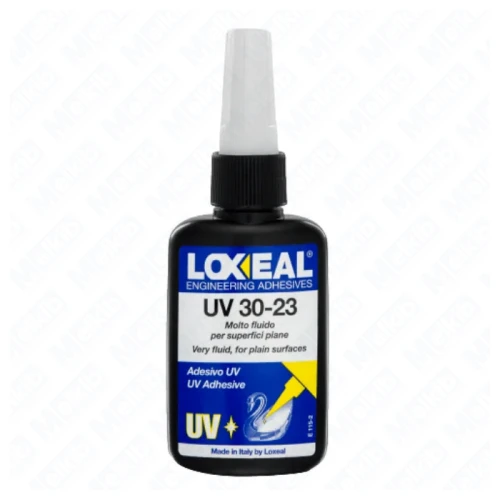



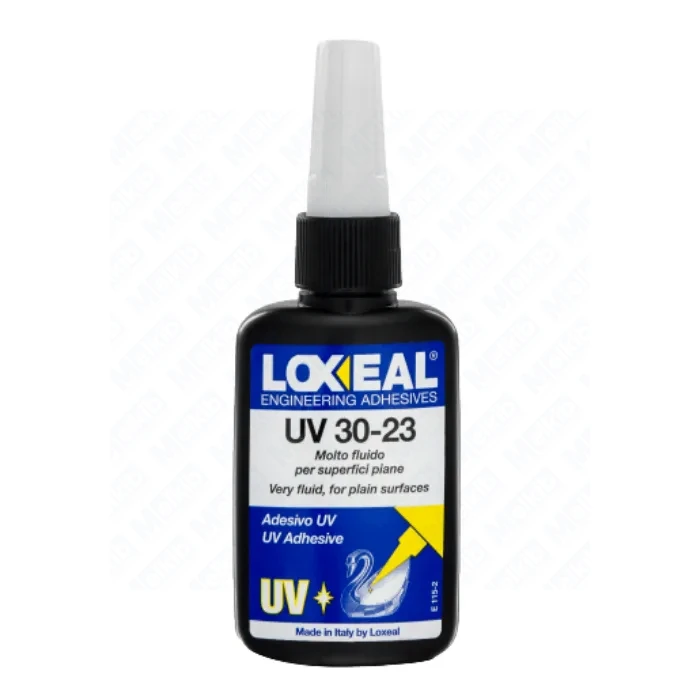
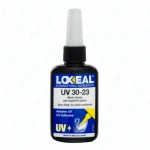
Loxeal 30-23 UV adhesive for glass and metal 50 ml, acrylic structural adhesive with thin clear bond line, fast UV curing

Product code: Kouv3023050
Leave feedback on the product
Shipping cost for the selected product
The shipping cost applies to this product (in the selected variant - if applicable). It may change after adding other products to the cart.
Related products





Secure purchase guarantee



Opis produktu
Loxeal 30-23 is a single-component acrylic UV adhesive for structural bonding of glass to glass, glass to metal and glass to other rigid substrates. It cures in the joint gap when exposed to UV radiation, forming thin, transparent and high-strength bond lines. The product is designed for applications where a clean appearance, short curing time and high mechanical performance of the joint are essential.
Advantages and unique features
- One-component structural adhesive – no mixing required, easy manual and automated dispensing.
- Fast UV curing – fixture time of about 8–15 seconds with an appropriate UV light source.
- Thin, clear bond line with light transmission > 98 % and refractive index 1.48–1.51.
- High mechanical strength – tensile strength 10–14 N/mm² and good flexibility (elongation at break 60–100 %).
- Resistant to many chemicals, impact and vibration, with stable performance over a wide service temperature range.
- Solvent-free formulation – reduced emissions and better process control.
Properties and applications
- Glass-to-glass and glass-to-metal bonding: suitable for structural joining of panes, displays, showcases and decorative glass parts where the bond line remains visible.
- Glass to other substrates: can be used between glass and selected plastics or rigid materials, provided that the joint area can be exposed to UV light and at least one substrate is UV transparent.
- Thin bond gaps: fills gaps from 0.03 to 1.5 mm, enabling narrow, aesthetic joints and compensation of small assembly tolerances.
- Fast assembly: very short handling time supports high-throughput production and assembly lines.
- Service durability: cured bonds retain properties between -55 and +120 °C and show long-term resistance to moisture without condensation.
- Limitations: not recommended for most thermoplastic plastics because of the risk of stress cracking; dedicated UV adhesives should be selected for such materials.
Technical data
| Parameter | Value |
|---|---|
| Chemical type | methacrylate ester, acrylic UV adhesive |
| Colour | colourless, transparent |
| Viscosity (25 °C) | 50–100 mPa·s |
| Density (25 °C) | approx. 1.02 g/cm³ |
| Flash point | > +100 °C |
| Solvent content | solvent-free |
| UV cure time (365 nm, 100 mW/cm²) | 8–15 s |
| Time to full strength (20 °C) | approx. 12 h |
| Recommended gap width | 0.03–1.5 mm |
| Tensile strength | 10–14 N/mm² (ASTM D2095-69) |
| Elongation at break | 60–100 % (DIN 535004) |
| Hardness | Shore D 65–75 |
| Refractive index | 1.48–1.51 |
| Light transmission | > 98 % |
| Coefficient of thermal expansion | 85×10⁻⁶ 1/K |
| Dielectric constant (1000 Hz, 25 °C) | approx. 4 |
| Thermal conductivity | > 0.1 W/mK |
| Dielectric strength | 10–12 kV/mm |
| Service temperature range | -55 to +120 °C |
| Packaging | plastic bottles 50 ml, 250 ml |
| Shelf life | up to 12 months at +8 to +28 °C in unopened original container |
Storage recommendations
Store UV 30-23 in its original, tightly closed container in a cool, dark place between +8 and +28 °C. Protect the product from direct sunlight, UV radiation and high temperatures to avoid premature polymerisation. After use, clean the bottle neck and close it immediately. Keep away from children and foodstuffs.
FAQ
What is Loxeal 30-23 used for?
It is a UV-curing adhesive for structural bonding of glass to glass, glass to metal and glass to other materials where the joint area can be exposed to UV light and at least one substrate is UV transparent.
What UV light and curing time are recommended?
Use UV lamps with wavelengths between 365 and 420 nm and an intensity of about 100 mW/cm². Typical curing time is 8–15 seconds, depending on bondline thickness and lamp output.
Can 30-23 be used on plastics?
The product can be used between glass and selected plastics, but it is not recommended for most thermoplastic plastics because of the risk of stress cracking. Dedicated UV adhesives for plastics should be selected for such applications.
How should surfaces be prepared before bonding?
Remove contamination and old coatings, then thoroughly degrease the surfaces using a suitable cleaner for metals or plastics. The parts must be dry and properly fixed in position during UV curing.
How can excess or uncured adhesive be removed?
Cured adhesive residues should be removed mechanically, while uncured material can be wiped off with an appropriate plastic cleaner. Avoid eye contact and prolonged skin contact and follow the safety instructions in the safety data sheet.
Product safety
Responsible person in the EU
Loxeal Srl
Via G. Marconato, 2
20811 Cesano Maderno MB, Italy
Reviews
If you've added a review and it doesn't appear on the list, it may be pending moderation.
Leave feedback on the product