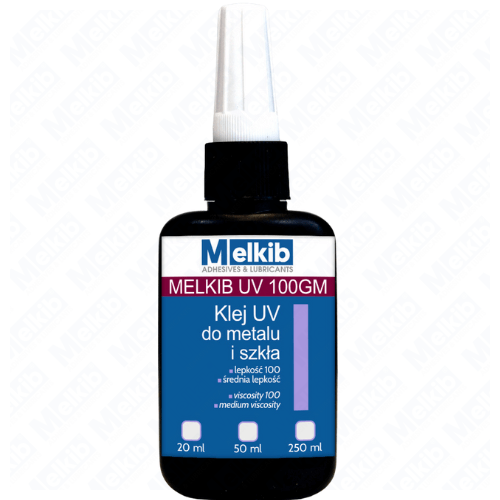



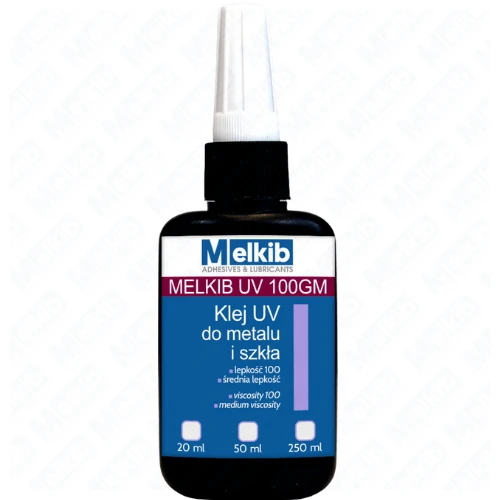
MELKIB UV 100GM MB-0042 50 ml – UV/VIS light-curing adhesive for glass and metal

Product code: MB-0042
Leave feedback on the product

Shipping cost for the selected product
The shipping cost applies to this product (in the selected variant - if applicable). It may change after adding other products to the cart.
Related products







Secure purchase guarantee



Opis produktu
What is MELKIB UV 100GM used for?
MELKIB UV 100GM MB-0042 50 ml is a single-component adhesive cured with UV/VIS light (200–400 nm), intended primarily for glass-to-glass and glass-to-metal bonds. It offers good resistance to thermal cycling and impact, and adhesion to a wide range of substrates (including many plastics and most metals).
The product is recommended for small gaps below 0.25 mm, enabling easy assembly of parts with tight tolerances.
The formulation meets halogen-free and RoHS requirements.
Key benefits
- Fast curing: can be fully cured within a few seconds after UV/VIS exposure.
- Precision bonding: recommended for small gaps (< 0.25 mm).
- Durable joints: good resistance to thermal cycling and impact.
- Wide adhesion: glass, many plastics and most metals.
Typical curing conditions
It can be fully cured within a few seconds after exposure to UV/VIS (220–400 nm). Surface cure is enhanced by UV exposure in the 220–260 nm range. Curing speed and depth depend on light intensity, spectral distribution of the source, exposure time and substrate transmittance.
| Parameter | Value |
|---|---|
| Curing wavelength | 220–400 nm |
| Dose | 1.5 J/cm2 |
Applications
- Precision bonding of glass-to-glass and glass-to-metal parts.
- Assembly of components with tight fit tolerances, especially with small gaps (< 0.25 mm).
How to use
- Protect from light: minimize exposure to daylight, UV radiation and artificial light during storage and handling.
- Surface preparation: for best performance, surfaces should be clean and free from grease.
- Curing: curing speed depends on lamp intensity, distance to the light source, required cure depth/bond gap and substrate transmittance.
- UV irradiance: for exposed surfaces, 100 mW/cm2 UV irradiance is required.
- Heat-sensitive substrates: provide cooling for thermoplastics. Plastic grades should be checked for stress cracking risk when in contact with liquid adhesive.
Technical data
| Before cure | Value |
|---|---|
| Solvent content | None (100% solids) |
| Type / chemical compound | Urethane acrylate |
| Appearance | Transparent |
| Solubility | Alcohols / chlorinated solvents / ketones |
| Specific gravity | 1.08 |
| Flash point | > 93°C (200°F) |
| Viscosity (@25°C) | 100 cps |
After-cure properties + video
| After cure | Value |
|---|---|
| Hardness (Shore) | D 70 |
| Elongation at break | 150% |
| Water absorption (24 h) | < 5.0% |
| Temperature range | -50 / 150°C |
| Linear shrinkage | < 2.0% |
| Shear strength | 150 kg/cm2 |
| Volume resistivity | 5–10 × 1012 |
Expert tip
With UV adhesives, complete illumination of the bond line is essential. If light does not reach the entire bonding area (e.g., due to opaque parts or joint geometry), curing may be incomplete. Always validate with a test on the final materials and joint geometry.
Video: UV/VIS application and curing
Practical tips: surface prep, exposure, and common mistakes affecting bond quality.
Need help selecting a UV adhesive?
Share materials, gap size and your lighting method — we’ll recommend a solution and process parameters.
Storage
Store in a cool, dark place when not in use. Shelf life: 12 months when stored at 5–25°C in the original, unopened container.
FAQ
Why doesn’t the adhesive cure through the entire joint?
The most common reason is insufficient illumination of the full bonding area. Curing occurs only where UV/VIS reaches the joint. Lamp intensity, distance, exposure time and substrate transmittance also matter.
What UV irradiance is required on exposed surfaces?
100 mW/cm2 UV irradiance is required for curing on exposed surfaces.
Can it be used on thermoplastics?
Yes, but provide cooling for heat-sensitive substrates and check plastic grades for stress cracking risk when in contact with liquid adhesive.
Note: data are indicative; testing under real application conditions is recommended before use.
Files to download

Product safety
Manufacturer
Melkib Klus Raczek Spółka Komandytowa
ul. Stawowa 91
43-400 Cieszyn, Poland
Responsible person in the EU
Melkib Klus Raczek Spółka Komandytowa
ul. Stawowa 91
43-400 Cieszyn, Poland
Reviews
If you've added a review and it doesn't appear on the list, it may be pending moderation.
Leave feedback on the product